 Counselling via MS Teams, Zoom and FaceTime available


03 Apr How to Rebuild Self-Trust After Repeated Relapse
Relapse in recovery from sex or pornography addiction often carries a weight that goes far beyond the act itself. For many people, it isn’t just the behaviour that hurts — it’s the story that follows it. The voice that says: I promised myself I wouldn’t. I knew better. And I did it anyway. What does that say about me?
That story, repeated often enough, can become its own obstacle to recovery. When you stop believing that you’re capable of keeping a promise to yourself, it becomes harder to make the next one — and easier to give up before you start. The loss of self-trust, in this sense, is one of the most significant and least talked-about consequences of repeated relapse.
This article addresses it directly. Not with platitudes, but with a realistic understanding of why self-trust breaks down during addiction, and what a genuine path back to it looks like.
| You Don’t Have to Work Through This Alone ASAA offers confidential, non-judgmental counselling for sex and pornography addiction — in Sydney and online Australia-wide. Heide McConkey has 25+ years of clinical experience. → Book a Confidential Session → |
Why Relapse Breaks Self-Trust — and Why That’s Not Your Fault
Self-trust is built on a simple mechanism: you make a commitment, you keep it, your brain updates its model of who you are. Over time, this creates a felt sense of reliability in yourself — an inner confidence that your intentions and actions will align.
Compulsive sexual behaviour disorder disrupts this mechanism at a neurological level. As the World Health Organisation has recognised in the ICD-11 classification, compulsive sexual behaviour disorder is a clinically defined condition characterised by loss of control over behaviour despite serious negative consequences. The brain’s reward circuitry — dopamine, serotonin, endorphins, oxytocin — is significantly altered by repeated addictive behaviour, creating a pull toward acting out that can override conscious intention.
This is not a character failing. As ASAA’s own clinical framework recognises, sexual addiction is a brain-based disorder that requires clinical treatment — not self-discipline alone. The person who relapses is not someone who ‘didn’t try hard enough.’ They are often someone whose neurological circuitry is actively working against the intentions of their conscious mind.
Understanding this matters — not to excuse the behaviour, but to remove the distorted shame narrative that makes recovery harder. You cannot rebuild self-trust on a foundation of self-contempt.
What Rebuilding Self-Trust Actually Requires
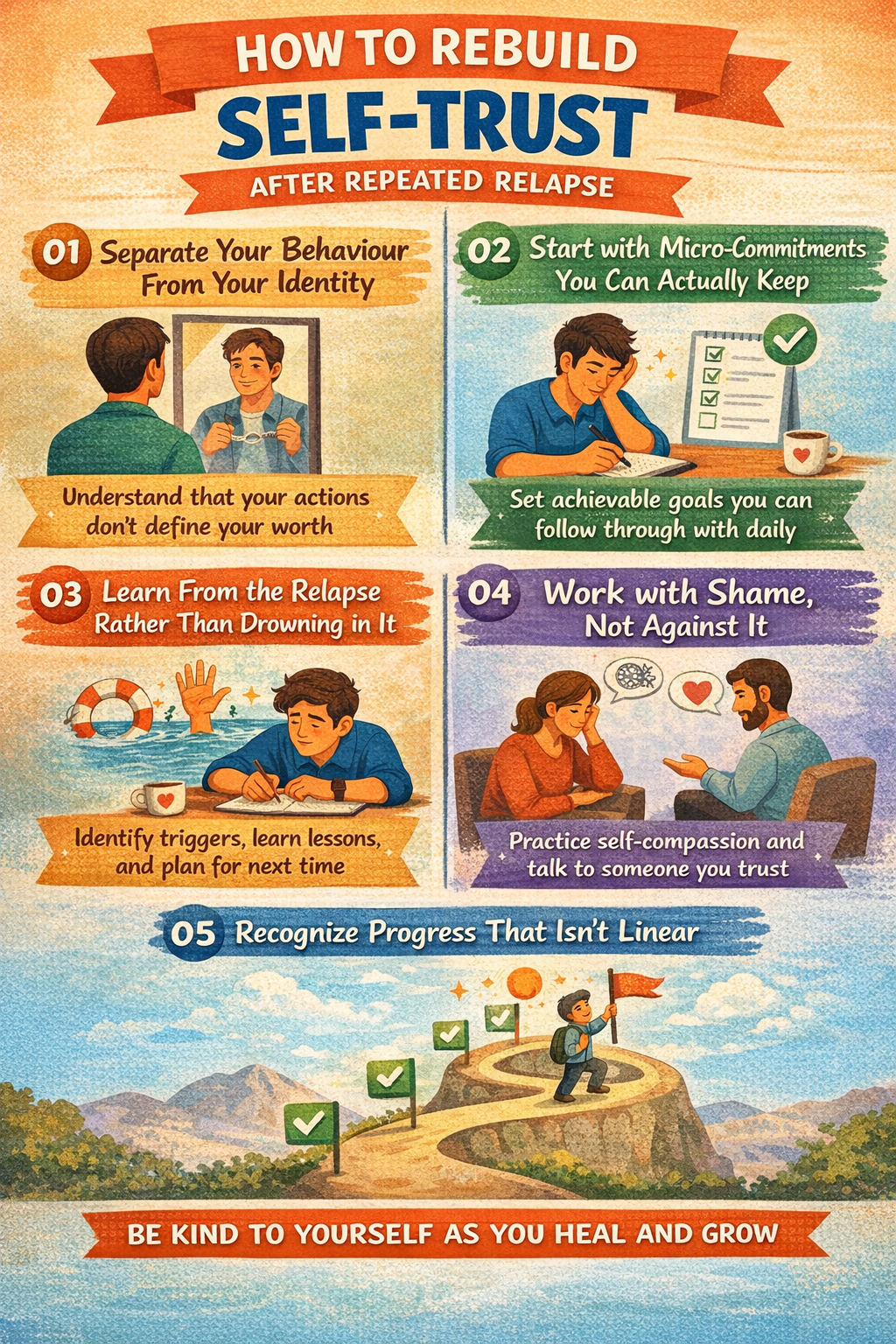
Self-trust in recovery isn’t rebuilt by making bigger promises. It’s rebuilt by making smaller ones — and keeping them. The following principles form the foundation of that process.
1. Separate your behaviour from your identity
You are not your addiction. You are a person who has developed an addictive behaviour pattern — a pattern that, with the right support and treatment, can be changed. This distinction is not semantic. When self-trust collapses after relapse, it usually collapses into a global self-judgement: I am weak. I am broken. I am incapable. None of these are accurate clinical assessments.
In therapy, this work is often framed as learning to hold yourself with the same compassion you would offer a person you care about — acknowledging the struggle without condemning the person struggling.
2. Start with micro-commitments you can actually keep
After repeated relapse, the instinct is often to make an even stronger commitment — a bigger promise, a more absolute vow. This rarely works. The self-trust rebuilding process works in the opposite direction: smaller commitments, reliably kept, accumulated over time.
This might look like: I will check in with my accountability partner tonight. I will use a content filter today. I will journal for ten minutes before bed. These are not impressive-sounding commitments. But each one kept adds a small deposit to the self-trust account — and those deposits compound.
| 💚 Recovery is not measured in grand gestures. It’s built in small, consistent acts of care toward yourself — one kept commitment at a time. |
3. Learn from the relapse rather than drowning in it
A relapse is information. It tells you something about your triggers, your vulnerabilities, and the gaps in your current strategy. A well-structured relapse prevention plan treats every setback as data to be analysed, not as evidence of fundamental failure.
Ask: What was happening in the hours or days before the relapse? What emotional state were you in? What need was the behaviour trying to meet? What coping resource was absent? These questions, answered honestly — ideally in a therapeutic context — turn a relapse into a map of what needs to change.
4. Work with shame, not against it
Shame is the most common emotional response to relapse — and it is also one of the most significant drivers of further relapse. The cycle is well-documented: act out, feel shame, use shame-based self-talk, feel worse, seek relief from discomfort, act out again.
Breaking this cycle requires learning to work with shame differently — not suppressing it, but not amplifying it either. This is one of the core skills developed in sex addiction counselling, particularly through evidence-based modalities such as Cognitive Behaviour Therapy and psychotherapy.
5. Recognise progress that isn’t linear
Many people in recovery measure themselves against an imagined version of recovery that looks like a straight line from addicted to healed. Real recovery is not linear. It includes steps forward, steps back, periods of relative stability, and periods of high vulnerability.
Self-trust is also rebuilt non-linearly. A relapse after six months of sobriety is painful — but six months of recovery happened. That matters. The person who went six months before relapsing is not the same person who relapsed every week. Progress is real even when it isn’t perfect.
The Role of Professional Support in Rebuilding Self-Trust
Working through repeated relapse and damaged self-trust alone is difficult — not because of any personal inadequacy, but because the neurological and psychological patterns driving the addiction are deeply embedded and require skilled clinical intervention to address.
ASAA’s comprehensive sex addiction counselling programme addresses relapse at its roots: the underlying psychological structures, unresolved emotions or trauma, and the compulsive coping mechanisms that addiction has formed around them. Heide McConkey’s 25+ years of clinical experience in treating compulsive sexual behaviour disorder includes specific work on relapse prevention, shame reduction, and the long, patient work of helping clients rebuild their relationship with themselves.
Counselling sessions include exploration of root causes, psychoeducation, coping skills, self-management strategies, and structured relapse prevention planning — adapted to each person’s individual history, triggers, and circumstances.
A Framework for Rebuilding Self-Trust Over Time
| Stage | What It Looks Like | Key Focus |
|---|---|---|
| Understanding | Learning the neuroscience of addiction and relapse | Removing shame-based explanations; building accurate understanding |
| Stabilising | Implementing immediate practical safeguards | Triggers, content filters, accountability, structured routine |
| Small commitments | Making and keeping micro-commitments daily | Building evidence that you can rely on yourself |
| Processing | Working through shame, trauma, underlying emotion | Therapy: CBT, psychotherapy, trauma processing |
| Revising the plan | Using relapse information to strengthen the strategy | Relapse prevention planning, identifying gaps |
| Consolidating | Building a recovery identity; extending sober periods | Recognising growth; celebrating non-linear progress |
Practical Steps to Begin Today
- Write down one commitment you can keep today — not one that sounds impressive, but one you will actually follow through on.
- If you’ve relapsed recently, give yourself one hour before making any grand promises. Spend that hour writing about what preceded the relapse.
- Contact a therapist if you haven’t already. Self-trust is rebuilt faster with skilled support than without it.
- Review your current relapse prevention plan — or create one if you don’t have one. What does it not account for that the last relapse revealed?
- Notice one thing you did well in recovery today, however small. Write it down.
| 💚 Relapse is part of the landscape of recovery for many people — not a final verdict on who you are. Every person who has achieved lasting recovery from sexual addiction has walked through setback. The path forward is not perfection. It is persistence, with support. |
| Confidential Support Is Available Whether you’re experiencing your first relapse or your tenth, ASAA offers expert, non-judgmental counselling for compulsive sexual behaviour disorder and pornography addiction — Sydney and Australia-wide online. → Make an Enquiry → |
Frequently Asked Questions
Is repeated relapse a sign that recovery isn’t possible for me?
No. Repeated relapse is a common feature of recovery from compulsive sexual behaviour disorder — not evidence that recovery is out of reach. The brain patterns that drive addiction are deeply embedded and require sustained clinical intervention to change. Many people who eventually achieve lasting recovery have experienced multiple relapses along the way.
How long does it take to rebuild self-trust after relapse?
There is no fixed timeline. Self-trust is rebuilt gradually, through accumulated evidence that your intentions and actions can align — even imperfectly. With professional therapeutic support, this process typically moves more quickly and more securely than without it.
Should I tell my partner about my relapse?
This depends on the agreements and boundaries in your relationship, and is ideally discussed with your therapist before making a decision. ASAA provides both individual counselling and partner support — if your relationship has been affected by your addiction, partner-specific support is also available.
What kind of therapy helps most with shame after relapse?
Cognitive Behaviour Therapy (CBT) and psychotherapy are both highly effective for working with the shame cycles that accompany relapse. At ASAA, these are used alongside trauma therapy, sex therapy, and relapse prevention counselling as part of a personalised treatment plan.
Can I work with ASAA if I’m not in Sydney?
Yes. ASAA offers confidential online counselling Australia-wide, as well as international appointments where appropriate. Distance is not a barrier to accessing specialist sex addiction therapy.
Is sex addiction a real clinical condition?
Yes. Compulsive Sexual Behaviour Disorder (CSBD) was formally classified by the World Health Organisation in the ICD-11 (2019) as a disorder of impulse control. It is recognised as a primary brain-based condition affecting reward, motivation, and memory circuitry — not a moral failing or a choice.