 Counselling via MS Teams, Zoom and FaceTime available


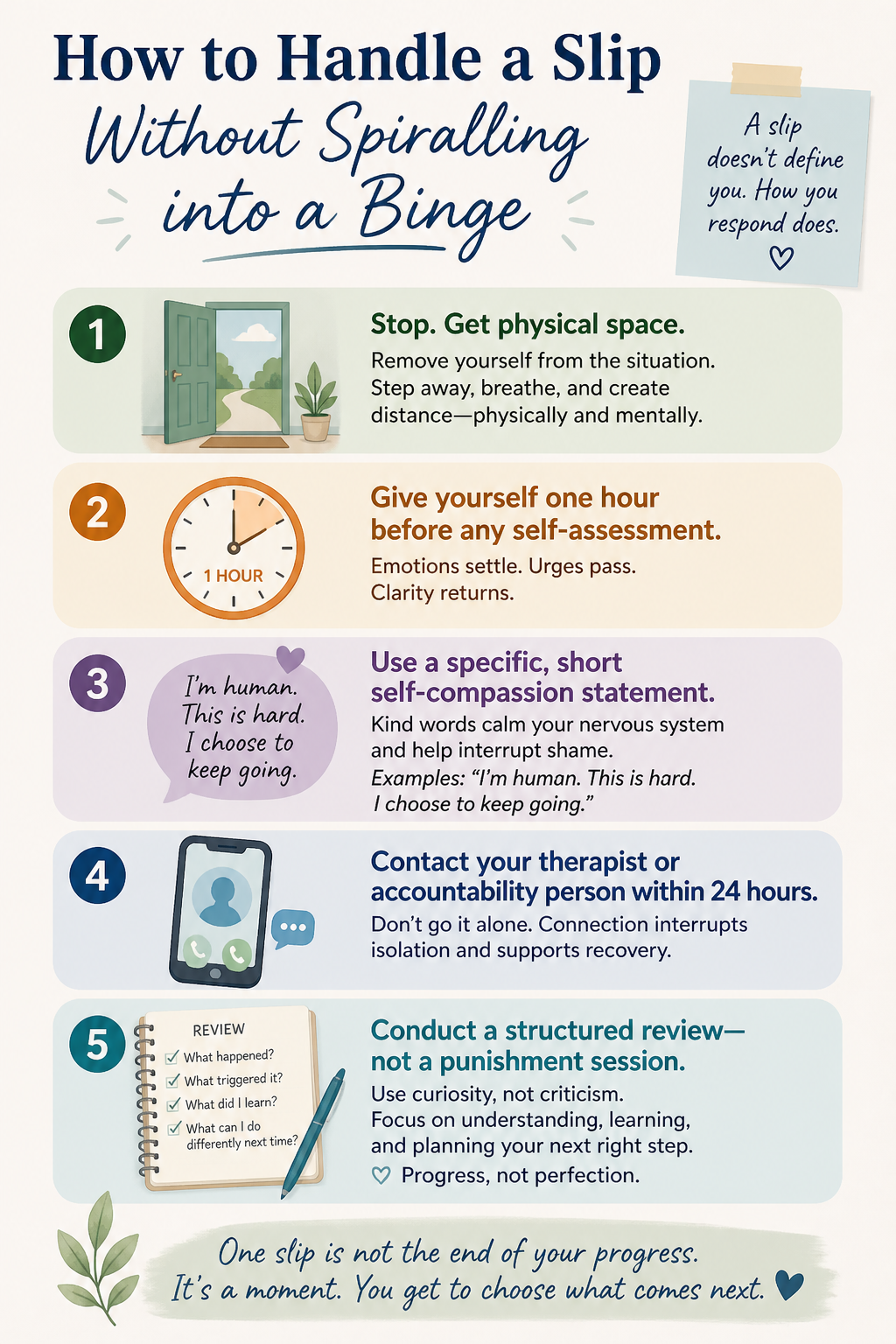
05 May How to Handle a Slip Without Spiralling into a Binge
A slip happens. You acted out — once, briefly — and now you’re in the hours immediately afterwards, sitting with what happened. What happens next matters enormously.
In the language of addiction recovery, a ‘slip’ refers to a single episode of the unwanted behaviour. A ‘binge’ or ‘relapse’ refers to what happens when that slip triggers a cascade — when shame, self-criticism, or the ‘what’s the point now’ logic drives repeated acting out over hours or days. The slip itself is not the most dangerous moment. The hours immediately afterwards are.
This article is about what to do in that window.
| You Don’t Have to Process This Alone ASAA provides confidential, compassionate counselling for people in all stages of recovery — including the difficult aftermath of a slip. Online across Australia. → Reach Out to ASAA → |
Why Slips Become Binges: The Shame Spiral
The mechanism that turns a slip into a binge is almost always shame. Not just regret, not just disappointment — but shame: the global self-condemnation that says ‘I am broken’, ‘I have failed again’, ‘I’ve undone everything’. Shame of this kind activates the very same distress pathways that the compulsive sexual behaviour was originally being used to manage. Which means that the intense shame response after a slip creates the internal conditions that drive further acting out.
This is one of the most clinically significant aspects of compulsive sexual behaviour disorder — the shame cycle is not incidental to the addiction, it is structurally part of it. Act out → shame → use acting out to escape the shame → act out again.
Breaking the cycle after a slip requires interrupting the shame response before it compounds — not by denying that something happened, but by holding it differently.
| 💚 A slip is a single data point, not a verdict. The person who slipped once is still the person who has been in recovery — who has worked hard, who has resisted other urges, who has made real changes. One event does not erase all of that. |
What Not to Do in the Hours After a Slip
Before covering what to do, it’s worth naming the responses that are most likely to make things worse:
- Catastrophising — telling yourself everything is ruined, that you’ll never recover, that you’re fundamentally incapable of change. None of this is accurate, and all of it feeds the shame spiral
- Isolating — withdrawal from your therapist, accountability person, or support network is one of the most reliable paths from a slip to a binge. Depression and shame in sex addicts is amplified by isolation
- Immediately trying to ‘make up for it’ through extreme restriction or vows — the pendulum swing from acting out to punishing restriction is exhausting and unsustainable, and often sets up the next slip
- Continuing to be in the triggering environment — staying in the physical and emotional space where the slip occurred makes further acting out significantly more likely
What to Do in the Hours After a Slip: A Practical Protocol
1. Stop. Get physical space.
The first thing to do is leave the environment where the slip occurred, if at all possible. Stand up. Move to a different room. Go outside. The physical environment shift interrupts the continuation of the episode and gives your nervous system a reset signal.
2. Give yourself one hour before any self-assessment
In the immediate aftermath of a slip, your emotional state is not a reliable guide to accurate self-assessment. Shame is flooding, cortisol is elevated, and the cognitive narrative is distorted. Give yourself one hour — not to avoid the event, but to let the acute physiological response settle before you try to process what happened.
3. Use a specific, short self-compassion statement
This step sounds soft. It isn’t. Research on self-compassion (Kristin Neff and colleagues) consistently shows that self-compassion — treating yourself with the same care you would extend to a friend in the same situation — produces better recovery outcomes than harsh self-criticism. It reduces shame, which reduces the spiral risk. Something like: ‘I slipped. This is hard. I’m still in recovery, and I’m going to reach out for support now.’ Not self-congratulation — simply not self-destruction.
4. Contact your therapist or accountability person within 24 hours
This is the most important step. ASAA’s counselling specifically includes support for relapse and post-slip processing — this is not a conversation you need to have alone. If you have an accountability person, contact them today. The act of reaching out breaks the isolation dynamic that enables continued acting out.
5. Conduct a structured review — not a punishment session
When you’re in a settled enough state — in a session with your therapist, or in your journal — review what happened:
- What was the trigger or sequence of events that led to the slip?
- What warning signs were present that you can identify in retrospect?
- What was the emotional state immediately preceding the slip?
- What gap in your relapse prevention plan does this reveal?
The goal of this review is clinical and forward-looking — not punitive. What does this slip tell you about what your plan needs to account for more accurately?
| 💚 The ability to review a slip with honesty and without self-destruction is itself evidence of recovery. It requires a relationship with yourself that many people in the early stages of addiction don’t have. It can be built. |
The Distinction Between a Slip and a Relapse
| Slip | Relapse / Binge | |
|---|---|---|
| Duration | Single episode | Repeated acting out over hours or days |
| What drives continuation | Often circumstantial | Shame spiral, catastrophising, isolation |
| Recovery impact | Setback within recovery | More significant disruption — but still recoverable |
| What it requires | Immediate response protocol as above | Therapeutic support, review of recovery plan |
| What it is NOT | A sign that recovery is impossible | A sign that recovery is impossible |
Both slips and relapses are part of the landscape of recovery for many people. Neither is the end of recovery.
Frequently Asked Questions
Does having a slip mean I have to reset to day zero of recovery?
Recovery is not primarily a counting exercise. The question of whether to reset a counter is secondary to the question of whether you are addressing what happened, learning from it, and continuing to move forward. Some people find day counts motivating; others find the reset devastating in ways that amplify the shame spiral. Discuss this with your therapist in the context of what serves your recovery.
I slipped and now I feel like everything is pointless. What should I do?
That feeling — ‘everything is pointless’ — is a recognised feature of the post-slip shame response, and it is not an accurate assessment of your situation. Please reach out to your therapist or to ASAA today. ASAA’s individual counselling is available online and can be accessed quickly for people who need support in exactly this moment.
How do I tell my partner about a slip?
This depends on the agreements and expectations in your relationship, and ideally should be discussed with your therapist before disclosure rather than in a reactive moment immediately after the slip. ASAA provides both individual and partner support — if your relationship has been affected by your addiction, a therapist-guided disclosure process is usually far more constructive than an unplanned admission.