 Counselling via MS Teams, Zoom and FaceTime available



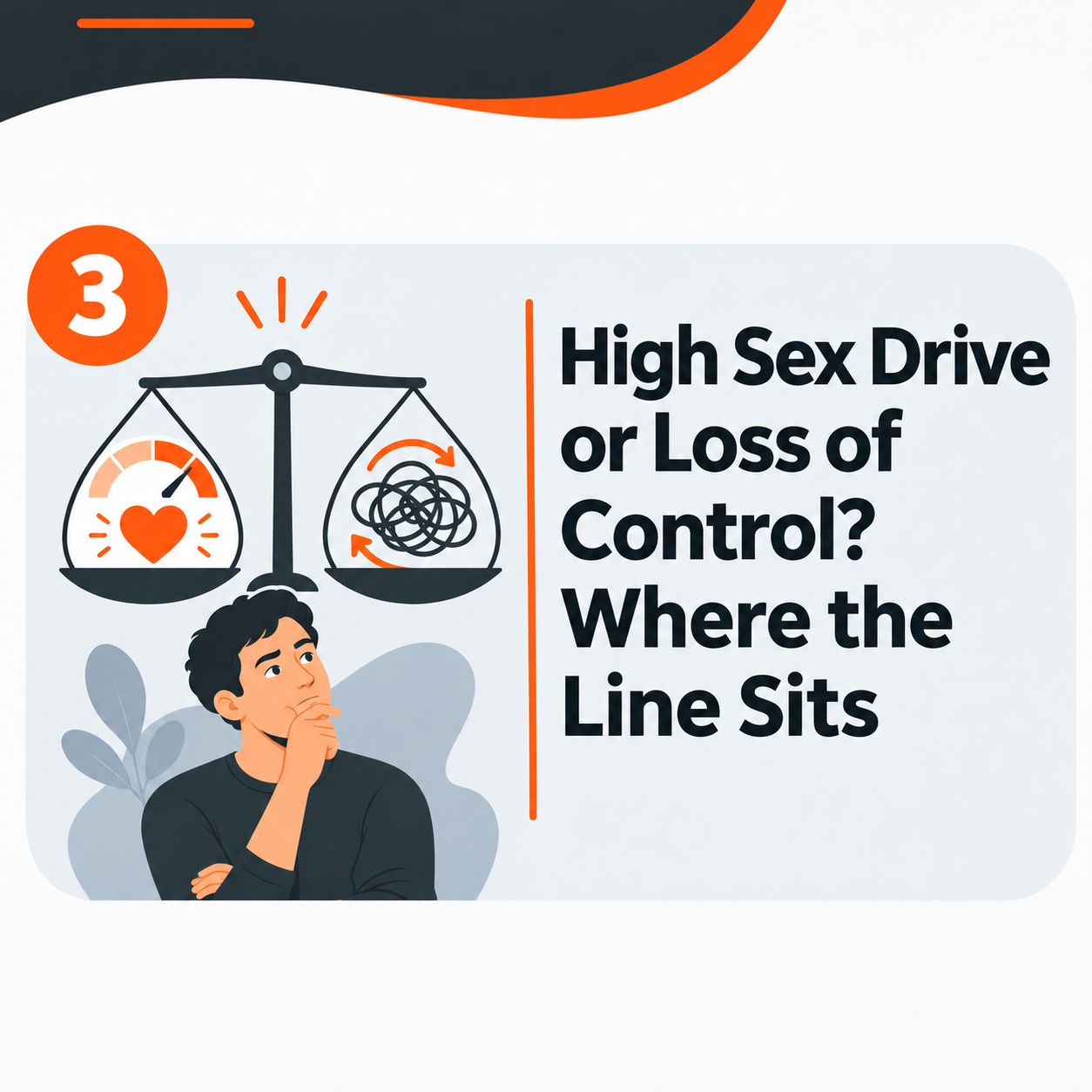
11 Nov High Sex Drive or Loss of Control? Where the Line Sits
High Sex Drive or Loss of Control? Where the Line Sits
Wanting sex often is not a disorder. The line between a high sex drive and compulsive sexual behaviour is not drawn at any level of desire or frequency. It is drawn at control and consequence: whether the behaviour continues when you decide it should not, and whether it is damaging things you care about.
This distinction matters because people arrive at it from two directions. Some worry their own appetite means something is wrong with them. Others are being told by a partner that it does. Neither the worry nor the accusation settles the question.
| Speak Confidentially with ASAA
Sex therapy and counselling for individuals and couples. 25+ years experience. Call 0419 430 534. |
What a High Sex Drive Looks Like Without a Disorder
Someone with a strong sexual appetite and no clinical difficulty generally shows a recognisable picture.
They can decline or postpone when circumstances require it, without significant distress. The behaviour fits around work, relationships and responsibilities rather than displacing them. It is enjoyable rather than compulsive or relieving. There is no escalating concealment. And when they decide to reduce it, the decision tends to hold.
Variation in sexual desire between people is enormous and mostly unremarkable. Being at the higher end of that range is not in itself a reason to seek treatment.
What Loss of Control Looks Like
The picture is different, and the contrast is usually clearer than people expect.
Decisions to stop or reduce are made sincerely and do not hold. The behaviour continues into circumstances that carry real risk, such as at work or when responsible for children. It persists despite consequences that matter, and often despite providing progressively less enjoyment. It becomes the reliable response to stress, loneliness or shame rather than something sought for pleasure. Time and attention are displaced from other parts of life. Concealment expands.
The useful question is not how much, but whether you can stop when you decide to, and what it is costing when you cannot. Where the answer is unclear, a confidential assessment is a more reliable way to settle it than further self-examination.
When the Real Issue Is a Difference in Desire
A substantial number of people who arrive worried about sex addiction are actually in a relationship where two people want sex at different frequencies. One partner frames the mismatch as excessive appetite; sometimes the other has started to wonder the same thing.
Differences in desire within a couple are extremely common and are not evidence of a disorder in either person. They are also genuinely difficult, and they tend to worsen when each person reads the difference as a statement about the relationship. The higher-desire partner often feels rejected, the lower-desire partner feels pressured, and the pattern becomes self-reinforcing.
This is ordinary territory for sex therapy, and it responds well. Treating it as an addiction question when it is a compatibility and communication question sends people down the wrong path.
| Work It Out With Support
Confidential counselling for individuals and couples. Online across Australia. Call 0419 430 534. |
A Note on the Word Hypersexuality
Hypersexuality is used inconsistently, which adds to the confusion.
Sometimes it describes an unusually high level of sexual desire, with no implication of disorder. Sometimes it is used as a near-synonym for compulsive sexual behaviour. It also appears as a recognised symptom of other conditions, including manic episodes in bipolar disorder, and as a side effect of certain medications, particularly some used in Parkinson’s disease.
That last point is worth taking seriously. A marked and relatively sudden change in sexual behaviour, especially alongside other changes in mood, sleep or judgement, or following a medication change, is a reason to speak with a doctor rather than to assume a compulsive pattern. The explanation may be medical and straightforward.
When Is It Worth Seeking Help?
You do not need to have resolved the question first, and most people have not.
It is worth speaking with someone if you have tried to reduce the behaviour and found you could not, if it is continuing despite real consequences, if it has become your main way of managing difficult feelings, or if it is causing you persistent distress. It is also worth it if a partner’s concern has left you genuinely uncertain, and partners carrying that concern can get their own support in parallel.
If you are in distress or having thoughts of suicide, Lifeline is available 24 hours a day on 13 11 14. In an emergency call 000.
Frequently Asked Questions
My partner says my sex drive is a problem. Are they right?
They may be describing a mismatch rather than a disorder, and those are different situations with different solutions. The test is not whether your appetite is higher than theirs, but whether you retain control over the behaviour and whether it is causing harm. A conversation with a practitioner, ideally together, usually clarifies which situation you are in faster than continuing to debate it.
Can a high sex drive turn into compulsive behaviour?
Appetite alone does not develop into a disorder. What tends to change things is the behaviour taking on a regulating function, becoming the reliable response to stress or difficult feelings. That shift is about what the behaviour is being used for, not about how much desire someone started with.