 Counselling via MS Teams, Zoom and FaceTime available



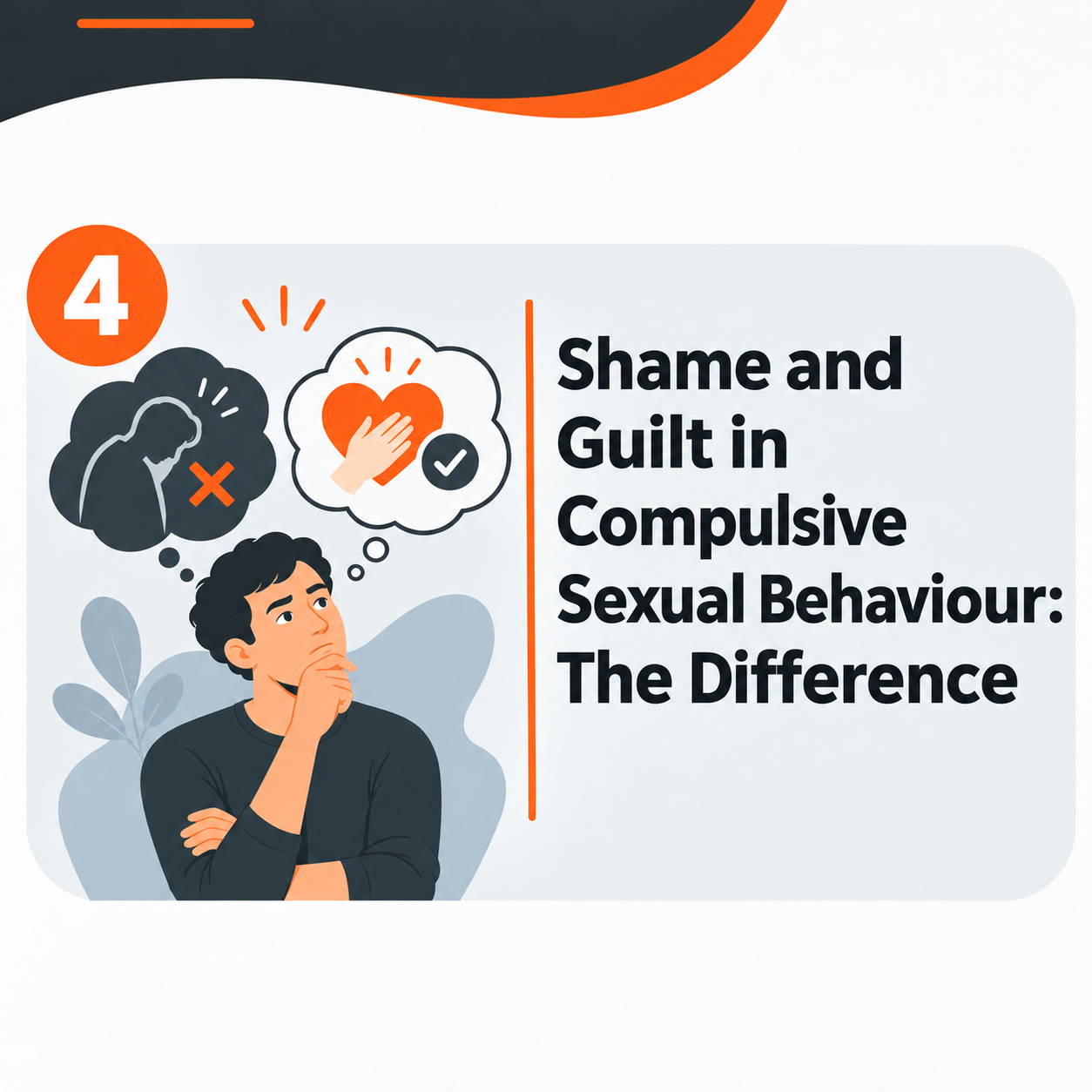
11 Nov Shame and Guilt in Compulsive Sexual Behaviour: The Difference
Guilt is about something you did. Shame is about who you believe you are. The distinction sounds academic until you notice that one of them tends to support change and the other reliably undermines it.
This is among the more practically useful things to understand about compulsive sexual behaviour, because shame is not merely an unpleasant consequence of the pattern. It is frequently part of what keeps it running.
| Speak Confidentially with ASAA
Non-judgemental counselling for compulsive sexual behaviour. 25+ years experience. Call 0419 430 534. |
The Difference in Practice
Guilt says: I did something that conflicts with my values, and it affected someone. The focus is on the action and its effects, and the natural response is repair, acknowledgement and doing differently.
Shame says: I am defective. The focus is the self rather than the behaviour, and the natural responses are hiding, withdrawal and self-attack. None of those changes anything.
You can feel both at once, and most people in this situation do. But they pull in opposite directions, which is why two people expressing what sounds like similar remorse can be in very different positions.
Why Shame Fuels the Cycle
The mechanism is straightforward once you see it.
Compulsive sexual behaviour is usually serving a regulating function. It provides relief from difficult internal states. Shame is one of the most difficult internal states there is. So shame about the behaviour generates exactly the discomfort that the behaviour reliably relieves.
The sequence that follows is familiar to almost everyone in this situation. Acting out, then shame, then an attempt to suppress or escape the shame, then acting out again. The emotion produced by the behaviour becomes the trigger for the next episode. This is why attempts to stop through self-criticism tend to intensify the pattern rather than interrupt it, and why interrupting it is an early focus of counselling for compulsive sexual behaviour.
Why Guilt Can Be Useful
Guilt gets a poor reputation by association, and it does not deserve it.
Appropriate guilt is information. It tells you that something you did conflicts with what you value, and it points towards repair. It assumes you are capable of behaving differently, which is precisely the assumption shame denies. People who can hold guilt without collapsing into shame generally have an easier time in this work, because they can look at what happened without needing to defend against it.
The aim is not to eliminate remorse. It is to keep it attached to the behaviour rather than to the whole person.
| A Space Without Judgement
ASAA provides confidential counselling, online across Australia and face to face in Sydney. Call 0419 430 534. |
What Shame Does to Help-Seeking
Shame’s most costly effect is often the delay it causes.
People routinely describe years between first recognising a problem and contacting anyone, with shame as the reason. The anticipated judgement, the fear of being seen as deviant, and the belief that a practitioner will react with disgust all keep people away. Those years are usually when the pattern becomes more entrenched and the consequences accumulate.
It is worth saying plainly that practitioners working in this field have heard the range of what people bring, and that counselling for pornography and sexual compulsivity is not an exercise in moral evaluation. The level of detail you share is yours to set, and no one will require explicit description as a condition of helping you.
How Shame Is Worked With
Shame is rarely addressed by direct reassurance, which tends to bounce off.
What is more effective is the experience of describing the behaviour to someone who does not react with disgust, repeated enough times that the expectation of rejection weakens. Alongside that, the work involves separating the behaviour from identity, understanding how the pattern developed, and shifting the internal commentary from verdicts about character to observations about a pattern.
Where a partner is involved, shame complicates things in both directions, and each person generally does better with support of their own rather than attempting to manage it entirely within the relationship.
If you are in distress or having thoughts of suicide, Lifeline is available 24 hours a day on 13 11 14.
Frequently Asked Questions
If I stop feeling ashamed, will I stop caring about the harm I caused?
No, and this is the most common worry about letting go of shame. The concern assumes shame is what motivates accountability, when in practice it usually interferes with it. Shame directs attention inward, towards managing your own distress. Guilt directs it outward, towards the person affected and what might repair things. Reducing shame tends to increase the capacity for accountability rather than reduce it.
Will my counsellor judge me?
The fear is close to universal and it is worth naming at the first session if it is present. Practitioners working in this area have heard a very wide range of material, and the task is to understand a pattern rather than to evaluate a character. Most people find the first conversation markedly less confronting than they had anticipated.