 Counselling via MS Teams, Zoom and FaceTime available


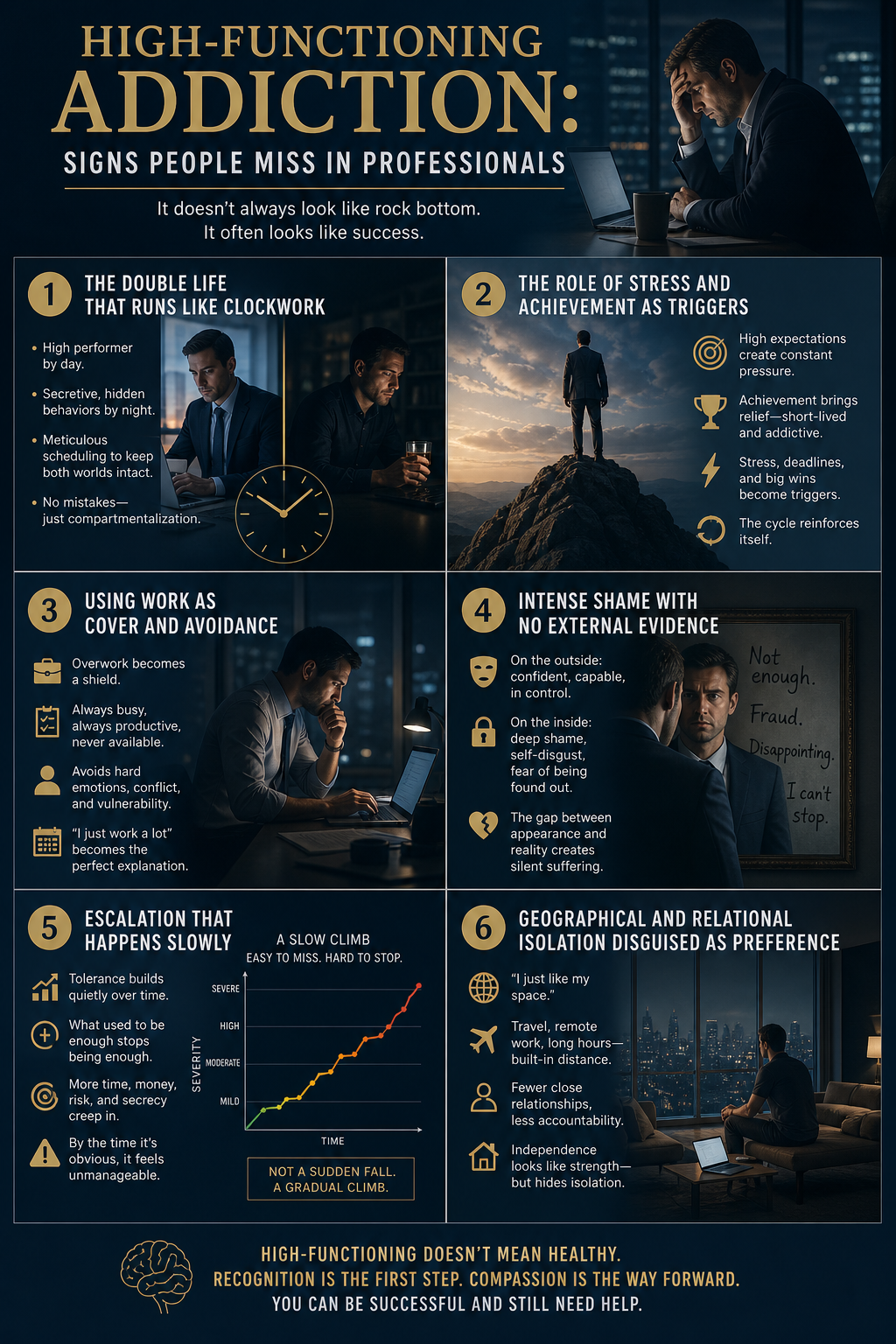
04 May High-Functioning Addiction: Signs People Miss in Professionals
There is a particular kind of pain that comes with being someone who, on the surface, appears to have everything together. You show up to work. You perform well. Your colleagues and family see a capable, competent person. And underneath all of it, there is a private life that runs on an entirely different track — one you can’t stop, can’t fully explain, and haven’t told anyone about.
This is what high-functioning compulsive sexual behaviour disorder looks like for many professionals. The addiction is real. The consequences are real. But the external presentation of competence and control makes it almost invisible — to others, and often to the person carrying it.
This article is about what that looks like, why it stays hidden for so long, and why high achievers in particular are both more vulnerable to developing it and more skilled at concealing it.
| You Can Speak Confidentially ASAA offers specialist, non-judgmental counselling for compulsive sexual behaviour — available online Australia-wide. Heide McConkey has 25+ years of clinical experience. → Make a Confidential Enquiry → |
Why ‘High-Functioning’ Masks the Problem
The popular picture of addiction involves visible collapse — job loss, relationship failure, financial ruin. But addiction rarely announces itself so loudly in its early and middle stages, particularly in people with strong executive function, disciplined external habits, and high personal standards.
Professionals are often skilled at compartmentalisation — a cognitive ability to separate different domains of life from one another. This is genuinely useful in many work contexts. It also means that the compartment containing the addictive behaviour can be kept tightly sealed, preventing it from visibly bleeding into professional performance for years, sometimes decades.
The person living this way is not ‘not really addicted’. They are experiencing the defining features of compulsive sexual behaviour disorder as classified in the WHO ICD-11: a persistent pattern of failure to control intense, repetitive sexual impulses, despite personal distress and negative consequences. The consequences are present — they’re just more likely to be internal (shame, anxiety, fractured self-image, secretiveness) than external (job loss, obvious relationship breakdown). See what sex addict behaviour looks like for a fuller picture.
Signs That Stay Hidden in Professional Contexts
The double life that runs like clockwork
High-functioning sex addiction often involves a carefully maintained parallel life. There are regular windows — specific times of day, specific triggers, specific locations — where the addictive behaviour reliably occurs. These windows are often tightly managed: before the morning commute, during a specific break, on business travel, after a certain kind of stressful meeting.
From the outside, this can look like discipline or routine. From the inside, it is compulsive scheduling that feels non-negotiable.
The role of stress and achievement as triggers
For professionals in high-pressure environments, stress is a constant. And stress is one of the most reliable triggers for compulsive sexual behaviour — cortisol elevation activates the brain’s reward-seeking circuitry, and for someone whose reward system has been conditioned around sexual acting out, high-performance pressure and compulsive sexual behaviour become neurologically linked.
This means that success itself — a promotion, a deal closed, a difficult project completed — can trigger acting out. As can failure, criticism, or pressure. The behaviour functions as a regulation mechanism for emotional states at both ends of the spectrum.
| 💚 Recognising this link between stress and compulsive behaviour is not a weakness. It is valuable clinical information that forms the basis of effective treatment. |
Using work as cover and avoidance
Work provides a socially acceptable reason to be unavailable — to partners, to social obligations, to emotional intimacy. Long hours, travel, and professional demands create natural cover for time spent acting out, and also provide a sense of legitimacy that insulates against self-scrutiny. If you are working hard and performing well, it can be difficult to accept that you also have a problem.
Intense shame with no external evidence
One of the clearest signs of high-functioning sex addiction is the presence of significant internal shame, guilt, or self-contempt — without any visible reason for it. From the outside, there is nothing wrong. From the inside, the person is carrying a private narrative of failure and disgust that has no outlet. This is one of the most distressing aspects of high-functioning addiction, and it is closely connected to the relationship between depression and sex addiction that many professionals experience.
Escalation that happens slowly
Because professionals are skilled at managing risk and perception, escalation in compulsive behaviour often happens incrementally — small step by small step — in ways that are easier to rationalise than a sudden, dramatic change. Online sex addiction and pornography addiction often follow this pattern particularly clearly: what began as occasional use becomes routine, then ritual, then compulsive, over a period of months or years.
Geographical and relational isolation disguised as preference
Many professionals with high-functioning addiction are more comfortable in functional, transactional, or professional interactions than in genuine emotional intimacy. They may describe themselves as private, independent, or simply ‘not relationship people’. What this often reflects is a pattern of withdrawing from authentic connection — because authentic connection creates the vulnerability that the addiction has been used to avoid.
Why Professionals Often Seek Help Later
Because the external performance is intact, the motivation to seek help often has to come from somewhere other than work consequences. It typically comes from one of three places:
- A relationship crisis — when a partner discovers the addiction, or when intimacy has become so eroded that the relationship is at breaking point
- An internal threshold — when the cognitive dissonance between private behaviour and professional identity becomes unbearable; when the shame is no longer containable
- A specific event — an encounter that felt dangerous, an exposure risk, an experience that broke through the usual rationalisation
Reaching out for help — regardless of what prompted it — takes real courage. It is not a sign of weakness or failure. It is the beginning of a different kind of life.
| 💚 You don’t need to wait for a visible crisis before seeking support. The internal distress you’re carrying right now is reason enough to reach out. |
The Professional Context in Treatment
Treatment for high-functioning sexual addiction in a professional context takes into account the specific patterns, triggers, and vulnerabilities that are relevant to high-achievement environments. Individual counselling with a specialist therapist addresses both the neurological and psychological dimensions of compulsive behaviour — including the stress-regulation role it plays, the shame cycle that sustains it, and the underlying emotional structures that drive it.
ASAA’s sex addict counselling is available entirely online for professionals who value privacy, flexibility, and the ability to access sessions around their schedule. Confidentiality is absolute.
Frequently Asked Questions
Can someone be a sex addict if they have never been caught or faced consequences?
Yes. The definition of compulsive sexual behaviour disorder (ICD-11) does not require external consequences — it requires a persistent pattern of failure to control intense sexual impulses despite distress and negative consequences, which may be entirely internal (shame, anxiety, damage to self-image). A sex addiction test can be a useful starting point for self-assessment.
Is high-functioning sex addiction just about pornography?
Not exclusively. High-functioning sexual addiction can involve pornography addiction, online sexual behaviour, affairs, paid sex, or a combination of these. The defining feature is compulsivity and loss of control — not the specific behaviour type.
I function well at work. Does that mean I don’t have a real problem?
No. Functioning well at work is not evidence that a problem doesn’t exist — it is evidence of how effectively it is being compartmentalised. The internal experience of distress, the private consequences, and the loss of control are the clinical indicators — not external professional performance.
Will seeking help affect my professional reputation?
ASAA provides entirely confidential counselling with a strict privacy policy. Sessions are conducted online, privately, on your schedule. There is no obligation to disclose to any employer, professional body, or other person. Seeking help is a private decision.