 Counselling via MS Teams, Zoom and FaceTime available


22 Apr The Role of Exercise in Reducing Sexual Cravings
When people are looking for tools to support recovery from compulsive sexual behaviour or pornography addiction, exercise rarely makes the top of the list in the way that therapy, accountability, or content filtering do. Yet the evidence for its impact on craving reduction is robust, its mechanisms are well understood neurologically, and its costs — in money, access, and complexity — are low compared to most other recovery tools.
This article looks at how exercise works in the context of sexual craving reduction, which types of physical activity are most useful and why, how to build an exercise practice that actually sticks in early recovery when motivation is frequently disrupted, and what exercise can and cannot do on its own.
| Recovery Needs More Than Willpower ASAA offers clinical counselling for sex and pornography addiction that addresses root causes, not just symptoms. Sydney and Australia-wide online. → Book a Confidential Session → |
Why Sexual Cravings Are So Difficult to Simply ‘Resist’
Compulsive sexual behaviour disorder — including pornography addiction — involves significant changes to the brain’s reward, motivation, and memory circuits. As ASAA’s clinical resource on sexual addiction explains, these changes mean that sexual cravings in addiction are not simply a matter of wanting something. They are neurological events — driven by conditioned dopamine responses, triggered by internal states (stress, boredom, loneliness) and external cues — that produce a compulsive pull that pure willpower is poorly equipped to resist.
This is why strategies that work at the level of the nervous system — rather than just the level of conscious decision-making — are so valuable. Exercise is one of the most accessible of these strategies.
How Exercise Reduces Sexual Cravings: The Neurological Mechanisms
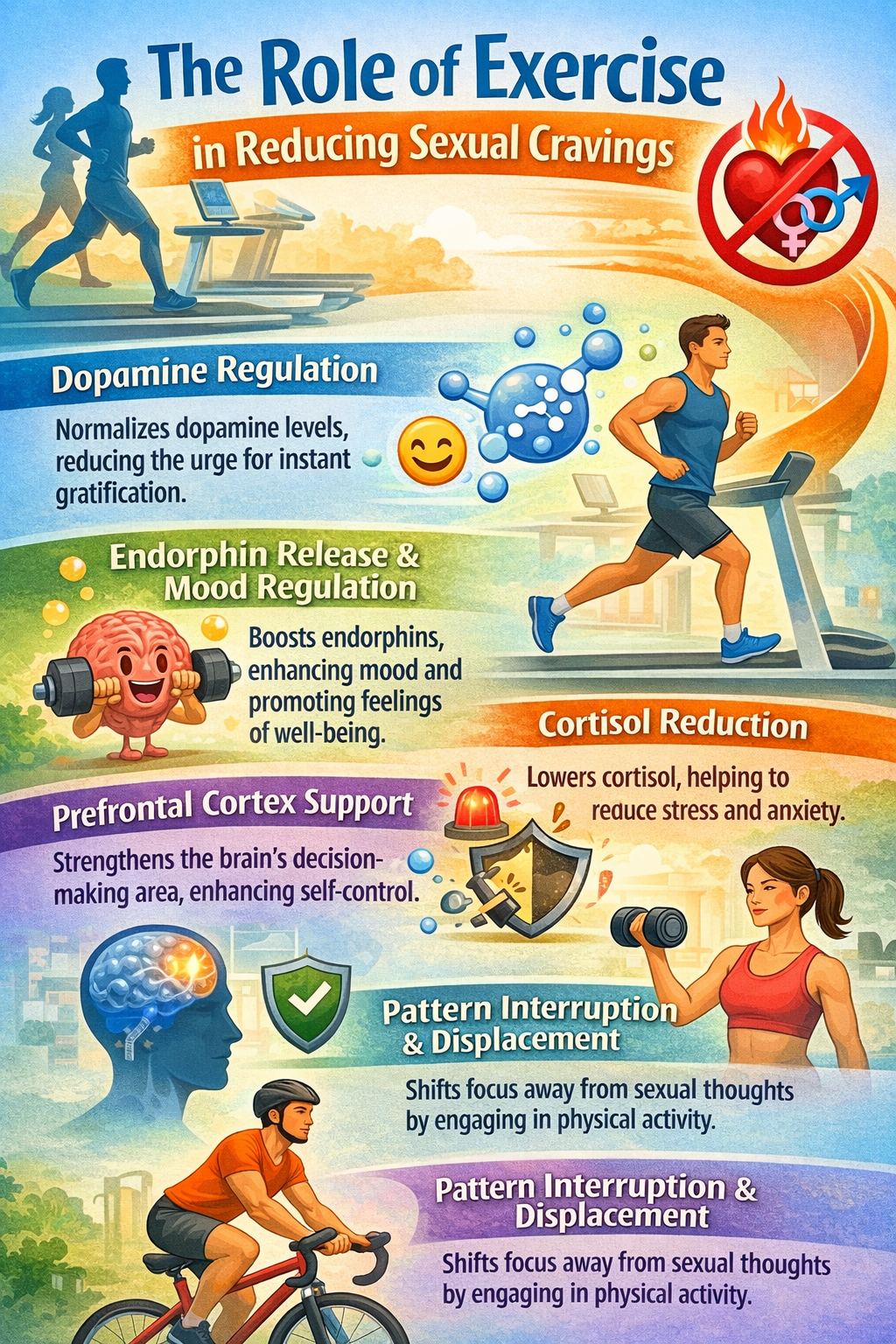
Dopamine regulation
As discussed in ASAA’s holistic approaches to pornography addiction recovery, pornography addiction overstimulates the dopamine system to the point where everyday rewards feel inadequate. Aerobic exercise engages the same dopamine pathways — but in a way that restores rather than depletes them. Regular exercise gradually rebuilds dopamine receptor sensitivity, which means that ordinary life begins to feel more rewarding over time, and the pull toward the addictive behaviour diminishes.
Endorphin release and mood regulation
Physical exercise — particularly sustained aerobic activity — produces significant endorphin release. Endorphins reduce the subjective experience of discomfort, including the anxiety and emotional dysregulation that are among the most common internal triggers for compulsive sexual behaviour. When the emotional states that typically precede craving are less intense, the craving itself is less likely to follow.
Cortisol reduction
Chronic stress is one of the most reliable predictors of relapse in compulsive sexual behaviour disorder. Stress elevates cortisol, which disrupts prefrontal cortex function (reducing impulse control) and increases the neurological drive to seek reward (as a coping mechanism). Regular aerobic exercise measurably reduces baseline cortisol levels, creating a physiological buffer against the stress-relapse pathway.
Prefrontal cortex support
The prefrontal cortex is the region of the brain responsible for executive function: planning, impulse control, and weighing short-term pleasure against long-term consequences. This is the region most compromised in addictive behaviour patterns. Research suggests that regular aerobic exercise supports prefrontal cortex function and connectivity — effectively strengthening the brain’s own capacity to resist compulsive impulses over time.
Pattern interruption and displacement
Beyond the neurological mechanisms, exercise works as a practical pattern interrupter. Sexual cravings in addiction are frequently strongest in predictable contexts: alone at night, stressed during the day, in specific physical locations or emotional states. Having an established exercise habit that activates during or before these high-risk windows provides a competing behaviour — one that is incompatible with the addictive one, and that produces its own genuine reward.
Which Types of Exercise Are Most Helpful in Recovery?
Different types of exercise produce different effects — and the most useful approach is one that combines them.
| Exercise Type | Primary Benefit | Recommended Frequency |
| Aerobic exercise (running, cycling, swimming) | Dopamine + endorphins; cortisol reduction; mood regulation | 3–5 times per week, 20–40 minutes |
| Resistance training (weights, bodyweight) | Testosterone regulation; confidence; discipline | 2–3 times per week |
| Yoga and breathwork | Nervous system regulation; mindfulness; body reconnection | 2–4 times per week |
| Team or social sport | Oxytocin; social connection; accountability | 1–2 times per week where possible |
| Walking in nature | Cortisol reduction; sensory regulation; accessibility | Daily where possible |
Note: These are general guidelines. Begin at a level appropriate to your current fitness and health, and increase gradually.
Building an Exercise Habit in Early Recovery
Early recovery is often not a high-motivation period. Disrupted sleep, mood instability, and the general neurological adjustment of removing an addictive behaviour can make starting an exercise routine feel daunting. Here is a realistic approach.
Start very small
A ten-minute walk is not an impressive exercise goal. But it is a kept commitment — and in early recovery, kept commitments are the currency of self-trust. Beginning with ten minutes and gradually increasing is more sustainable than beginning with an ambitious programme that collapses after a week.
Tie exercise to a consistent time and context
Habits form most reliably when attached to consistent cues. Decide that exercise happens at a specific time — before work, at lunch, immediately after dinner — and hold to that context. The decision-making burden reduces when exercise is a scheduled behaviour rather than something you choose about each day.
Use exercise as a craving response
Incorporate exercise explicitly into your relapse prevention plan as a craving response strategy. When you notice a craving beginning — the restlessness, the rationalisation, the pull — have a specific physical response ready: put on shoes, go outside, move. The physiological shift of even a brisk five-minute walk can interrupt the craving cycle before it escalates.
Find something you can actually sustain
The best exercise is the one you will do. Running is excellent neurologically — but if you hate running, you won’t maintain it. Swimming, walking, cycling, dancing, martial arts, yoga, gym training, team sport — the physical modality matters less than consistency over time.
| 💚 You don’t need a gym membership or a structured programme. A daily walk at the same time each day — maintained consistently — produces real physiological benefit. Start with what is accessible. |
What Exercise Cannot Do on Its Own
Exercise is a powerful supportive tool in recovery from compulsive sexual behaviour disorder. It is not a treatment for the underlying condition. Pornography addiction and sexual addiction have psychological and often trauma-related roots that a running programme alone is not designed to address.
The most effective recovery combines clinical treatment — including sex addiction counselling using evidence-based approaches such as CBT, psychotherapy, and relapse prevention work — with supportive lifestyle practices including exercise, social connection, structured routine, and reduced exposure to triggers.
Exercise improves the conditions for recovery. Therapy addresses the causes of the addiction. Both are needed.
| Clinical Support + Lifestyle Change = Lasting Recovery ASAA provides comprehensive, confidential treatment for sex and pornography addiction — tailored to your individual circumstances. Available in Sydney and online Australia-wide. → Begin Your Recovery → |
Frequently Asked Questions
How quickly does exercise start reducing sexual cravings?
The immediate cortisol-reducing and endorphin-producing effects of a single aerobic session can produce a noticeable shift in mood and craving intensity within minutes to hours. The longer-term neurological benefits — dopamine receptor restoration, prefrontal cortex support, baseline cortisol reduction — develop over weeks to months of consistent practice.
Can exercise replace therapy for sex addiction?
No. Exercise is a powerful complement to therapy but does not address the psychological and often trauma-related root causes of compulsive sexual behaviour. Professional counselling remains the most important component of treatment.
What if I have a physical condition that limits exercise?
Even low-impact movement — gentle walking, stretching, chair-based yoga, swimming — produces meaningful physiological benefit. If you have a health condition affecting your capacity for exercise, consult with your doctor about what is safe and appropriate. The principle of consistent, moderate physical movement applies even when high-intensity exercise is not possible.
Is there a specific time of day when exercise is most helpful for craving reduction?
Exercise is most helpful when it disrupts the highest-risk windows for craving — which vary by individual. For many people in pornography addiction recovery, evening and late-night periods are highest risk. An evening exercise habit can be particularly effective at interrupting the craving cycle during these windows.
How do I stay motivated to exercise during recovery?
Motivation in early recovery is frequently unreliable — don’t wait for it. Build exercise into your routine as a non-negotiable commitment, beginning with a scale small enough that you can sustain it regardless of mood. Accountability to another person — a friend, a gym partner, or your therapist — significantly increases adherence.
How does ASAA incorporate exercise and lifestyle into its treatment approach?
ASAA’s treatment approach addresses the whole person — not just the addictive behaviour. Holistic and lifestyle-based strategies including exercise, routine structure, and emotional regulation are incorporated alongside clinical modalities such as CBT, psychotherapy, and relapse prevention counselling as part of each client’s personalised programme.