 Counselling via MS Teams, Zoom and FaceTime available


04 May “Urge Surfing” for Sexual Triggers: A Step-by-Step Guide
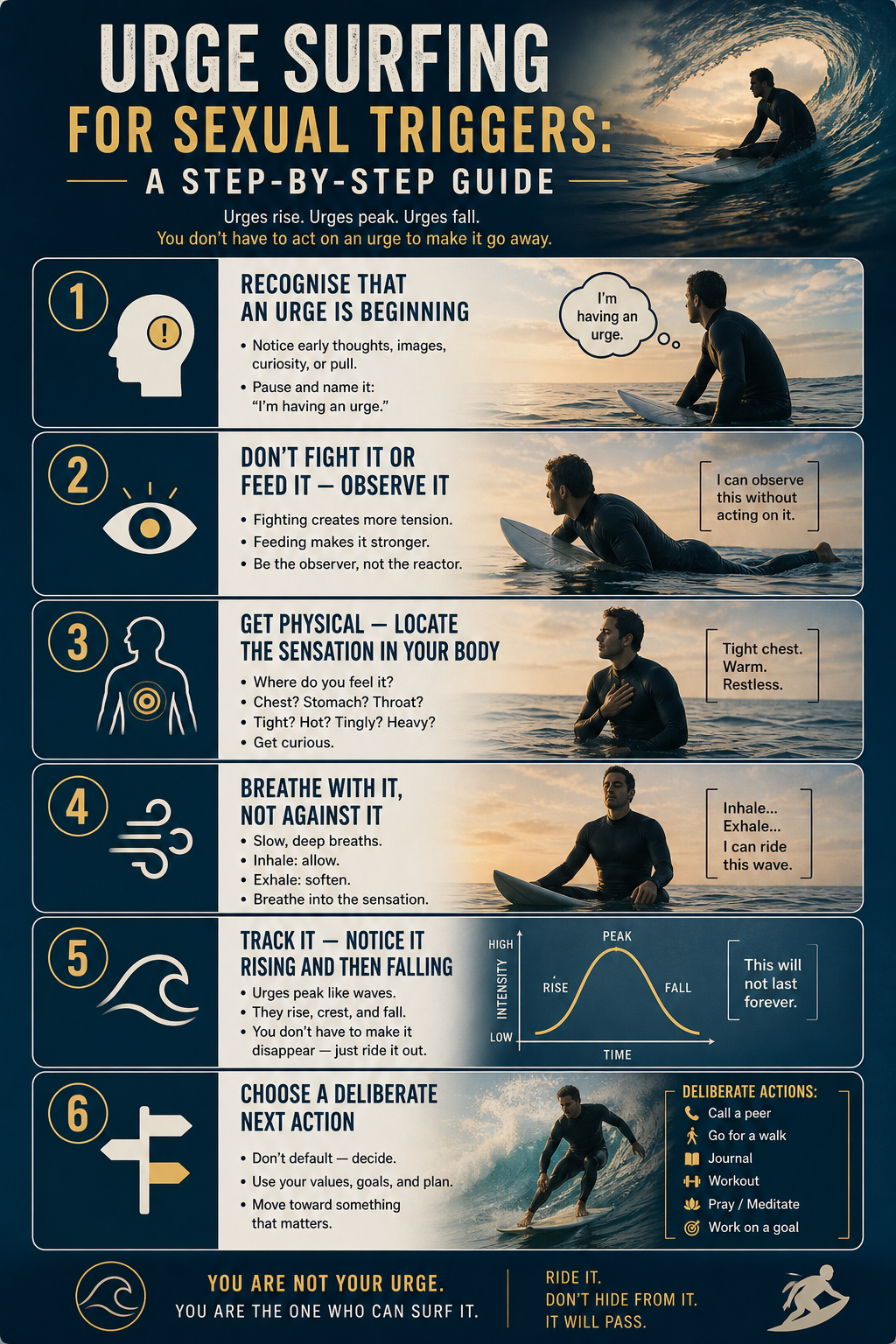
Cravings don’t last forever. They feel like they will — particularly the intense, physical cravings that accompany compulsive sexual behaviour. They feel like pressure that will keep building until it’s released. But that’s not actually how cravings work neurologically.
Cravings are waves. They rise, peak, and fall — usually within 15 to 30 minutes — if you don’t feed them. The problem is that in that window, the urge to act out is so powerful that it feels permanent, and most people either act on it to make it stop, or resist it through sheer willpower until they can’t anymore.
Urge surfing offers a third option: you ride the wave without acting on it — and without fighting it. You observe it. And it passes.
This technique was originally developed in the context of addiction treatment and has become a core skill in mindfulness-based relapse prevention. At ASAA, it forms part of the broader toolkit for managing sexual addiction and pornography addiction in clinical counselling. This guide explains how to do it.
| Urge Surfing Is a Skill — Therapy Helps You Build It ASAA’s counselling programme includes practical coping skill development alongside deeper psychological work. Available online across Australia. → Book a Session → |
The Science Behind It
Cravings are partly neurological and partly psychological. The neurological component involves the dopamine and reward circuitry that has been conditioned by repeated addictive behaviour — the brain has learned to produce a strong motivational signal toward acting out in response to specific triggers. The psychological component involves the interpretation of that signal: the belief that the craving must be relieved, that it will keep intensifying, or that you cannot tolerate it without acting.
Urge surfing addresses the psychological component. By observing the craving without attaching to it or fighting it, you gradually reduce its power — both in the immediate moment and, over time, through repeated practice. Each successful surf is a small piece of evidence that the craving can be tolerated without being acted on. That evidence accumulates.
| 💚 Every time you ride an urge without acting on it, you’re creating new neural evidence that the craving doesn’t require action. This is recovery at the neurological level. |
Step-by-Step: How to Urge Surf
Step 1: Recognise that an urge is beginning
The earliest possible recognition gives you the most time and the most cognitive resource. Look for the initial signs you’ve learned to identify — a specific thought pattern, a restlessness, a pull toward your phone or a particular environment. Name what’s happening: ‘This is an urge. It’s beginning now.’ That simple act of naming creates a small but real distance between you and the experience.
Step 2: Don’t fight it or feed it — observe it
This is counterintuitive. The instinct when a craving hits is either to act on it immediately (feed it) or to clench and resist (fight it). Urge surfing asks you to do neither. Instead, step back into the role of an observer — someone watching the wave from the shore, not someone being pulled under it.
Say to yourself: ‘There is an urge here. I’m watching it.’ You are not the urge. You are the person observing it.
Step 3: Get physical — locate the sensation in your body
Cravings are not just mental — they have a physical signature. Where do you feel this urge in your body? Chest? Stomach? Throat? Hands? Breathe slowly and deliberately, and notice where the physical sensation is present. Describe it to yourself without judgment: ‘There is tension in my chest. It’s about a 6 out of 10 right now.’
This practice of locating the sensation grounds you in your body rather than in the narrative the craving is generating.
Step 4: Breathe with it, not against it
Use slow, diaphragmatic breathing — four counts in, hold for two, six counts out. Don’t try to breathe the craving away. Breathe with it. Each breath is simply you being present with the experience, not fighting it.
Step 5: Track it — notice it rising and then falling
On a mental or literal scale of 0–10, track the intensity of the urge. Notice as it rises. Notice — and this is the key moment — as it peaks and begins to come down. Most people who practise urge surfing report that cravings peak within about 5–20 minutes and then begin to subside. When you notice the fall, you have just surfed the wave. ‘The urge is going down now. I’m still here.’
Step 6: Choose a deliberate next action
Once the initial peak has passed, make a deliberate choice about what comes next. Don’t simply default into whatever the situation offers. Stand up, change the physical environment, make a call, go outside, eat something — whatever your plan specifies for this situation. You’ve created a window by surfing the urge; now use it.
Practising Between Craving Episodes
Urge surfing is a skill, and like any skill, it improves with practice. You can practise it on low-intensity cravings — hunger, the impulse to check your phone, mild irritability — to build the observational capacity you’ll need for higher-intensity sexual triggers.
You can also practise the breathing component alone, daily, as a way of strengthening the physiological self-regulation that underpins the technique.
| 💚 The goal isn’t to eliminate cravings. It’s to change your relationship with them — from something that commands action to something you can observe, ride, and let pass. |
When Urge Surfing Isn’t Enough
Urge surfing is a powerful tool, but it works best within a broader recovery framework. In states of extreme stress, sleep deprivation, significant emotional distress, or acute relapse risk, the cognitive capacity for observation may be compromised. In these moments, the more active components of your relapse prevention plan — changing environment, contacting your therapist or accountability person — need to take priority. ASAA’s counselling helps you build the broader framework within which urge surfing operates.
Frequently Asked Questions
What if urge surfing doesn’t work and the urge keeps getting stronger?
If the intensity is not subsiding after 20–30 minutes of focused observation, or if you’re in a particularly high-risk environmental or emotional state, move to the more active components of your plan immediately — change your environment, contact your accountability person, or call your therapist. Urge surfing is most effective when practised regularly; its effectiveness builds over time.
Is urge surfing the same as just white-knuckling it?
No — this is an important distinction. White-knuckling involves resisting the urge through force of will — which is exhausting and tends to amplify the craving’s subjective intensity. Urge surfing involves non-resistant observation — you’re not fighting the urge, you’re watching it. The phenomenology and the neurological effect are different. Over time, observation reduces a craving’s power; resistance often increases it. See also sex addict behaviour patterns for more on the cycle urge surfing helps interrupt.
Can urge surfing be used for all types of sexual addiction?
Yes — the technique applies across all forms of compulsive sexual behaviour, including pornography addiction, online sexual behaviour, and other compulsive patterns. The specific triggers and environmental contexts will differ, but the technique of observing the urge as a wave applies across all of them.