 Counselling via MS Teams, Zoom and FaceTime available


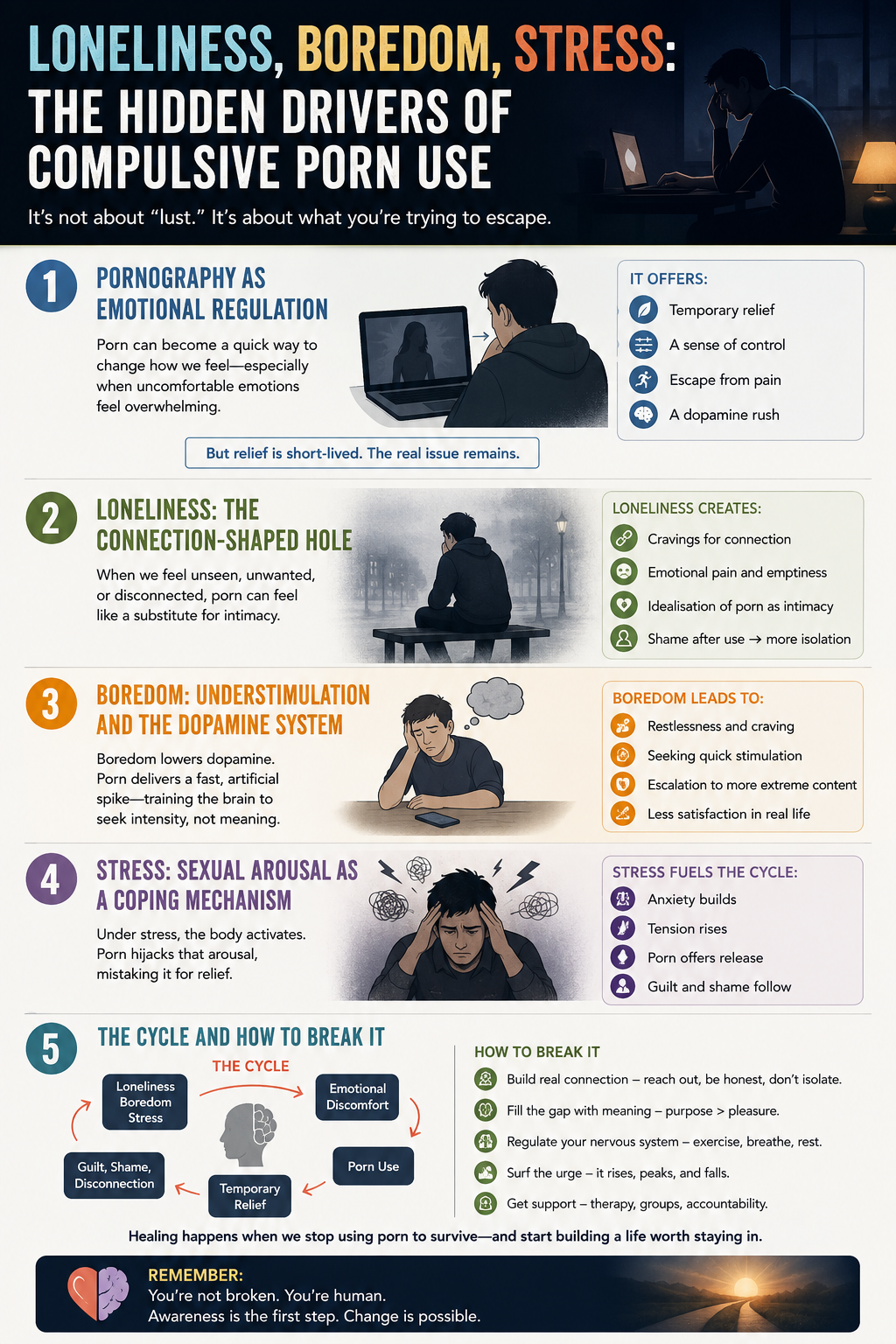
08 Jul Loneliness, Boredom, Stress: The Hidden Drivers of Compulsive Porn Use
Most people who develop a compulsive relationship with pornography assume the problem is about sex. It looks like it is about sex. It happens in the context of sexuality. But for the majority of people seeking help for compulsive pornography use, the driving force behind the behaviour is not sexual desire at all. It is emotional.
Loneliness. Boredom. Stress. These three emotional states quietly underpin a great deal of the compulsive pornography use that Affirmotive Sex Addiction Australia (ASAA) treats in clinical practice. Understanding how they connect to compulsive sexual behaviour is one of the most important steps in changing it.
| Confidential Support for Pornography Addiction ASAA has over 25 years of clinical experience helping individuals and couples. Online and Sydney-based. Non-judgmental. Book a Confidential Session |
Pornography as Emotional Regulation
To understand why loneliness, boredom, and stress drive compulsive porn use, it helps to first understand what pornography does neurologically. Viewing pornography activates the brain’s reward circuitry, releasing dopamine, the neurotransmitter most closely associated with pleasure and motivation. This activation creates an immediate sense of relief from uncomfortable emotional states.
The brain learns quickly. When an unpleasant emotional state is repeatedly followed by the reward of pornography use, the neural pathway between that state and the compulsive behaviour becomes stronger and more automatic over time. Eventually, reaching for pornography in response to stress, loneliness, or boredom can feel as automatic and as necessary as reaching for water when thirsty.
This is why compulsive pornography use is better understood as a strategy for emotional regulation that has become deeply entrenched, rather than as evidence of moral failure or excessive sexual desire. The sexual element is often more vehicle than destination. The destination is relief.
Loneliness: The Connection-Shaped Hole
Loneliness is one of the most potent drivers of compulsive pornography use, and one of the least discussed. Human beings are neurologically wired for connection. When genuine connection is absent or feels inaccessible, whether because of social isolation, relationship difficulties, emotional disconnection within a relationship, or an underlying difficulty with intimacy, the brain seeks substitutes.
Pornography provides a form of simulated intimacy that can temporarily soothe the pain of disconnection. It creates a sense of engagement, stimulation, and physical warmth without requiring the vulnerability and risk of actual human connection. For people who find intimacy frightening or who have learned that closeness leads to pain, this can feel safer than seeking genuine connection.
The problem is that pornography use does not address the underlying loneliness. It temporarily anaesthetises it while the loneliness itself often deepens, as the time and energy invested in pornography use further displaces the possibilities for genuine connection.
| 💡 Loneliness and secrecy: Compulsive pornography use typically happens in secrecy, and the secrecy itself reinforces loneliness. The isolation of the habit adds another barrier between the person and the possibility of real connection. This is part of why transparency and connection are so central to effective treatment. |
Boredom: Understimulation and the Dopamine System
Boredom is not simply the absence of activity. It is a state of understimulation that the brain registers as uncomfortable, even distressing. The dopamine system, which drives motivation and reward-seeking behaviour, responds to boredom by generating a powerful urge to find stimulation.
Pornography is a highly effective and immediately available source of intense stimulation. It delivers concentrated novelty, visual engagement, and sexual arousal in a format that can be accessed instantly. For someone whose dopamine system has been sensitised by repeated pornography use, even mild boredom can trigger a strong pull toward the behaviour.
Over time, people with compulsive pornography use often find that ordinary sources of stimulation and pleasure become less engaging. The neurological tolerance built up through repeated exposure to the heightened stimulation of pornography means that everyday life begins to feel dull or flat by comparison. This creates a cycle where boredom triggers pornography use, which deepens the neurological pattern that makes boredom feel worse, which in turn makes pornography use feel more necessary.
Stress: Sexual Arousal as a Coping Mechanism
Stress activates the body’s physiological stress response, which includes elevated cortisol levels and heightened nervous system arousal. Sexual arousal produces competing neurochemical signals that can temporarily counteract the physical sensations of stress. For people who discover, often quite early in life, that sexual arousal or release provides stress relief, this connection can become strongly conditioned.
In adulthood, particularly in the context of high-pressure work environments, relationship difficulties, financial strain, or chronic anxiety, this conditioned response can become a primary stress management tool. The problem is that pornography-based stress relief does not address the stressor. It creates a brief neurological respite from the physical sensations of stress, but the stressor remains unchanged, and the habitual nature of the response means that pornography use itself eventually becomes another source of stress through the shame, secrecy, and relationship consequences it generates.
| ✦ Early life patterns: For many people who seek help for compulsive pornography use, the emotional regulation function of the behaviour began in adolescence or early adulthood. Stress, loneliness, or boredom during formative years created the initial neural pathway between uncomfortable emotion and pornography use. Understanding these patterns in their original context is an important part of therapeutic work at ASAA. |
The Cycle and How to Break It
Understanding these hidden drivers does not mean that recovery is simply a matter of addressing loneliness, boredom, and stress. Compulsive sexual behaviour is a complex disorder, and effective treatment needs to address both the neurological habituation and the underlying emotional patterns that sustain it. ASAA’s approach to pornography addiction combines evidence-based modalities including Cognitive Behaviour Therapy, psychotherapy, and trauma counselling to address both levels.
Recovery typically involves:
- Developing awareness of the emotional triggers that precede compulsive behaviour
- Learning to tolerate the underlying uncomfortable emotions without reaching for the habitual response
- Building alternative strategies for managing loneliness, boredom, and stress that are sustainable and genuinely restorative
- Addressing the deeper relational and psychological patterns that created vulnerability to the compulsive behaviour in the first place
If you recognise these patterns in your own behaviour, confidential and non-judgemental help is available at ASAA. Speaking with a qualified therapist is the most effective first step.
| Take the First Step Toward Change ASAA provides confidential, non-judgemental pornography addiction counselling. Online Australia-wide and in Sydney. Call +61 419 430 534. Book a Session |
Frequently Asked Questions
Is compulsive porn use always about sex?
No. For many people, compulsive pornography use is primarily a response to emotional discomfort rather than sexual desire. The most common emotional triggers include loneliness, boredom, stress, anxiety, and low mood. Understanding the emotional function of the behaviour is a central part of effective treatment. ASAA’s pornography addiction counselling helps individuals explore and address these underlying drivers.
Can someone develop compulsive porn use even if they are in a relationship?
Yes. Being in a relationship does not protect against compulsive pornography use. Relationship loneliness (feeling emotionally disconnected from a partner while living with them), relationship stress, or an unresolved avoidance of intimacy can all function as drivers even within an active relationship. In many cases, compulsive pornography use is kept secret within the relationship, which deepens the isolation that sustains it.
At what point does pornography use become a problem?
Pornography use moves from habitual into compulsive when it begins to cause distress, when attempts to stop or reduce it are unsuccessful despite motivation to change, when it interferes with relationships, work, or daily function, or when it becomes the primary strategy for managing emotional discomfort. ASAA offers a free online pornography addiction test as a starting point for self-assessment. If you are concerned about your own behaviour, speaking with a qualified therapist provides a more complete picture.