 Counselling via MS Teams, Zoom and FaceTime available


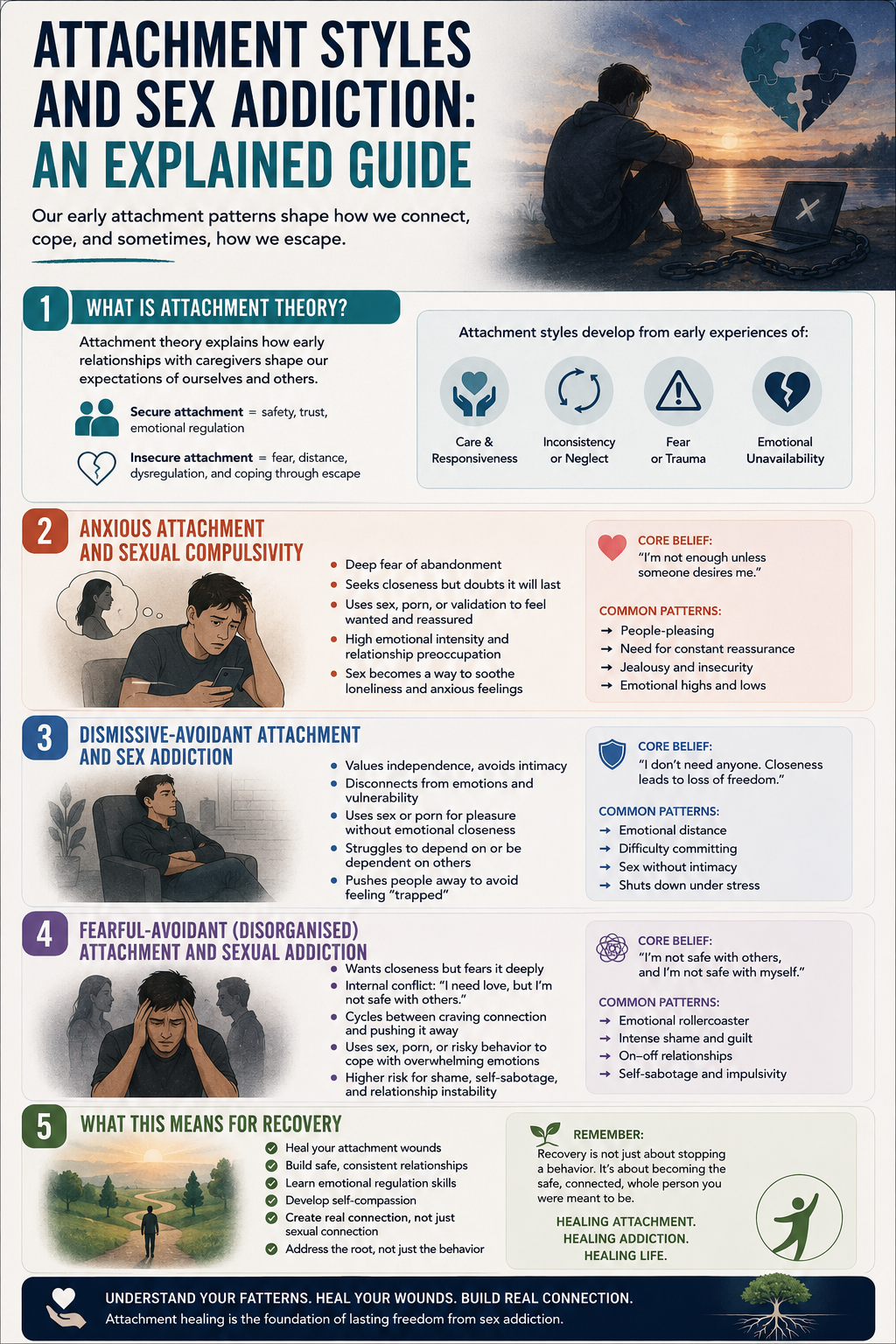
08 Jul Attachment Styles and Sex Addiction: An Explained Guide
When we look honestly at the lives of people struggling with sex or pornography addiction, we often find something that has less to do with sex and more to do with their earliest experiences of closeness and safety. Attachment theory, one of the most well-supported frameworks in developmental psychology, helps explain a pattern that appears consistently in the clinical literature: compulsive sexual behaviour is strongly associated with insecure early attachment.
This does not mean that everyone with an insecure attachment style will develop a sexual addiction, or that everyone with a sexual addiction had a difficult childhood. What it does mean is that the way we learned, as very young children, to relate to closeness, safety, and emotional need shapes how we regulate emotion and seek comfort as adults. And for some people, that path leads to compulsive sexual behaviour. Affirmotive Sex Addiction Australia works with clients to understand and address these deeper patterns as part of comprehensive recovery.
| Understanding the Deeper Drivers of Sexual Addiction ASAA provides person-centred, trauma-informed counselling for sex and pornography addiction. Online Australia-wide and in Sydney. Book a Confidential Session |
What Is Attachment Theory?
Attachment theory, developed by psychiatrist John Bowlby and further empirically developed by developmental psychologist Mary Ainsworth, describes the way early relationships with primary caregivers shape a child’s internal working model: their implicit beliefs about whether they are worthy of love, whether others can be trusted to meet their needs, and whether closeness is safe or dangerous.
Ainsworth’s research identified distinct patterns of attachment behaviour in children that correspond to the caregiving they received. These patterns persist into adulthood, influencing how we relate to intimacy, conflict, and emotional regulation in all close relationships. Four broad attachment styles are generally recognised:
- Secure attachment: develops when caregivers are consistently responsive and attuning. Adults with secure attachment generally feel comfortable with intimacy and interdependence, and are resilient in the face of relational stress
- Anxious attachment: develops when caregiving is inconsistent: sometimes available, sometimes not. Adults with anxious attachment tend toward hypervigilance in relationships, fear of abandonment, and a strong preoccupation with the availability and responsiveness of close others
- Dismissive-avoidant attachment: develops when caregivers are consistently emotionally unavailable or dismissive of the child’s emotional needs. Adults with this style tend to minimise emotional needs, prioritise self-sufficiency, and experience discomfort with intimacy and dependence
- Fearful-avoidant (disorganised) attachment: often associated with early trauma or abuse, this style involves both a desire for closeness and a fear of it. Adults with fearful-avoidant attachment frequently have histories that include significant loss, abuse, or unpredictable caregiving
Anxious Attachment and Sexual Compulsivity
Anxious attachment creates a heightened sensitivity to perceived rejection, abandonment, and emotional unavailability in relationships. The core fear is: I am not enough, and the people I need will leave me. This persistent underlying anxiety creates a powerful need for reassurance and soothing.
In the context of sex and pornography addiction, anxious attachment can manifest in several ways:
- Compulsive pornography use as a way to manage the intolerable feeling of anxious arousal when the feared abandonment feels close
- Compulsive sexual seeking in relationships as a form of reassurance or attempts to secure connection
- Love addiction, which often co-occurs with anxious attachment: an obsessive preoccupation with a romantic partner and a compulsive need for their attention and affirmation
- Using sexual contact as a way to feel temporarily connected and valued, followed by the inevitable return of anxiety when the contact ends
ASAA treats love addiction alongside sex and pornography addiction, recognising that these patterns often overlap and share the same relational roots.
Dismissive-Avoidant Attachment and Sex Addiction
Dismissive-avoidant attachment creates a very different relationship with intimacy. Where anxious attachment produces hypervigilance and preoccupation with connection, dismissive-avoidant attachment produces a learned minimisation of emotional needs and a preference for keeping others at a distance.
For people with this attachment style, compulsive sexual behaviour often serves a specific function: it provides a form of physical and emotional stimulation and release without requiring the vulnerability of genuine intimacy. Pornography in particular is ideally suited to this function. It delivers arousal and reward without reciprocal emotional exposure, without risk of rejection, and without requiring the person to be known by another.
This can create a pattern where the compulsive sexual behaviour becomes a substitute for the genuine intimacy the person is simultaneously unable to risk and unconsciously hungry for. Relationships may be maintained at a surface level while the deeper emotional needs are met, or avoided, through compulsive sexual behaviour.
| 💡 Avoidant attachment and disclosure: People with dismissive-avoidant attachment often present with significant shame and resistance to seeking help. The idea of being known by a therapist, including the known facts of their behaviour, can feel as threatening as being known by a partner. Understanding this resistance with compassion is an important part of the therapeutic process. |
Fearful-Avoidant (Disorganised) Attachment and Sexual Addiction
Fearful-avoidant attachment is the most complex pattern in relation to sexual addiction, because it involves the simultaneous desire for and terror of closeness. People with this attachment style often have histories that include early trauma, neglect, or abuse, and may have internalised a world model in which closeness and danger are connected.
The result is a relational experience characterised by contradictory impulses: approach and withdrawal, desire and fear, connection and self-sabotage. In the context of compulsive sexual behaviour, this can manifest as intense sexual seeking followed by shame and withdrawal, difficulty integrating emotional and sexual intimacy, and a pattern where genuine closeness consistently triggers the urge to escape.
Trauma is often a significant factor in the background of people with fearful-avoidant attachment. ASAA’s clinical approach addresses both the compulsive sexual behaviour and the underlying trauma that may be sustaining it, using Cognitive Behaviour Therapy, psychotherapy, and trauma-specific counselling modalities. Learn more about the treatment approach.
What This Means for Recovery
Understanding your attachment style is not about locating the source of blame in childhood. It is about developing compassion for the adaptations that were once necessary and that are now limiting. Compulsive sexual behaviour, viewed through an attachment lens, is often a sophisticated but ultimately self-defeating strategy for managing the anxiety, loneliness, and disconnection that insecure attachment creates.
Recovery, then, involves more than stopping the compulsive behaviour. It involves gradually developing the relational capacities that insecure attachment constrained: the ability to tolerate intimacy, to be emotionally present, to feel worthy of genuine connection, and to seek comfort in ways that do not ultimately damage the relationships and the life the person is trying to build.
If you recognise patterns of insecure attachment in your own experience and are concerned about the role these patterns may be playing in compulsive sexual behaviour, ASAA offers confidential, person-centred support. Reaching out is the first step toward a different kind of relationship with yourself and others.
| Professional Support for Sexual Addiction ASAA provides person-tailored counselling that addresses the deeper psychological drivers of compulsive sexual behaviour. Call +61 419 430 534. Make an Appointment |
Frequently Asked Questions
Can therapy change attachment styles?
Yes. Attachment patterns, while formed early, are not fixed. Psychotherapy, and in particular therapeutic relationships that provide consistent, attuning, and safe engagement, can support meaningful changes in attachment patterns over time. Recovery from sexual addiction often involves this kind of deeper relational work alongside the specific work of addressing the compulsive behaviour itself.
Does everyone with a sexual addiction have an insecure attachment style?
Not necessarily. Attachment style is one significant factor among many that can contribute to compulsive sexual behaviour. Other relevant factors include trauma history, neurological factors, the influence of early exposure to pornography, social isolation, co-occurring mental health conditions (including anxiety, depression, ADHD, and bipolar disorder), and the specific circumstances of the person’s life. ASAA’s assessment process is comprehensive, addressing the full range of factors relevant to each individual. The sexual addiction information page provides further background on the range of factors involved.
Can partners develop better understanding of each other’s attachment styles together?
Yes, and couples work that incorporates attachment awareness can be deeply valuable in the context of sex addiction recovery. Understanding that a partner’s avoidance of intimacy or compulsive sexual behaviour may be rooted in attachment patterns (rather than being a personal rejection or a character deficiency) does not excuse the behaviour, but it can shift the relational dynamics in ways that support recovery. ASAA provides support for partners of sex addicts as well as individual and couples counselling.