 Counselling via MS Teams, Zoom and FaceTime available


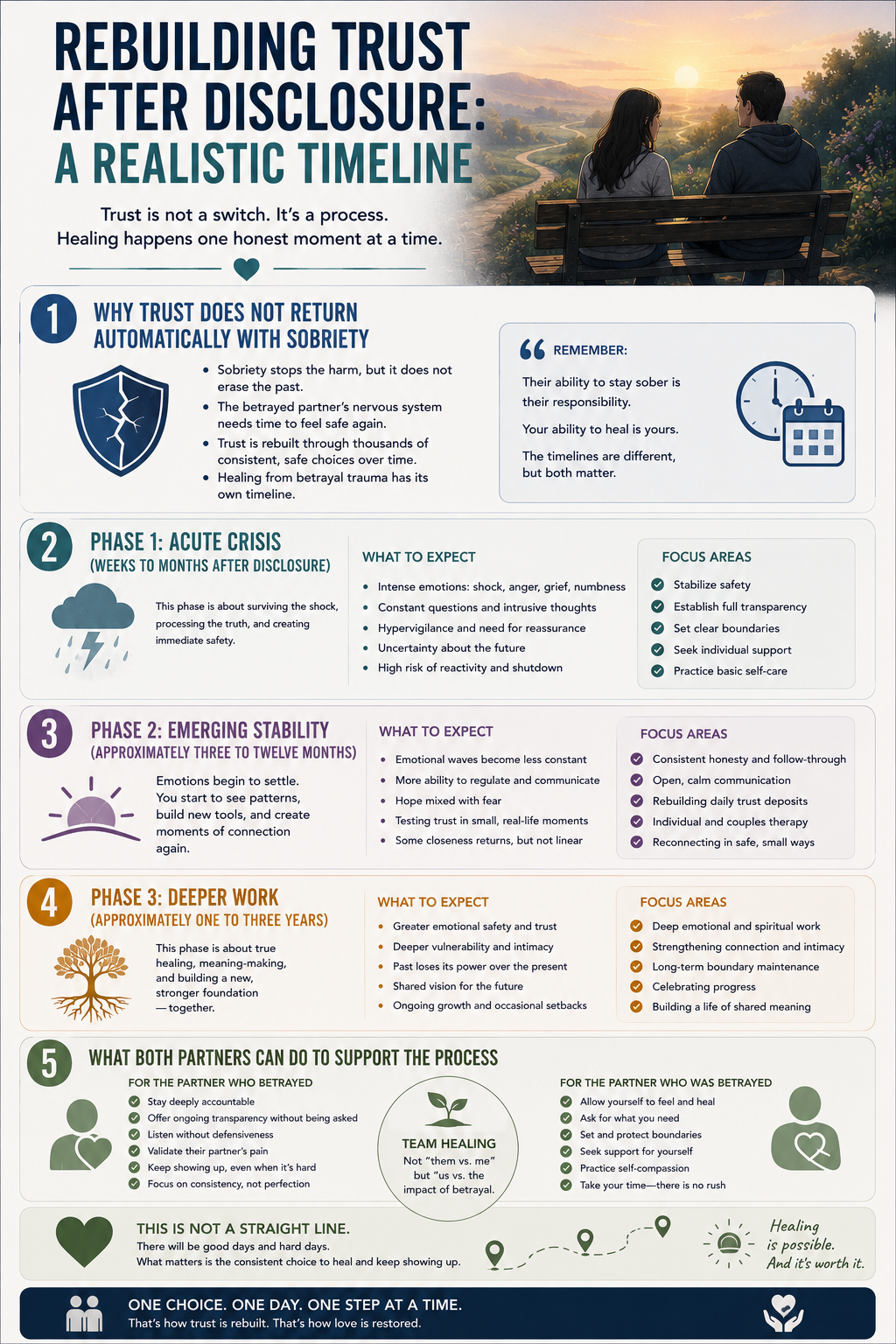
08 Jul Rebuilding Trust After Disclosure: A Realistic Timeline
One of the most common questions asked by both sex addicts in early recovery and their partners is some version of the same thing: how long until things are normal again? It is a completely understandable question. Both partners are exhausted. Both have been living in the chaos and secrecy that sexual addiction generates. Both want relief.
The honest answer is that rebuilding trust after sex addiction disclosure is a slow, non-linear process that unfolds in stages. There is no standard timeline that applies universally. But there is a realistic shape to the process that couples who receive good professional support tend to move through. Understanding that shape helps both partners calibrate their expectations, sustain their efforts through the difficult phases, and recognise genuine progress when it is happening. ASAA works with both individuals and couples throughout this process.
| ASAA Supports Both Partners Through Recovery Specialist counselling for sex addicts and their partners. Individual and couples sessions available. Sydney and Australia-wide online. Book a Session |
Why Trust Does Not Return Automatically With Sobriety
A common misconception in the early stages of recovery is that if the addicted partner stops their compulsive sexual behaviour, trust should naturally follow. This is understandable from the addict’s perspective: they have done the hardest thing, which is to stop. Why doesn’t that restore what was lost?
The reason is that trust was not broken simply by the sexual behaviour. It was broken by the years of deliberate deception that made the behaviour possible. The partner’s trust was in a reality that turned out to be substantially constructed. Sobriety removes the ongoing behaviour but does not, on its own, address the history of deception, the partner’s traumatic response to discovery, or the underlying patterns in the addict’s character and behaviour that made sustained deception possible.
Trust rebuilding, therefore, requires consistent, demonstrated trustworthiness over time, not the absence of the behaviour alone. And for the partner, it requires not just evidence of changed behaviour but a genuine processing of the betrayal trauma, which has its own timeline independent of the addict’s recovery.
Phase 1: Acute Crisis (Weeks to Months After Disclosure)
The period immediately following disclosure is typically characterised by acute emotional upheaval for both partners. The partner is in the acute phase of betrayal trauma: hypervigilant, emotionally dysregulated, alternating between intense emotions. The addicted partner, if genuinely committed to recovery, is simultaneously managing the reality of what they have caused, the discomfort of early sobriety, and the emotional intensity of the partner’s response.
What realistic progress looks like in this phase:
- The addicted partner engages consistently with professional treatment and does not minimise or deflect responsibility
- Initial transparency agreements are established (see our blog on healthy transparency for guidance)
- The partner accesses their own independent therapeutic support
- Both partners agree on basic safety agreements for how they will function in the immediate period
What is not realistic to expect in this phase: emotional stability, comfortable intimacy, or the partner’s trust. These are not signs that recovery is not working. They are the nature of the phase.
Phase 2: Emerging Stability (Approximately Three to Twelve Months)
As consistent recovery behaviours and consistent therapeutic engagement continue, a fragile and tentative stability typically begins to emerge. The acute emotional crises of the first phase begin to occur less frequently, though they will recur, particularly around triggers such as anniversaries, new discoveries, or relational stress.
For the addicted partner, this phase involves building a track record of changed behaviour: not just the absence of acting out, but the presence of honesty, accountability, emotional availability, and willingness to tolerate the partner’s ongoing trauma response without defensiveness.
For the partner, this phase often involves beginning to distinguish between their trauma responses and current reality, starting to cautiously test whether the changed behaviour is consistent, and working through the grief and meaning-making aspects of their betrayal trauma.
| ✦ The importance of relapse: Relapse during recovery does not necessarily mean that trust rebuilding cannot continue, but it requires complete honesty and transparency from the addicted partner if it occurs. A relapse that is concealed, even briefly, significantly damages the trust-building process. How relapse is handled is often as important for trust as whether it occurs. |
Phase 3: Deeper Work (Approximately One to Three Years)
With sustained sobriety, consistent honesty, and ongoing therapeutic support, couples in this phase begin to address the more complex layers of the relationship: the patterns of distance, avoidance, or disconnection that may have existed before the addiction was known about, the attachment needs of both partners, and the question of what kind of relationship both people want to build going forward.
This is the phase where genuine intimacy, if it is going to return, begins to feel possible. It is also the phase where unaddressed individual issues in either partner can surface, particularly if the relationship was using the drama and crisis of the addiction to avoid other relational difficulties.
Trust in this phase is not a single restored thing. It is a capability that both partners are gradually building, together and separately, for a different kind of relationship than the one that existed before disclosure.
What Both Partners Can Do to Support the Process
For the addicted partner:
- Maintain consistent sobriety and be honest immediately about any relapse
- Continue with professional treatment even when it feels unnecessary or repetitive
- Tolerate the partner’s trauma responses without becoming defensive or withdrawing
- Demonstrate changed behaviour consistently and without expectation of immediate reward
For the partner:
- Access independent therapeutic support, not just couples sessions
- Allow the recovery process to be what it is, rather than requiring it to move at a particular pace
- Set clear boundaries about what is and is not acceptable, and communicate them
- Give attention to their own recovery and needs independently of the relationship’s trajectory
Recovery from sexual addiction within a relationship is possible. It is not easy, and it is not fast. But couples who receive good professional support and who both bring genuine commitment to the process do rebuild. ASAA supports both individuals and couples at every stage.
| Specialist Support for Individuals and Couples ASAA provides counselling for sex addicts and betrayed partners, individually and together. 25+ years of clinical experience. Call +61 419 430 534. Contact ASAA |
Frequently Asked Questions
How long does trust rebuilding typically take after sex addiction disclosure?
There is no universal timeline. Research and clinical observation consistently suggest that meaningful trust rebuilding in relationships affected by sex addiction typically takes at least two to three years of sustained recovery work by both partners. Some couples make significant progress more quickly; others find the process longer. The quality of professional support, the consistency of the addicted partner’s recovery, and both partners’ individual healing all influence the pace.
Is it normal to feel like trust has returned and then feel suspicious again?
Yes. Trust rebuilding is not linear. It is normal for periods of increased confidence to be followed by setbacks triggered by anniversaries, discoveries, or other relational stress. This is part of the pattern of betrayal trauma recovery, not evidence that recovery is failing. Working with a therapist who understands this pattern helps both partners navigate these fluctuations without interpreting them as permanent regression. ASAA provides specialist support for exactly this stage of recovery.
What if only one partner is willing to do the work?
Recovery from sex addiction within a relationship requires genuine effort from both partners, though the nature of that effort differs significantly. If the addicted partner is not genuinely committed to recovery, the partner’s own healing is still possible and important, and the question of the relationship’s future needs to be approached on its own terms. If the partner is unable or unwilling to engage with their own healing, the addicted partner’s recovery work continues independently, recognising that recovery is ultimately personal. ASAA works with individuals at all stages, including those navigating the possibility of separation.