 Counselling via MS Teams, Zoom and FaceTime available


08 Jul Betrayal Trauma for Partners: Symptoms, Support, and Healing
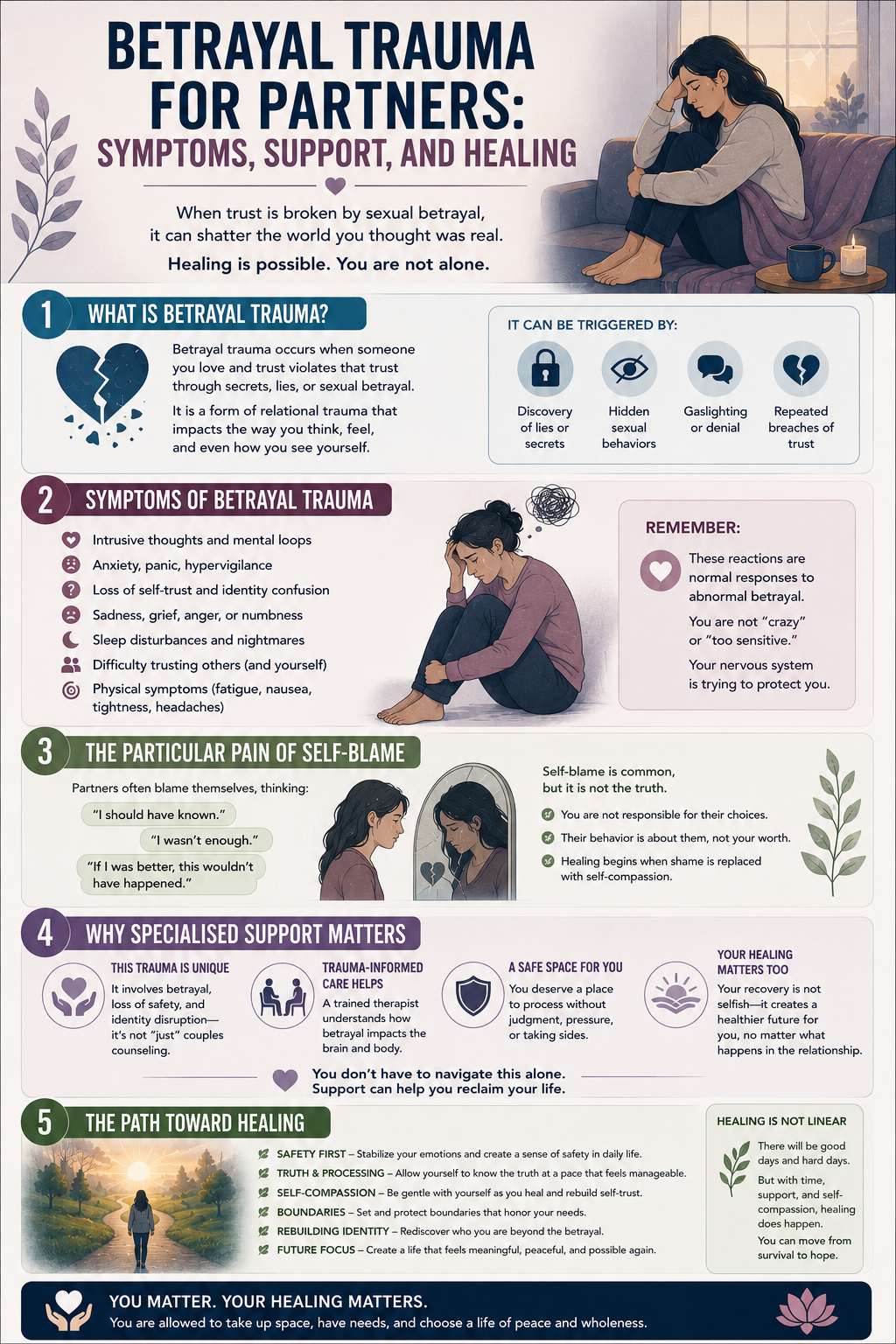
Discovering that a partner has been engaging in secret sexual behaviour, whether through pornography addiction, affairs, paid sexual encounters, or other forms of sexual deception, is not simply a painful experience. For many partners, it is a psychologically traumatic one. The ground beneath their reality gives way. What they believed to be true about their relationship, their partner, and themselves becomes suddenly uncertain. This is betrayal trauma.
Betrayal trauma in the context of sexual addiction is distinct from ordinary relationship hurt. It is the result of repeated deception, the deliberate concealment of a secret life, and the psychological impact of having trusted someone who was, in specific and significant ways, not who they appeared to be. Affirmotive Sex Addiction Australia specialises in providing compassionate, expert support to partners who are navigating this experience.
| Specialised Support for Partners of Sex Addicts ASAA provides confidential betrayal trauma counselling with over 25 years of clinical experience. Sydney and Australia-wide online. Reach Out to ASAA |
What Is Betrayal Trauma?
Betrayal trauma describes the psychological injury that occurs when someone we depend on and trust for safety and wellbeing engages in behaviour that threatens or harms us, and that is deliberately hidden from us. In the context of a partner’s sexual addiction, this typically involves months or years of concealment, gaslighting (where the addict’s denials caused the partner to doubt their own perceptions and instincts), and the discovery that a significant portion of the shared relationship was built on deception.
The traumatic quality of this experience is not simply about the sexual behaviour itself, though that is certainly significant. It is about the shattering of a person’s basic sense of safety, reality, and their capacity to trust their own perceptions. Betrayed partners frequently describe a feeling of having their entire life rewritten, of not knowing what was real.
Affirmotive Sex Addiction Australia uses the clinical term Sex Addiction Induced Betrayal Trauma (SAI-T) to describe the specific trauma response that develops in partners of sex addicts. This is a recognised clinical presentation that requires specialised treatment, not simply general relationship counselling.
Symptoms of Betrayal Trauma
Betrayal trauma can produce a range of symptoms that closely parallel Post-Traumatic Stress Disorder (PTSD). Many partners are surprised by the intensity and nature of what they experience, and may not initially recognise it as trauma. Common symptoms include:
- Intrusive thoughts and images: unwanted, recurring mental images or thoughts about the partner’s sexual behaviour, often appearing involuntarily and without warning
- Hypervigilance: a persistent heightened state of alert, constantly scanning the environment and the partner’s behaviour for signs of further deception. Checking phones, computers, bank statements, calendars, and social media is a common expression of this hypervigilance
- Emotional dysregulation: intense and unpredictable emotional reactions including rage, grief, shame, fear, and numbness, sometimes switching rapidly between these states
- Sleep disturbance and physical symptoms: difficulty sleeping, nightmares, and physical symptoms including fatigue, appetite changes, nausea, and difficulty concentrating
- Dissociation or unreality: a sense of being disconnected from oneself or from reality, as if existing in a dreamlike or surreal state
- Loss of self-trust: profound self-doubt about one’s capacity to trust one’s own perceptions, judgements, and instincts, often exacerbated by the history of having one’s perceptions denied by the addicted partner
- Self-blame: despite having no causal role in the partner’s addiction, many betrayed partners experience significant self-blame. This is common and important to address: a partner cannot cause, prevent, or cure their partner’s sexual addiction
The Particular Pain of Self-Blame
One of the most damaging aspects of betrayal trauma is the tendency toward self-blame that many partners experience. This can take the form of wondering whether they were insufficiently attentive, attractive, sexual, or emotionally available. It can also be reinforced by the addicted partner’s own denial and blame-shifting, or by family or friends who suggest, however unintentionally, that the partner should have known or should have done something differently.
The reality, consistently supported by clinical understanding of compulsive sexual behaviour disorder, is that a partner cannot cause their spouse’s sexual addiction, and cannot prevent it. Compulsive Sexual Behaviour Disorder is a recognised condition under the World Health Organisation’s ICD-11, and like other compulsive behaviour disorders, it has its roots in neurological, psychological, and historical factors that predate the relationship.
| 💡 You did not cause this: The shame and self-blame that betrayed partners carry often belongs to the addicted partner, not to the person who was deceived. Therapy with a specialist who understands betrayal trauma helps partners untangle the emotions that are genuinely theirs from those that were placed on them through the deception and blame-shifting that characterises active sexual addiction. |
Why Specialised Support Matters
Betrayal trauma requires specialised therapeutic support, not simply general counselling or relationship advice from people who may not understand its unique dynamics. A therapist without experience in sexual addiction and betrayal trauma may inadvertently focus too quickly on the relationship at the expense of the partner’s individual trauma, may not understand the dynamics of gaslighting and its long-term effects on self-trust, or may misread the partner’s symptoms as disproportionate or as a reflection of pre-existing psychological difficulties.
ASAA provides person-sensitive betrayal trauma counselling that prioritises the partner’s own healing independently of the outcome of the relationship. A partner’s recovery does not depend on the addicted partner’s recovery, and the therapeutic work is designed to restore the betrayed partner’s own sense of self, safety, and future possibility.
The Path Toward Healing
Healing from betrayal trauma is a genuine possibility, though it is not quick and it is not linear. Partners consistently report that effective therapeutic support involves several elements:
- Having their experience validated and named accurately, without minimisation
- Developing understanding of the addiction as a compulsive disorder, which does not excuse the behaviour but helps make sense of it
- Working through the grief associated with the relationship they thought they had
- Gradually rebuilding trust in their own perceptions and judgements
- Clarifying their own values, boundaries, and requirements for a future in the relationship or outside it
- Finding sources of support and connection beyond the relationship
ASAA works with partners at every stage of this process, whether they are in the acute shock of initial discovery or further along in a longer recovery journey. Contact ASAA to speak with our specialist in complete confidence.
| You Deserve Support Too ASAA’s betrayal trauma counselling is for the partners of sex addicts. Confidential, compassionate, and specialist. Call +61 419 430 534. Book a Partner Support Session |
Frequently Asked Questions
Do I need to be in couples counselling to get help for betrayal trauma?
No. Individual support for a betrayed partner is appropriate and often preferable, at least in the initial stages of recovery. Couples counselling before both partners have done significant individual work can sometimes cause more harm than good, particularly if the addicted partner is not yet fully in recovery. ASAA provides individual partner support counselling as a distinct service, independent of whether the couple is in joint counselling.
How long does betrayal trauma last?
Betrayal trauma does not have a fixed timeline. The acute phase, characterised by intense intrusive symptoms and emotional dysregulation, typically diminishes with appropriate professional support. Deeper healing, which involves rebuilding self-trust, processing grief, and recalibrating expectations of intimacy and relationships, is a longer process that varies significantly between individuals. Many factors affect the timeline, including the severity and duration of the deception, the presence of other trauma in the person’s history, the quality of professional support, and the actions (or inactions) of the addicted partner.
Should I stay in the relationship while healing from betrayal trauma?
This is one of the most difficult questions that betrayed partners face, and it is not one that any therapist or article should answer on your behalf. The decision about whether to stay in or leave the relationship is deeply personal and depends on many factors, including the addicted partner’s genuine commitment to recovery, the nature and extent of the deception, your own values and circumstances, and the support available to you. ASAA’s role is to support you in making this decision from a place of clear information and restored self-trust, not to make it for you.