 Counselling via MS Teams, Zoom and FaceTime available


10 Aug Emotional Numbing and Sexual Acting Out: What Is the Link?
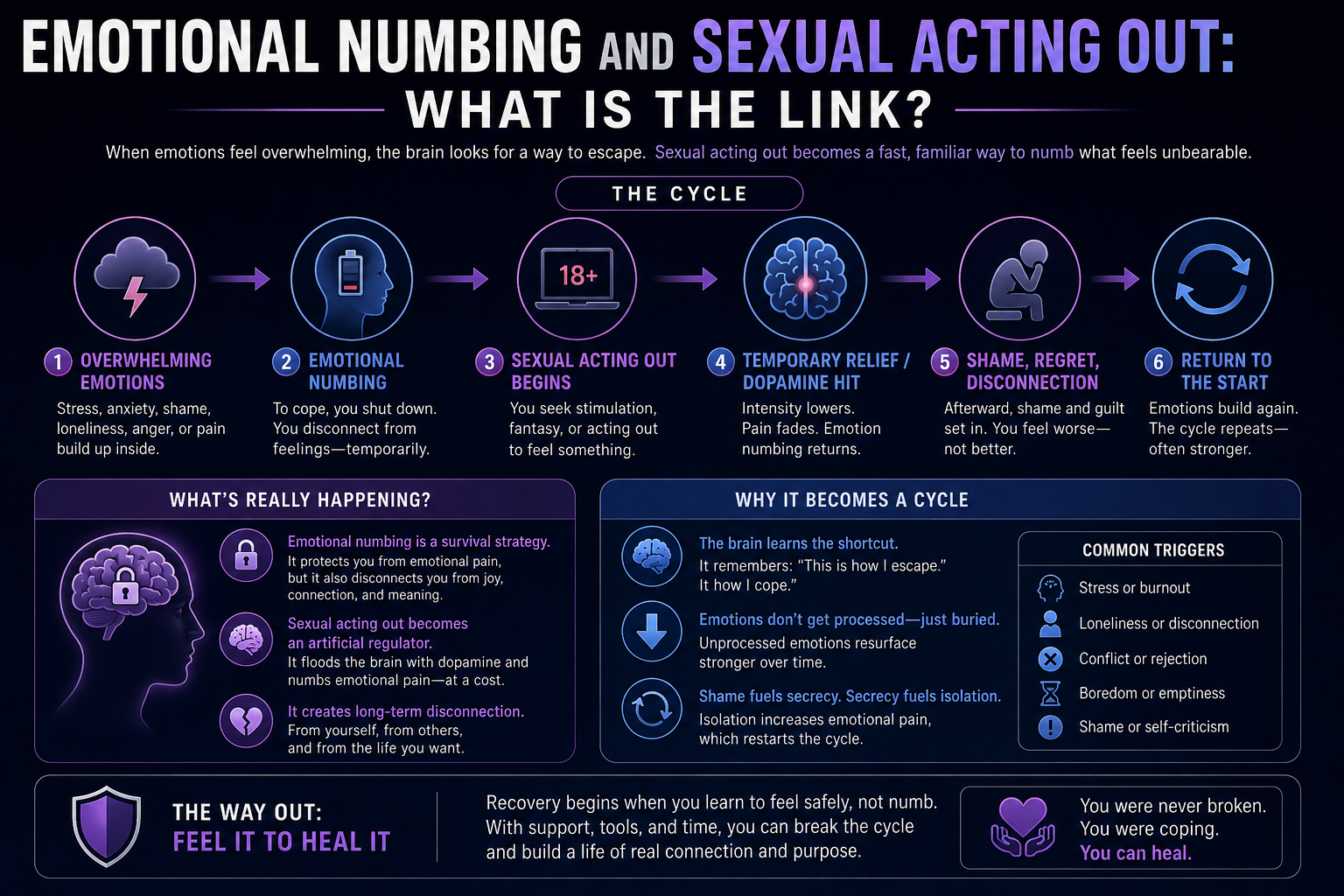
Ask many people in treatment for compulsive sexual behaviour disorder (CSBD) to describe what they were feeling in the moments before acting out, and a surprisingly consistent answer emerges: nothing. Or more precisely: an uncomfortable nothing, a flatness, a restlessness, a need to feel something. The emotional state that precedes the behaviour is not always identifiable as a specific emotion. Often it is the absence of emotion, or the suppression of it.
The connection between emotional numbing and sexual acting out is one of the most clinically significant aspects of CSBD, and one of the areas where trauma-informed treatment makes the greatest difference. ASAA’s Heide McConkey brings over 25 years of clinical sex therapy and trauma counselling experience to this work.
| ASAA: Trauma-Informed Counselling for Sexual Compulsivity Online and face-to-face. Confidential. 25+ years. Call 0419 430 534.Book a Confidential Consultation |
What Is Emotional Numbing?
Emotional numbing refers to the reduced ability to feel and process emotions, particularly the more difficult ones: grief, shame, loneliness, anxiety, fear, and anger. It is a protective psychological mechanism: the mind learns, particularly through experiences of overwhelming emotional pain or trauma, to limit emotional input to a manageable level by suppressing the feeling response.
Emotional numbing is not the same as not having emotions. The emotions are present; they are simply not fully experienced or processed. The result is a state that can feel like boredom, restlessness, emptiness, or a vague discomfort that the person cannot clearly identify. This state is unpleasant, and the mind seeks relief from it.
How Sexual Acting Out Addresses Emotional Numbing
Sexual activity, including compulsive sexual activity, produces a powerful neurochemical response that reliably breaks through emotional numbing. Intense sexual arousal and orgasm produce dopamine, oxytocin, endorphins, and other neurochemicals that create a vivid, intense experience. For a person in a state of emotional flatness or suppression, this intense experience provides exactly what the numbed state is lacking: a feeling, a sensation, a signal that one is alive and present.
The sexual behaviour is not primarily about sex in these cases. It is about breaking out of the numbed state: using the intensity of sexual experience as a guaranteed way to feel something. This explains why the behaviour often has a driven, compulsive quality that is disconnected from genuine desire or pleasure in the conventional sense.
The Trauma Connection
Emotional numbing has a strong connection to trauma. Chronic emotional numbing is a recognised feature of post-traumatic stress responses: the nervous system, overloaded by traumatic experience, develops a habitual dampening of emotional response as a protective mechanism. This numbing is adaptive in the context of ongoing threat, but it becomes problematic when the threat has passed and the person is left with an emotional system that functions in a perpetually suppressed state.
Research and clinical experience consistently identify high rates of trauma history in people with CSBD. The sexual behaviour often develops as a coping mechanism for the emotional flatness and disconnection of a nervous system living in a chronic post-traumatic state. Understanding this connection changes how treatment is approached: it is not enough to address the sexual behaviour in isolation if the underlying emotional dysregulation from unresolved trauma remains unaddressed.
The Shame Cycle
There is a painful irony in the emotional numbing and acting out cycle. The shame generated by the sexual behaviour is itself an intense emotional experience that temporarily activates a feeling state after the numbing. For some people, the shame of having acted out may be the most intense emotion they regularly allow themselves to fully experience. This creates a situation where shame, rather than being a deterrent to the behaviour, actually becomes part of the emotional cycle that sustains it.
This is one of the reasons why shame-based approaches to treating CSBD, which emphasise self-condemnation and moral failure, are clinically counterproductive. They add intensity to the shame experience that is already part of the cycle rather than creating the conditions for genuine change.
What Treatment Addresses
At ASAA, treatment for CSBD with an emotional numbing presentation involves several interlocking areas of work:
- Trauma therapy: addressing the unresolved traumatic experiences that created the original emotional numbing, allowing the nervous system to gradually develop a more full and flexible emotional response range
- Emotional regulation skills: developing practical tools for identifying, tolerating, and processing difficult emotions in ways that do not require the intensity of sexual acting out to break through the numbness
- Somatic awareness: reconnecting with the body’s physical sensations as a route back into emotional awareness, when the cognitive and narrative routes to emotion are blocked by numbing
- Shame reduction: replacing shame-based self-condemnation with a compassionate understanding of why the behaviour developed, which reduces shame’s role as a driver in the cycle
| Begin Trauma-Informed Treatment at ASAA Experienced in complex CSBD, trauma, and emotional dysregulation. Online and face-to-face. Call 0419 430 534.Book a Consultation |
Frequently Asked Questions
Do I need to have experienced a specific trauma to have emotional numbing?
No. Significant emotional numbing can develop from chronic relational pain, ongoing invalidation of emotional experience, childhood emotional neglect, or the cumulative experience of managing difficult emotions alone over many years, without a single identifiable traumatic event. In clinical practice, a clear trauma history is often present, but the absence of a specific trauma does not rule out emotional numbing as a factor in CSBD.
How does treatment for emotional numbing differ from standard CBT?
Standard Cognitive Behavioural Therapy (CBT) works primarily at the level of thought and behaviour. Where emotional numbing and trauma are central to CSBD, CBT alone is often insufficient because the emotional dysregulation operates at a deeper level than conscious thought patterns. ASAA’s treatment approach integrates CBT with Psychotherapy, Trauma Therapy, and Clinical Sex Therapy in a way that addresses both the cognitive and the deeper emotional and physiological dimensions of the condition.