 Counselling via MS Teams, Zoom and FaceTime available


10 Aug How Habit Loops Keep Compulsive Sexual Behaviour Alive
One of the most confusing and painful aspects of compulsive sexual behaviour disorder (CSBD) is the persistence of the behaviour even when the person experiencing it genuinely does not want to continue. People in the grip of sexual compulsivity often express the same bewilderment: I know this is damaging my relationship, my self-respect, my life. Why can I not stop?
Part of the answer lies in a concept well-established in behavioural science: the habit loop. Understanding how habit loops work, and how they become entrenched in compulsive sexual behaviour, is one of the foundations of effective treatment at Sex Addiction Australia (ASAA). Heide McConkey, ASAA’s clinical sex therapist and counsellor, has over 25 years of experience working with this dynamic.
| Speak Confidentially with ASAA Online and face-to-face counselling for compulsive sexual behaviour. 25+ years experience. Call 0419 430 534. Book a Confidential Consultation |
What Is a Habit Loop?
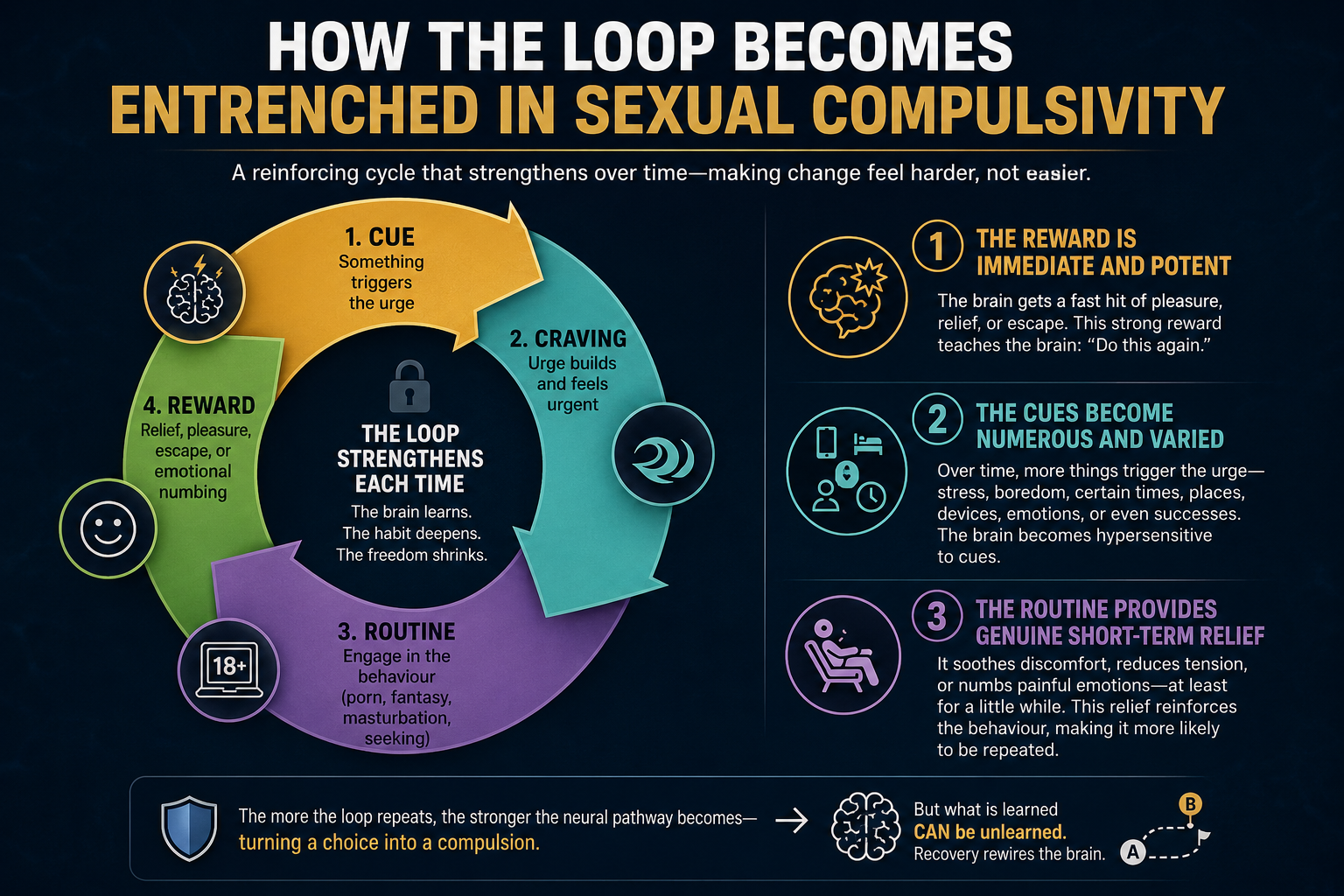
The habit loop is a behavioural framework that describes how automatic, conditioned behaviours develop and persist. The basic structure has three components:
- Cue: a trigger stimulus that initiates the sequence. A cue can be environmental (a particular time, place, or person), emotional (loneliness, boredom, anxiety, shame), or physiological (physical tension, fatigue)
- Routine: the automatic behaviour sequence that the cue initiates. In compulsive sexual behaviour, this is the sexual behaviour itself: pornography use, sexual contact, or other compulsive sexual activity
- Reward: the reinforcing consequence that follows the routine. In sexual compulsivity, the immediate reward is typically a powerful neurochemical response: the release of dopamine and other neurotransmitters associated with pleasure and relief. This reward is real and physiologically significant
The loop becomes self-reinforcing because the reward creates a strong memory trace that associates the cue with the expectation of reward. Over time, the cue alone is sufficient to trigger powerful craving, and the behaviour occurs almost automatically.
How the Loop Becomes Entrenched in Sexual Compulsivity
In compulsive sexual behaviour, the habit loop is particularly powerful for several reasons.
The reward is immediate and potent
The neurochemical reward of sexual activity is among the most powerful that the human brain is capable of generating. Unlike many other habitual rewards, the sexual reward operates on the same dopamine pathways implicated in substance addiction. The intensity and immediacy of the reward drives rapid loop entrenchment.
The cues become numerous and varied
As the loop repeats, the range of cues that can trigger it expands. What began as a single specific trigger (stress at work, for example) gradually broadens to include many different emotional states, environments, and times of day. By the time someone seeks treatment, the cue landscape is often so extensive that avoidance of cues alone is not a viable strategy.
The routine provides genuine short-term relief
The sexual behaviour provides genuine short-term relief from whatever emotional state preceded it. This is not an illusion. Shame, loneliness, anxiety, and boredom are genuinely temporarily reduced by the neurochemical response to sexual activity. The problem is that the relief is short-lived and is followed by its own negative emotional consequences (shame, self-recrimination, resolution to stop) that then become cues for the next cycle.
Why Willpower Alone Does Not Break the Loop
The reason willpower is inadequate as a treatment for established habit loops in CSBD is that by the time a loop is entrenched, it is operating largely below the level of conscious deliberation. The sequence from cue to craving to behaviour can unfold rapidly, and the rational mind that wants to stop is often engaged too late in the sequence to intervene effectively.
Effective treatment does not rely on willpower applied at the point of the cue. It works upstream of the cue: identifying and addressing the underlying emotional states and psychological structures that generate cues in the first place, developing new responses that interrupt the routine before the reward is sought, and creating alternative loops that provide legitimate forms of the relief or connection the sexual behaviour was providing.
How ASAA Treatment Targets the Habit Loop
At ASAA, Heide McConkey works with clients to map their specific habit loops in detail: identifying the specific cues, the emotional states that precede the behaviour, and the nature of the reward being sought. This mapping work is the foundation of treatment because it replaces the vague experience of ‘losing control’ with a specific, understandable pattern that can be addressed systematically.
The treatment approach draws on Cognitive Behavioural Therapy (CBT) to identify and challenge the cognitive patterns that maintain the loop, Psychotherapy to address the underlying emotional and relational structures that generate cues, and Trauma Therapy where applicable, as unresolved trauma is a common foundation for the emotional dysregulation that drives compulsive sexual behaviour.
| Begin Treatment for Compulsive Sexual Behaviour ASAA: professional counselling and sex therapy. Online and face-to-face. 25+ years. Call 0419 430 534.Book a Confidential Appointment |
Frequently Asked Questions
Is the habit loop the same for everyone with CSBD?
The structure of the habit loop is universal, but the specific cues, the emotional states involved, and the nature of the reward sought vary significantly between individuals. Some people’s loops are primarily driven by stress and anxiety; others by loneliness and disconnection; others by shame itself. Effective treatment requires mapping the specific loop, not applying a generic template.
Can understanding habit loops help with self-management between sessions?
Yes. One of the most immediately useful aspects of habit loop work in treatment is that clients develop the ability to recognise their own cue-to-craving sequence earlier, before the momentum of the loop becomes overwhelming. This recognition creates a window for intervention. ASAA’s counselling programme includes specific work on developing this recognition and the practical skills to use it.