 Counselling via MS Teams, Zoom and FaceTime available


08 Jul How to Create Healthy Transparency Without Policing Each Other
In the aftermath of a sex addiction disclosure, the need to know feels enormous. For the betrayed partner, finding out the extent of the deception creates an understandable and deeply human drive to verify: to check that the person who lied to them is now being truthful. For the addicted partner, transparency is a legitimate part of recovery accountability. These two needs are real. But they can, if not handled carefully, create a dynamic that keeps both partners stuck in crisis and trauma rather than moving toward genuine recovery.
The difference between healthy transparency and compulsive policing is not always obvious when you are inside it. ASAA works with both partners to establish accountability structures that serve recovery rather than undermining it.
| Get Professional Guidance on Navigating Recovery ASAA provides specialist counselling for sex addicts and betrayed partners. Creating healthy structures is part of our work. Contact ASAA |
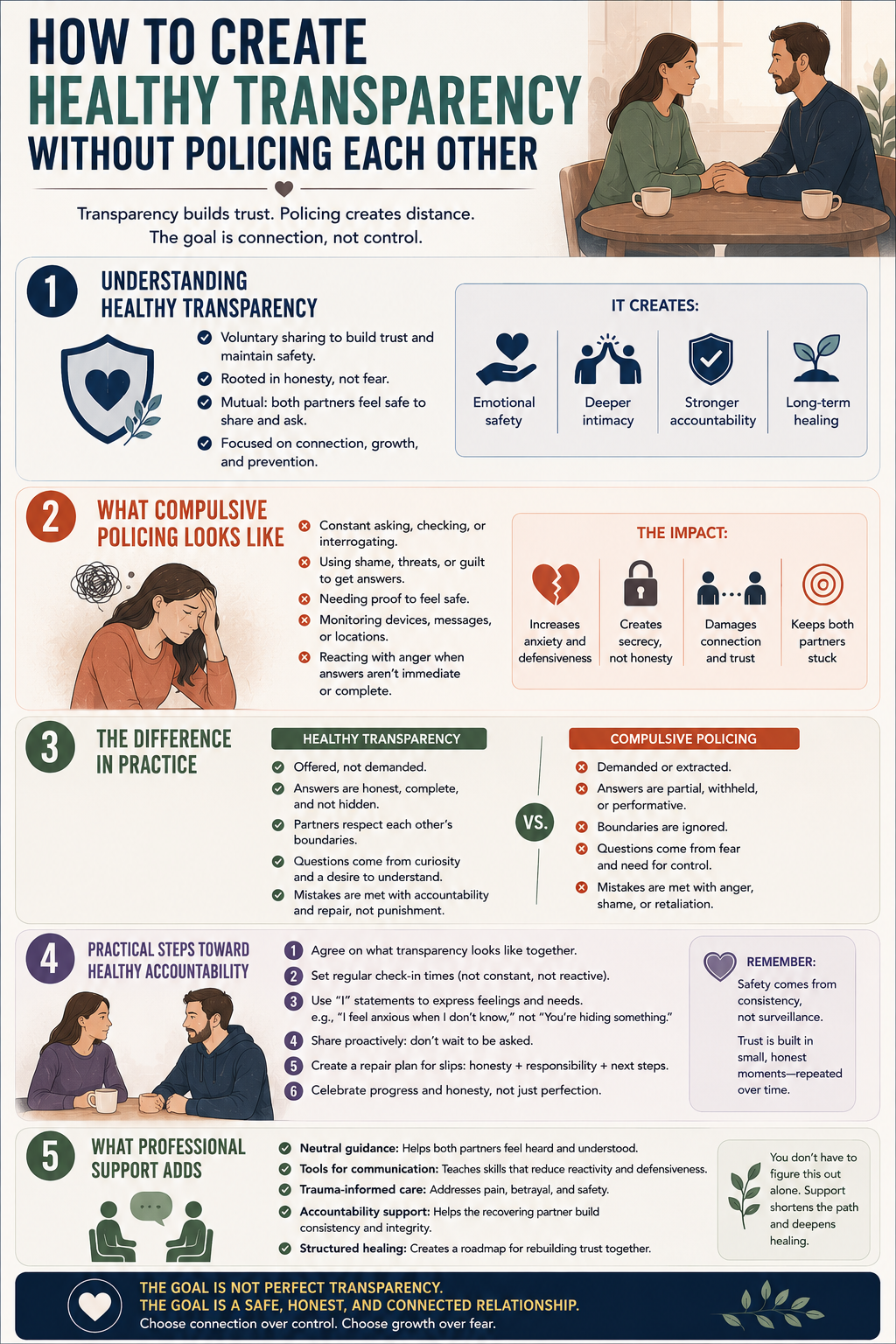
Understanding Healthy Transparency
Healthy transparency in sex addiction recovery is not simply the addicted partner agreeing to let the partner check everything at any time. That arrangement, while it might feel reassuring initially, is not a transparency structure. It is an anxiety management strategy for the partner that places the addicted partner in a position of permanent surveillance.
Healthy transparency has specific characteristics:
- It is proactive rather than reactive: the addicted partner does not simply respond to checks. They actively communicate relevant information before they are asked. Coming home later than expected and not mentioning it, for example, is a failure of transparency regardless of what happened
- It is agreed and bounded: both partners agree to what transparency looks like, what information is shared, at what frequency, and through what channels. A transparent structure agreed by both is fundamentally different from one imposed by anxiety
- It has a defined purpose: healthy transparency exists to support trust rebuilding by demonstrating consistent honesty over time. It is not an investigation and not a punishment
- It is time-limited in its most intensive form: the most intensive transparency agreements are typically appropriate in the early stages of recovery. As genuine trust rebuilds over time, the structure can be reviewed and adjusted by mutual agreement
- It includes both partners: the addicted partner makes commitments, and the partner makes commitments about how they will receive and respond to transparency information without turning it into interrogation
What Compulsive Policing Looks Like
Compulsive policing is the hypervigilance of betrayal trauma in action. It is not an exercise of power or control for its own sake: it is a traumatic response to the experience of having been deceived, and the driving motivation is the desperate need to prevent being hurt again.
Common expressions of compulsive policing include:
- Checking the partner’s phone, social media, browser history, email, bank statements, and location repeatedly throughout the day
- Demanding to know the details of every interaction, every movement, every conversation
- Being unable to stop checking even when checking consistently reveals nothing concerning
- Feeling temporarily relieved by a check and then needing to check again almost immediately
- Escalating checking behaviour when stress is high, even when no new trigger has arisen
It is important to name this clearly: compulsive checking is a symptom of betrayal trauma. It is not a character flaw or a sign that the partner is unreasonable. However, it is also a pattern that tends to maintain the traumatic state rather than resolve it, and it can create significant resentment and pressure in the relationship that is counterproductive to recovery.
| ✦ When policing becomes its own problem: Compulsive checking can, over time, begin to interfere with the partner’s own healing, work, and daily functioning. If checking behaviour is consuming significant time and mental energy, or if the partner finds themselves unable to stop even when they want to, this is a signal that the betrayal trauma requires its own therapeutic attention. Checking will not restore trust: consistent behaviour over time will. |
The Difference in Practice
| Healthy transparency | Compulsive policing |
|---|---|
| Agreed between both partners | Unilateral: driven by one partner’s anxiety |
| Proactive: information is offered | Reactive: information is extracted |
| Bounded and time-limited | Continuous and escalating |
| Supports trust-building over time | Temporarily soothes anxiety without resolving it |
| Reduces hypervigilance gradually | Maintains hypervigilance through constant re-activation |
| Respects the addicted partner’s recovery process | Can become a form of ongoing punishment |
| Is discussed and adjusted by agreement | Is resisted and resented by the addicted partner |
Both types of behaviour make sense given the circumstances. The goal is not to judge either partner but to shift toward the version that serves long-term recovery.
Practical Steps Toward Healthy Accountability
The following steps are general guidance only. Creating effective accountability structures is best done with professional guidance, as the specifics need to reflect each couple’s particular situation, stage of recovery, and the addicted partner’s specific type of compulsive sexual behaviour.
- Have an explicit conversation, ideally with a therapist present, about what transparency means for both of you and what specific behaviours will constitute transparency in your context
- The addicted partner makes specific, active commitments about what they will proactively share, not just what they will allow to be checked
- The partner articulates what specific information they need to feel reassured, rather than a blanket permission to check everything at any time
- Both partners agree on a process for when transparency is felt to have been insufficient, rather than defaulting to unilateral investigation
- The transparency structure is reviewed at agreed intervals and adjusted based on how recovery is progressing
- Each partner continues to access their own individual therapeutic support independently of the couples or accountability work
| 💡 Transparency is not the same as trust: A fully transparent partner is not a trusted partner. Trust is earned through consistent trustworthy behaviour over an extended period of time. Transparency creates the conditions in which trust can be observed and tested. This distinction matters: if the transparency structure feels like the destination rather than the context for something being built, both partners are likely to feel frustrated by how little it resolves. |
What Professional Support Adds
Creating and maintaining healthy accountability and transparency structures is genuinely difficult. Both partners are navigating significant emotional states, and the line between healthy transparency and compulsive checking can be hard to see from the inside. ASAA’s specialist counselling provides both partners with a safe, structured context in which these agreements can be established, reviewed, and maintained.
A therapist who understands both the addicted partner’s recovery needs and the betrayed partner’s trauma needs can hold both perspectives simultaneously in ways that are very difficult for either partner to do alone. Contact ASAA to discuss how we can support this stage of your recovery.
| ASAA Can Help You Navigate This Together Specialist counselling for sex addicts and betrayed partners. Creating recovery structures is part of what we do best. Book a Session |
Frequently Asked Questions
Is it reasonable for a partner to check phones and devices after sex addiction disclosure?
Some level of checking behaviour is a very normal response to the betrayal trauma of sex addiction disclosure, particularly in the early stages. However, there is a meaningful difference between the partner having reasonable and agreed-upon transparency from the addicted partner, and the partner engaging in constant unilateral surveillance that escalates without limit. The goal is to move from the latter toward the former, with the support of a therapist who can help both partners navigate this transition.
What if the addicted partner resists being accountable?
Resistance to accountability from an addicted partner in early recovery is a significant concern. Genuine commitment to recovery typically includes a willingness to be transparent and accountable, recognising that this is both fair and necessary given the impact of their behaviour. Consistent resistance to accountability is often a sign that the commitment to recovery is not yet fully genuine. ASAA’s sex addiction counselling works with addicted partners on understanding why accountability is part of recovery, not a punishment.
Can healthy transparency eventually look just like a normal relationship?
Yes. The intensive transparency structures that are appropriate in the early stages of recovery are not intended to be permanent features of the relationship. As genuine trust rebuilds over time through consistent honest behaviour, the formal accountability structures naturally become less necessary and less prominent. Most couples who reach the later stages of recovery describe a relationship that functions with ordinary mutual respect and honesty, without the surveillance and checking of the earlier phases. This is the realistic destination: different from what came before the disclosure, but genuinely functional and often significantly healthier.