 Counselling via MS Teams, Zoom and FaceTime available


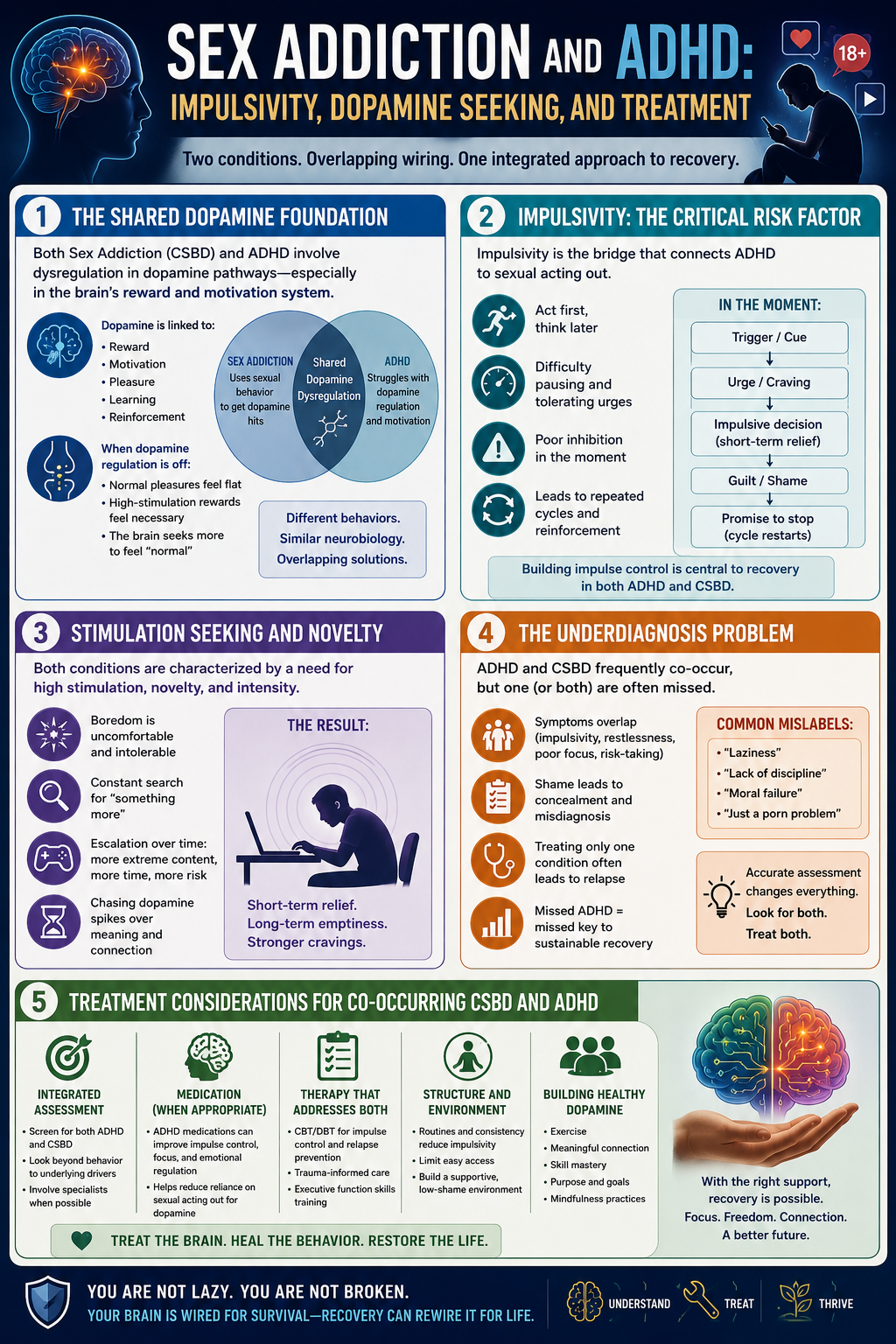
10 Aug Sex Addiction and ADHD: Impulsivity, Dopamine Seeking, and Treatment
The co-occurrence of attention deficit hyperactivity disorder (ADHD) and compulsive sexual behaviour disorder (CSBD) is far more common in clinical practice than the general public recognises. For people who carry both, the interaction between the two conditions creates a presentation that is often more complex, more treatment-resistant in some respects, and more frequently misdiagnosed or incompletely treated when the ADHD component is not identified and addressed.
At ASAA, Heide McConkey encounters clients with both ADHD and CSBD regularly and has over 25 years of experience in treating the complex presentations that arise when these two conditions interact. Confidential counselling and sex therapy is available online and face-to-face.
| ASAA: Complex CSBD Presentations Including Co-Occurring ADHD Professional counselling and sex therapy. Online and face-to-face. 25+ years. Call 0419 430 534.Book a Confidential Consultation |
The Shared Dopamine Foundation
Both ADHD and CSBD have a significant dopamine component, and this shared neurological substrate is central to understanding their co-occurrence.
ADHD involves dysregulation of dopamine (and to a lesser extent norepinephrine) in the prefrontal cortex and reward circuits of the brain. The ADHD brain characteristically underresponds to ordinary levels of stimulation and reward, creating a chronic state of stimulus-seeking behaviour. Activities and environments that generate high-intensity, immediate stimulation are particularly rewarding to the ADHD brain in a way that they are not to a neurotypical brain.
CSBD involves a compulsive pursuit of sexual stimulation that delivers a particularly powerful and immediate dopamine response. For the ADHD brain, which is already seeking high-intensity stimulation, sexual activity has an unusually strong neurochemical pull. This creates a vulnerability to sexual compulsivity that is meaningfully higher in people with ADHD compared to the general population.
Impulsivity: The Critical Risk Factor
Impulsivity is a core feature of ADHD and one of the most significant risk factors for the development of CSBD. Impulse control difficulties mean that the gap between an urge and the act of pursuing it is smaller in ADHD than in neurotypical functioning. The cognitive checks that allow a neurotypical person to notice a sexual urge, assess the consequences of acting on it, and defer or redirect the behaviour are less reliably available to the ADHD brain.
This does not mean that people with ADHD cannot develop impulse control or that CSBD is inevitable for people with ADHD. It means that the neurological challenge is meaningfully higher, and that treatment for CSBD in a person with ADHD must specifically address the impulsivity component and not simply expect standard CBT impulse management techniques to work without ADHD-informed adaptation.
Stimulation Seeking and Novelty
ADHD is associated with a strong preference for novelty and high stimulation. The consistent finding in ADHD neuropsychology is that monotonous, low-stimulation tasks are disproportionately difficult, while novel, high-stimulation activities are disproportionately rewarding. This novelty-seeking tendency interacts with the escalation dynamic of CSBD described in other articles: as existing sexual stimuli become habituated, the ADHD brain’s hunger for novelty drives escalation more readily and more rapidly than in non-ADHD presentations.
The Underdiagnosis Problem
A significant proportion of adults with ADHD remain undiagnosed, particularly women, who present differently from the hyperactive stereotype and are more frequently missed in childhood assessment. Adults in treatment for CSBD who also have undiagnosed ADHD will often struggle more with standard treatment approaches and show less consistent progress than might be expected, not because they are less committed, but because the neurological substrate is not being addressed.
If a client in treatment for CSBD finds themselves repeatedly unable to maintain the behavioural strategies agreed in therapy, experiences significant difficulty with the attention and consistency demands of a structured treatment programme, or reports a lifelong pattern of difficulty with impulse control and task completion that extends well beyond their sexual behaviour, an assessment for ADHD may be appropriate.
Treatment Considerations for Co-Occurring CSBD and ADHD
Treatment of CSBD in the context of ADHD at ASAA involves several considerations that differ from standard CSBD treatment:
- ADHD-informed structure: treatment sessions and homework tasks need to be structured in ways that are accessible for the ADHD brain, with shorter, more focused interventions rather than extended analytical tasks that demand sustained concentration
- Impulse gap skills: developing specific skills for extending the gap between impulse and action, including mindfulness-based approaches that build moment-to-moment awareness of the impulse without automatic enactment
- Addressing ADHD directly: where ADHD is formally diagnosed and medication is appropriate, ADHD treatment (pharmacological and/or behavioural) is an important parallel intervention that reduces the neurological vulnerability driving compulsive behaviour
- Substitution awareness: ADHD’s stimulus-seeking creates a risk that addressing one compulsive behaviour leads to its substitution with another. Treatment helps clients develop awareness of this dynamic and sustainable approaches to meeting the ADHD brain’s legitimate stimulation needs through healthy channels
| Complex CSBD Presentations: ASAA Can Help ADHD-informed approach to sexual addiction counselling. Online and face-to-face. Call 0419 430 534.Book a Consultation |
Frequently Asked Questions
How do I know if my CSBD treatment is being affected by undiagnosed ADHD?
Signs that undiagnosed ADHD may be affecting CSBD treatment include: persistent difficulty maintaining the behavioural strategies discussed in sessions; significant attention difficulties during sessions themselves; a lifelong pattern of impulsivity and difficulty completing tasks that is much broader than the CSBD; and a pattern of substituting one compulsive behaviour for another when the sexual behaviour is addressed. If you recognise these patterns, raise them with your counsellor. Contact ASAA to discuss your specific situation.
Can ADHD medication help with sexual compulsivity?
ADHD medication that improves dopamine regulation and reduces impulsivity may help to reduce the neurological vulnerability to sexual compulsivity in someone with co-occurring ADHD. However, ADHD medication alone is not a treatment for CSBD. It addresses part of the neurological substrate but not the psychological patterns, relational dynamics, and behavioural habits that maintain the compulsive behaviour. Combined treatment, addressing both conditions, produces better outcomes than addressing either in isolation.