 Counselling via MS Teams, Zoom and FaceTime available


15 Jun How Shame Hijacks the Recovery Process
Of all the emotional barriers that people in recovery from sex addiction encounter, shame is the most persistent and the most damaging. It is also the one most likely to be mistaken for a driver of change, when in reality it is one of the primary engines of the very cycle it appears to condemn.
Understanding how shame operates is not an exercise in self-justification. It is a clinical necessity. Without an accurate picture of what shame is doing in the recovery process, it is very difficult to interrupt the patterns it creates. This is a central area of specialist sex addiction counselling at ASAA, and one of the most consistently misunderstood aspects of compulsive sexual behaviour disorder.
Shame Versus Guilt: A Crucial Distinction
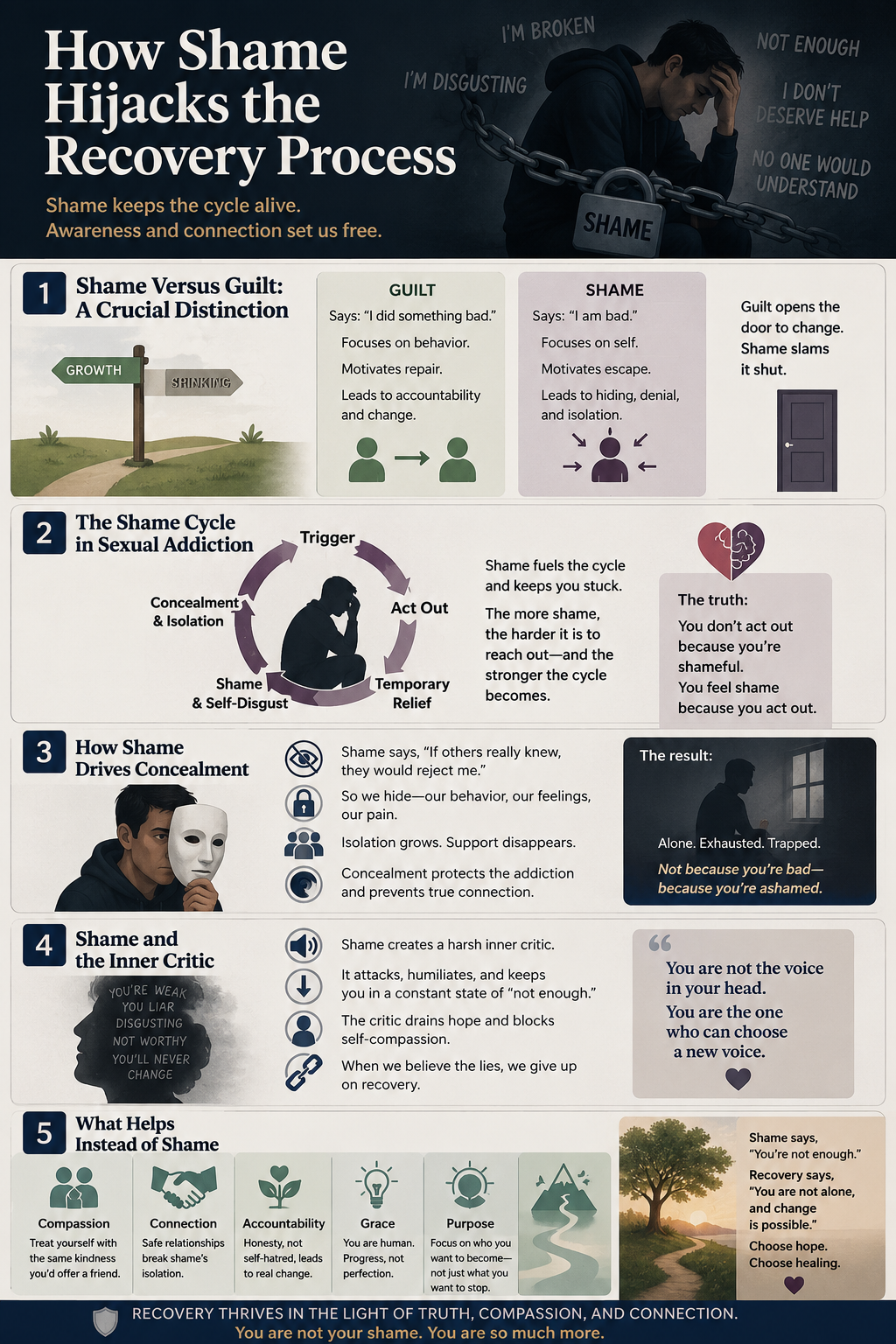
Many people use shame and guilt interchangeably, but they describe meaningfully different psychological experiences with very different effects on behaviour.
Guilt is the experience of feeling bad about something you have done. It is behaviour-focused. Healthy guilt says: ‘That action caused harm. I want to repair it and make a different choice.’ Guilt is, in this sense, a functional emotion. It produces accountability, repair, and the motivation to change.
Shame is the experience of feeling bad about who you are. It is identity-focused. Shame says: ‘I am bad. I am broken. I am fundamentally defective as a person.’ Shame does not produce repair. It produces hiding, avoidance, and in the context of addiction, relapse.
| Research context The distinction between shame and guilt has been extensively studied by researchers including Dr Brene Brown and Professor June Price Tangney. Their work consistently finds that guilt is associated with pro-social behaviour and motivation to change, while toxic shame is associated with destructive coping behaviours and psychological harm. This distinction is clinically significant in addiction treatment. |
The Shame Cycle in Sexual Addiction
In compulsive sexual behaviour, shame does not exist outside the addictive cycle. It is embedded within it. This is the pattern that therapists working in this field see repeatedly:
- The person engages in the compulsive sexual behaviour
- They experience profound shame in the aftermath: self-disgust, self-condemnation, a sense of worthlessness or fundamental brokenness
- The shame state is intensely painful and emotionally dysregulating
- To escape the pain of the shame state, the brain seeks relief through the same mechanism that has provided relief before: the addictive behaviour
- The behaviour occurs again, generating another wave of shame
This is not a failure of character. It is a neurological and psychological loop in which shame becomes one of the primary triggers for the very behaviour that produces it. Telling someone to feel more ashamed of their behaviour as a strategy for stopping it is the clinical equivalent of treating a wound by repeatedly reopening it.
How Shame Drives Concealment
One of the most clinically significant effects of shame in sexual addiction recovery is its impact on disclosure. Shame creates a powerful incentive to conceal, to manage appearances, to present a version of oneself in therapy and in relationships that contains the parts that feel acceptable and hides the parts that feel intolerable.
This concealment is not deceptive in the conventional sense. It is a survival response. The person has come to believe, usually from a very early age and often from experiences that long predate the addiction, that full visibility of their inner world is dangerous. That the parts of them that feel most broken are also the parts most likely to result in rejection, abandonment, or condemnation.
When this belief is operating, a person can be attending counselling sessions regularly and still be in partial recovery, because the parts of their experience that most need therapeutic attention are the parts they cannot yet bring into the room. The therapeutic relationship itself must be safe enough to hold shame before shame can begin to be addressed.
Shame and the Inner Critic
Many people in recovery carry an inner critic voice that is relentlessly condemnatory. This is a part of psychological experience, sometimes described in Voice Dialogue and related models as a protective inner figure, that interprets every stumble in recovery as evidence of fundamental defectiveness.
The inner critic is not trying to harm the person. It developed, typically in childhood or adolescence, as a way of managing the threat of external criticism and rejection. The logic is: ‘If I condemn myself first, the condemnation from others cannot surprise me.’ But in adult life, and particularly in recovery, the inner critic has become a source of the very pain it was originally designed to prevent. Working with this pattern directly is one of the areas where Heide McConkey’s Voice Dialogue approach offers a specific and effective pathway in sexual addiction treatment.
What Helps Instead of Shame
If shame does not drive recovery forward, what does? The evidence points consistently toward several interconnected capacities:
| What drives recovery | How it differs from shame |
|---|---|
| Accountability | Acknowledges behaviour without collapsing into self-condemnation |
| Self-compassion | Creates emotional stability that makes continued therapeutic engagement possible |
| Honest disclosure | Allows the full picture to be seen and therapeutically addressed |
| Repair-oriented action | Focuses energy on what can be done rather than ruminating on what was done |
| Curiosity about underlying need | Asks what the compulsive behaviour is attempting to address emotionally |
These capacities are not innate. They are developed through therapeutic work, often slowly, in a relationship with a therapist who models the non-condemnatory stance toward the person’s experience that the person has not yet been able to adopt toward themselves.
| 🌿 Recovery is not about becoming someone who never feels shame. It is about developing the capacity to be with difficult emotions, including shame, without being consumed by them or driven by them toward behaviours that cause further harm. |
| Working With Shame in a Safe Therapeutic Space ASAA offers confidential, non-judgmental specialist counselling for sex and pornography addiction. You do not need to have it all together before you call. Book a Confidential Session |
Frequently Asked Questions
Is feeling ashamed about my behaviour the same as knowing it is wrong?
Not quite. Knowing that a behaviour is causing harm and wanting to change it is different from the experience of toxic shame, which is characterised by a generalised sense of personal defectiveness rather than a specific response to a specific action. Healthy acknowledgment of the impact of behaviour is possible, and important, without the collapse into shame that drives the addiction cycle further.
Will talking about my behaviour in therapy make the shame worse?
For most people, the anticipation of disclosure is more painful than the disclosure itself. Specialist therapists working in this field are trained to receive difficult material with consistency and without condemnation. Many people report that the experience of being seen and not rejected in therapy is among the most significant moments in their recovery process.
How long does it take to work through shame in recovery?
Shame is one of the deeper layers of recovery work, and it tends to become more accessible as the more surface-level stabilisation of behaviour patterns is established. It is not a single conversation but an ongoing dimension of therapeutic work. The timeline varies considerably depending on the person’s history, the therapeutic relationship, and other factors. The important thing is that it can be worked with.