 Counselling via MS Teams, Zoom and FaceTime available


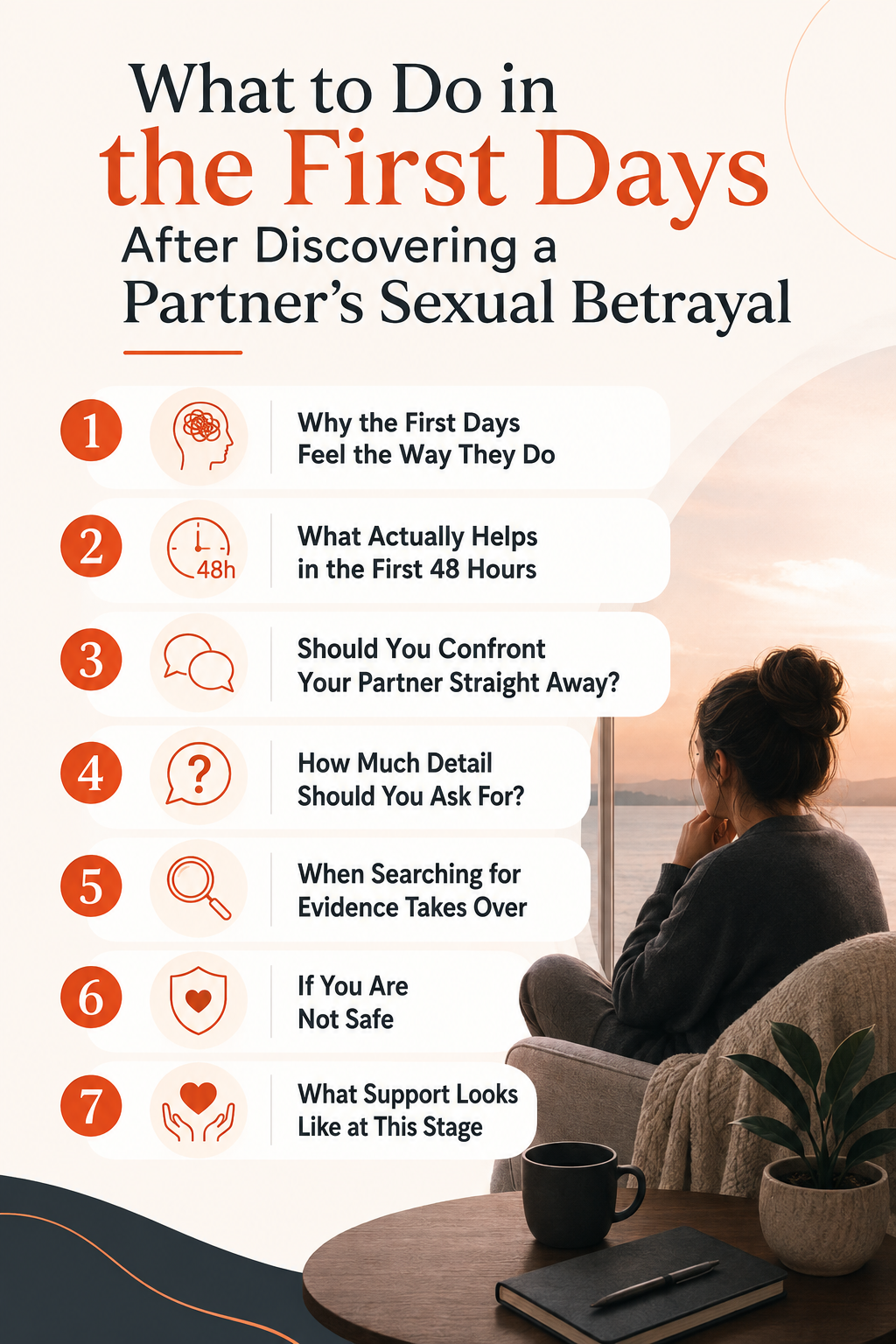
01 Sep What to Do in the First Days After Discovering a Partner’s Sexual Betrayal
If you have just discovered that your partner has been engaging in secret sexual behaviour, the most useful thing to know in the first days is this: you do not have to decide anything about the relationship right now. Not today, not this week. The early period after discovery is not the time for permanent decisions. It is the time for steadying yourself, getting accurate information, and finding support. Everything else can wait, and waiting is a legitimate choice rather than a failure to act.
That advice can feel impossible to follow when your mind is demanding answers immediately. At Sex Addiction Australia (ASAA), the period immediately after discovery is one of the most common points at which spouses and partners make contact. Heide McConkey, ASAA’s founder and clinical sex therapist, has more than 25 years of experience working with people at exactly this stage, and provides confidential counselling online and face to face.
Why the First Days Feel the Way They Do
Many people describe discovery as physical rather than emotional. Nausea, shaking, an inability to eat or sleep, a racing heart, a sense of the room being unreal. This response is not an overreaction and it is not a sign that you are coping badly.
What has happened is that the person you relied on for safety has become, at least temporarily, the source of the threat. Your nervous system responds to that the way it responds to danger, because in an attachment sense that is precisely what it is. The result is a body running on alarm, at the exact moment you are being asked to think clearly. That combination is why the first days feel unmanageable, and it is also why decisions made in them are so often regretted.
What Actually Helps in the First 48 Hours
The aim in this window is stabilisation rather than resolution.
- Attend to your body first. Food, water, and sleep are not trivial. A nervous system in alarm cannot be reasoned out of it, but it can be slowly settled through basic physical care
- Postpone irreversible decisions. Do not move out, hand in a resignation, contact your partner’s employer, or tell extended family in the first days unless your safety requires it
- Tell one trusted person. Isolation makes this significantly harder to carry. One person, chosen carefully, is enough at this stage
- Write down what you know. Memory becomes unreliable under stress, and a written record means you are not relying on recall in later conversations
- Keep your routine where you can. Work, school runs and ordinary structure are stabilising even when they feel absurd
Should You Confront Your Partner Straight Away?
There is no single correct answer, and you are not obliged to do it immediately. Some people need to speak straight away because the silence is unbearable. Others need days to gather themselves first. Both are reasonable.
What is worth avoiding is the extended interrogation that many couples fall into in the first week, where hours of questioning produce partial answers, which produce further questioning. This pattern is exhausting for both people and rarely produces the clarity it promises. Information disclosed under pressure, in stages, tends to prolong distress rather than resolve it. A structured process for disclosure, guided by a counsellor, generally produces a more complete and more reliable account than an escalating series of confrontations at home.
How Much Detail Should You Ask For?
This is one of the most common questions partners bring, and the honest answer is that it depends on the person. Some people find that specific information reduces the power of their imagination. Others find that graphic detail becomes intrusive and difficult to displace afterwards.
A useful distinction is between information you need in order to make decisions, and detail that answers curiosity but is likely to stay with you. The first category typically includes sexual health matters, financial exposure, whether anyone in your immediate circle was involved, and the broad timeline. The second category is usually the explicit specifics. Many partners find it helpful to decide in advance which category they are asking about, rather than making that judgement in the middle of a distressing conversation.
When Searching for Evidence Takes Over
It is very common, after discovery, to find yourself checking devices, reconstructing timelines, and searching for anything that was missed. This behaviour makes complete sense. Your sense of what was real has been disrupted, and searching is an attempt to rebuild it.
It also has costs. The searching rarely produces the settled feeling it is aiming for, and it can consume days at a time. Rather than judging yourself for it, it is more useful to notice what you are hoping to feel once you find the next piece of information, and whether the previous pieces delivered it. This is a pattern that responds well to structured support, and it is one of the things spouse and partner support counselling is designed to address.
If You Are Not Safe
Most situations discussed here involve secrecy and betrayal rather than danger. Some do involve danger. If you are being threatened, intimidated, physically harmed, or coerced, or if you are being pressured into sexual activity you have not freely agreed to, that is a safety matter and it takes priority over everything else in this article.
In an emergency call 000. For confidential 24 hour support relating to sexual assault, domestic or family violence, call 1800RESPECT on 1800 737 732. If you are in distress or having thoughts of suicide, Lifeline is available 24 hours a day on 13 11 14.
What Support Looks Like at This Stage
Early support for partners is not primarily about deciding the future of the relationship. It is about reducing the intensity of the immediate response, making sense of what has happened, and helping you get to a point where a considered decision becomes possible.
At ASAA that work is available to you individually, regardless of what your partner is doing. You do not need your partner’s agreement, participation, or knowledge in order to seek support for yourself. Where couples do choose to work on the relationship, relationship counselling generally follows individual stabilisation rather than replacing it. Sessions are available online across Australia and face to face in Sydney.
Frequently Asked Questions
Is it too soon to see a counsellor if I only found out a few days ago?
No. The days immediately after discovery are one of the most useful times to speak with someone, precisely because so much of the difficulty in this period comes from carrying it alone and from the pressure to make decisions before you are ready. There is no threshold of certainty you need to reach first, and you do not need to have decided anything about the relationship.
Can I get support if my partner refuses to acknowledge there is a problem?
Yes. Support for partners and spouses is provided independently of whether the other person is engaged in any process of their own. Your distress is real whether or not it is acknowledged, and your ability to think clearly, look after yourself and make decisions is worth supporting on its own terms. ASAA’s partner support counselling is available to you individually.