 Counselling via MS Teams, Zoom and FaceTime available


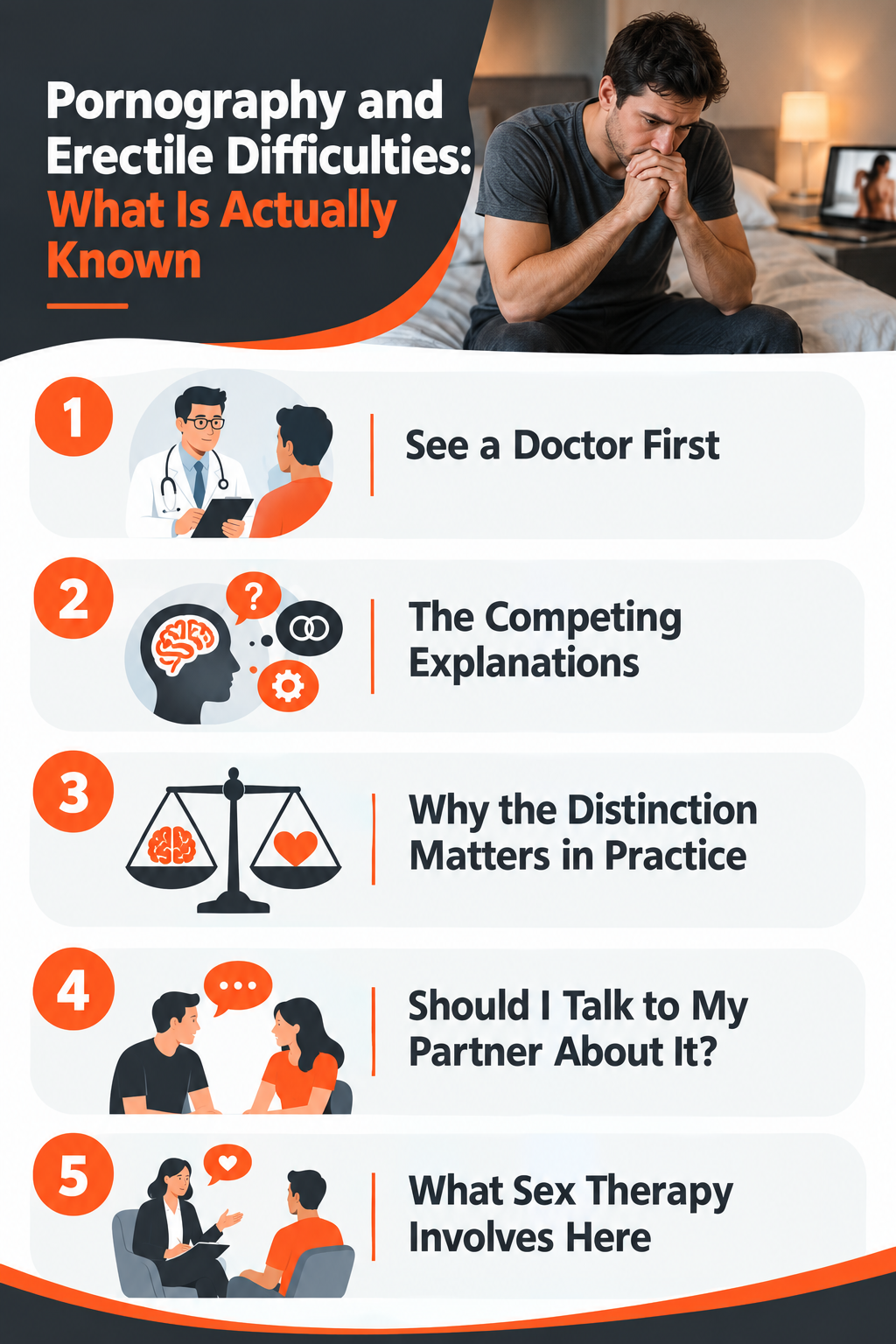
15 Oct Pornography and Erectile Difficulties: What Is Actually Known
If you have encountered the idea that pornography causes erectile dysfunction, it is worth knowing that this is an area of genuine scientific disagreement rather than settled fact. Some studies report an association between heavy pornography use and difficulties with erection or arousal with a partner. Others find no such relationship. Researchers disagree about whether any association reflects cause, consequence, or a third factor influencing both.
Anyone telling you this question is definitively resolved, in either direction, is overstating the evidence. What can be said usefully is what the competing explanations are, and what to do about the difficulty itself. At Sex Addiction Australia (ASAA), sexual function concerns are addressed as part of sex therapy, delivered by Heide McConkey, founder and clinical sex therapist with more than 25 years of experience.
See a Doctor First
This is the most important point in this article, and it comes before any discussion of pornography.
Erectile difficulties can be an early indicator of cardiovascular disease, diabetes, hormonal conditions, neurological conditions, or a side effect of prescribed medication. The blood vessels involved are small and are often affected before symptoms appear elsewhere. This is well established and is not a matter of scientific dispute.
Attributing the difficulty to pornography without a medical assessment risks leaving a treatable and potentially serious physical condition unexamined. Speak to your GP first. A counsellor, including a clinical sex therapist, is not a substitute for that assessment, and any practitioner who tells you otherwise is giving you poor advice.
The Competing Explanations
Assuming physical causes have been excluded, several explanations are put forward for difficulties that occur with a partner but not alone.
Conditioned arousal
The proposal is that arousal becomes strongly associated with a specific set of conditions, including particular content, pacing, and solitary circumstances, and that partnered sex differs enough from those conditions that the response is weaker. This is a plausible mechanism and is consistent with how conditioning works generally, but the evidence specifically linking it to pornography is contested.
Performance anxiety
Once a difficulty has occurred with a partner, anticipation of it recurring is itself a highly effective inhibitor of arousal. This is well documented and creates a self-sustaining cycle that can persist long after whatever caused the original episode has gone.
Relationship factors
Unresolved conflict, resentment, loss of emotional closeness, or difficulty following a partner’s discovery of concealed behaviour all affect sexual response, and often more powerfully than anything else on this list.
Reverse causation
It is also possible that some people increase solitary pornography use because partnered sex has become difficult or anxiety-provoking, rather than the other way around. Studies that find an association cannot generally distinguish between these directions.
Why the Distinction Matters in Practice
It matters because the explanations point to different work.
If performance anxiety is central, the work involves reducing the pressure attached to sexual encounters. If the issue is relational, the work is on the relationship. If conditioned arousal is a substantial factor, the work involves broadening the range of conditions under which arousal occurs. Assuming pornography is the whole answer risks months spent on abstinence while the actual contributing factor continues untouched.
Should I Talk to My Partner About It?
In most cases yes, and earlier than feels comfortable.
Erectile difficulties in a relationship are rarely a private matter, because a partner almost always notices and, in the absence of an explanation, tends to construct one. The explanations people reach for unprompted are usually about attraction or interest, which are more damaging than the reality and considerably harder to undo later.
A brief, plain explanation that you are having a physical difficulty, that you are having it checked, and that it is not about them, removes most of that. You do not need a diagnosis before having that conversation. Where the difficulty has already caused distance or repeated difficult episodes, working on it together is generally more effective than one person trying to resolve it alone.
What Sex Therapy Involves Here
Sex therapy for these concerns is a talking therapy. It involves no physical examination and no sexual activity in session, which is worth stating plainly because it is a common and understandable worry.
The work generally covers assessing what is happening and in what circumstances, identifying the contributing factors, reducing the anxiety that maintains the difficulty, and where relevant addressing the conditions under which arousal has become narrow. Where a partner is involved and willing, some of this work is more effective done together. Where compulsive use is also present, counselling for pornography concerns may run alongside it.
Frequently Asked Questions
If I stop using pornography, will the difficulty resolve?
It may improve, and for some people it does, but this cannot be promised and the evidence does not support presenting it as a reliable outcome. If anxiety, relationship factors or an undiagnosed physical cause are contributing, abstinence alone will not address them. This is a reason to have the difficulty properly assessed rather than to self-treat on an assumption.
Is this something I should raise with my GP, or is it embarrassing?
It is a routine presentation that GPs see very frequently, and it is one of the situations where a medical check has value beyond the immediate concern, given the links to cardiovascular and metabolic conditions. Raising it is the sensible first step regardless of what you think the cause is.