 Counselling via MS Teams, Zoom and FaceTime available


15 Oct Is My Pornography Use a Problem? Signs Worth Taking Seriously
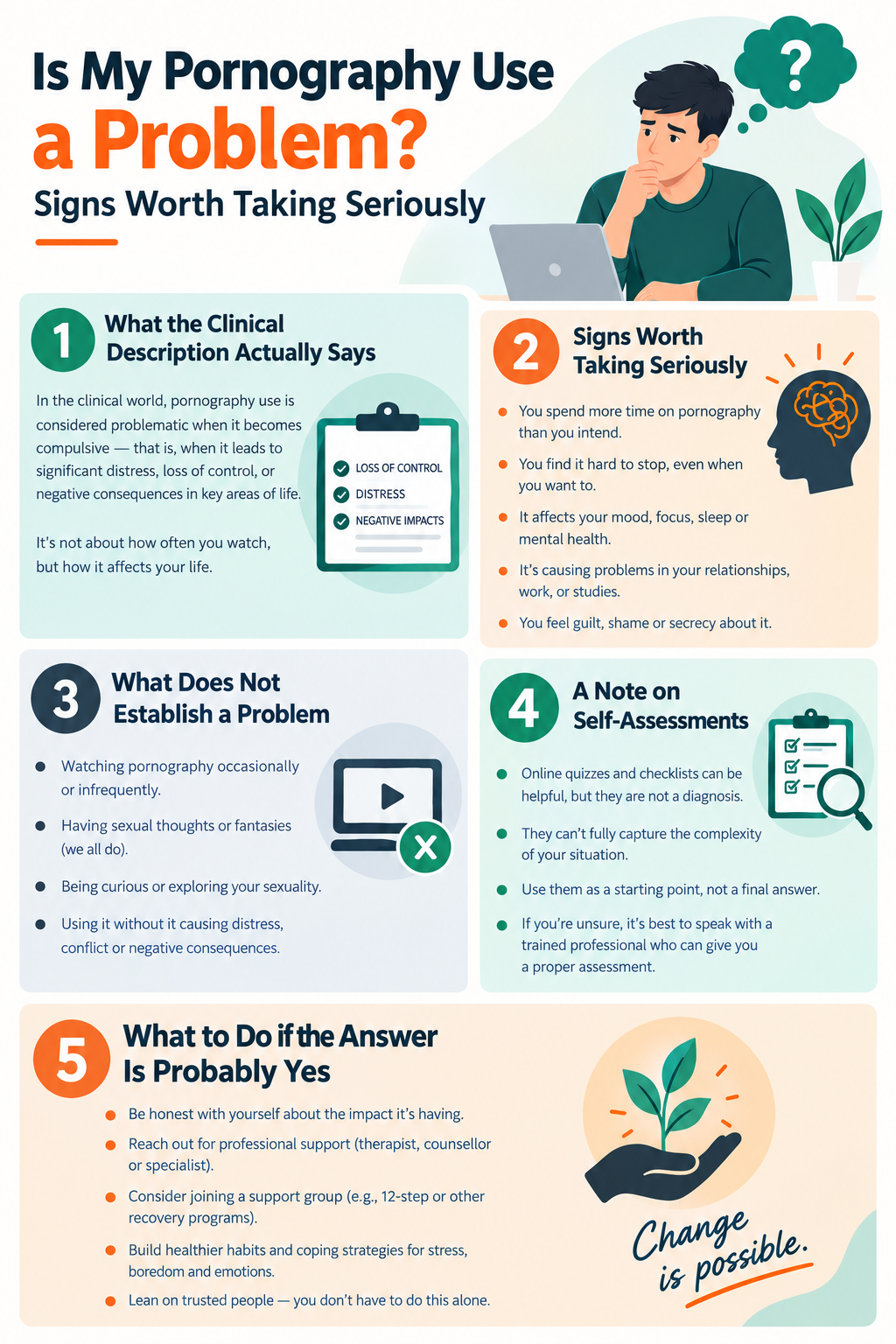
The question most people ask themselves is how much is too much, and it is the wrong question. There is no threshold of frequency that marks the point where pornography use becomes a problem. What matters instead is control and consequence: whether you can stop when you decide to, and whether the use is continuing despite costing you things you care about.
That reframing matters because people can spend years measuring themselves against an imagined norm rather than looking at what is actually happening in their own life. At Sex Addiction Australia (ASAA), pornography is the most common presenting concern. Heide McConkey, ASAA’s founder and clinical sex therapist, has more than 25 years of experience in this area, with counselling available online and face to face.
What the Clinical Description Actually Says
The World Health Organisation’s International Classification of Diseases, eleventh revision, includes Compulsive Sexual Behaviour Disorder as an impulse control disorder. This is the clinical frame. Sex addiction and porn addiction are the everyday terms, and they are widely understood, but they are not diagnostic categories in themselves.
The features the clinical description emphasises are worth knowing, because they are more useful than any frequency count:
- A persistent pattern of failing to control repetitive sexual impulses
- Repeated unsuccessful efforts to reduce the behaviour
- The behaviour becoming a central focus of life, to the neglect of health, personal care, interests or responsibilities
- Continuation despite adverse consequences, or despite deriving little satisfaction from it
- Marked distress or significant impairment sustained over an extended period
One further point is important. Distress arising purely from moral or religious disapproval of pornography is specifically excluded. Feeling guilty about pornography use does not on its own indicate a disorder. That distinction is not a dismissal of the guilt, which may be worth addressing in its own right, but it is a different matter from loss of control.
Signs Worth Taking Seriously
The signals that tend to be clinically meaningful are about function rather than volume.
Repeated failed attempts to stop
A history of sincere resolutions followed by resumption is one of the more informative signs. Not a single lapse, but an established pattern of deciding to stop and finding that the decision does not hold.
Escalating time or content
Needing more time, or material that is further from what you initially sought, in order to achieve the same effect.
Use in circumstances that carry real risk
Using at work, while responsible for children, or in situations where discovery would carry serious consequences, and continuing anyway.
Displacement of other things
Sleep, exercise, friendships, hobbies and work quality giving way over time.
Using to manage feelings
Turning to pornography reliably when stressed, lonely, bored or ashamed, rather than primarily for pleasure.
Concealment that has grown
Not privacy, which is normal, but an expanding apparatus of hiding: deleted histories, secondary devices, accounting for time.
What Does Not Establish a Problem
It is as useful to know what is not diagnostic.
Frequency alone does not establish anything, and neither does the nature of the content viewed, which varies enormously among people with no difficulties at all. A partner’s disapproval is a genuine relationship issue but is not in itself evidence of a disorder. Guilt following use is extremely common and is often about values rather than control. And a single period of heavy use during a difficult stretch of life is not the same as an entrenched pattern.
A Note on Self-Assessments
ASAA offers free anonymous self-assessments, and many similar tools exist online. These are structured prompts for reflection. They can be genuinely useful for organising your own thinking and for making a first conversation easier to start.
What they cannot do is produce a diagnosis. A questionnaire has no access to your history, your circumstances, or the distinction between distress caused by loss of control and distress caused by disapproval. A result in either direction is a starting point for a conversation, not a conclusion. Assessment by a qualified practitioner is a different thing entirely.
What to Do if the Answer Is Probably Yes
You do not need certainty before seeking help, and waiting until the situation is undeniable simply means a longer period of difficulty beforehand.
An initial conversation is largely about establishing what is actually happening: the pattern, what precedes it, what it is doing for you, and what it is costing. That picture is what treatment is built on. Counselling at ASAA is confidential, available to adults of any gender and sexual orientation, and delivered online across Australia as well as face to face in Sydney.
If you are in distress or having thoughts of suicide, Lifeline is available 24 hours a day on 13 11 14. In an emergency call 000.
Frequently Asked Questions
Is there a number of times per week that counts as too much?
No, and any specific figure would be misleading. Two people with identical frequency can be in entirely different situations, one managing it without difficulty and the other unable to stop despite serious consequences. Control and consequence are what distinguish them, not volume.
Can I get help if I am not sure it is an addiction?
Yes, and uncertainty is the most common starting point. Part of what an initial session does is clarify what is actually going on, which may or may not turn out to be a compulsive pattern. You do not need to arrive with a conclusion. Online counselling is available if that feels more manageable than attending in person.