 Counselling via MS Teams, Zoom and FaceTime available


15 Oct Escalation: Why Pornography Content Changes Over Time
One of the more distressing things people notice is that the material they are now seeking is different from what they sought at the beginning, sometimes markedly so. The common private conclusion is that this reveals something disturbing about who they really are. That conclusion is usually wrong, and it is worth addressing directly, because it is one of the main reasons people do not seek help.
Escalation is a recognised feature of the pattern rather than a revelation of hidden character. Understanding what drives it tends to reduce the shame attached to it, which matters because that shame is itself part of what keeps the cycle running. At Sex Addiction Australia (ASAA), this is routine territory. Heide McConkey, founder and clinical sex therapist, has more than 25 years of experience, online and face to face.
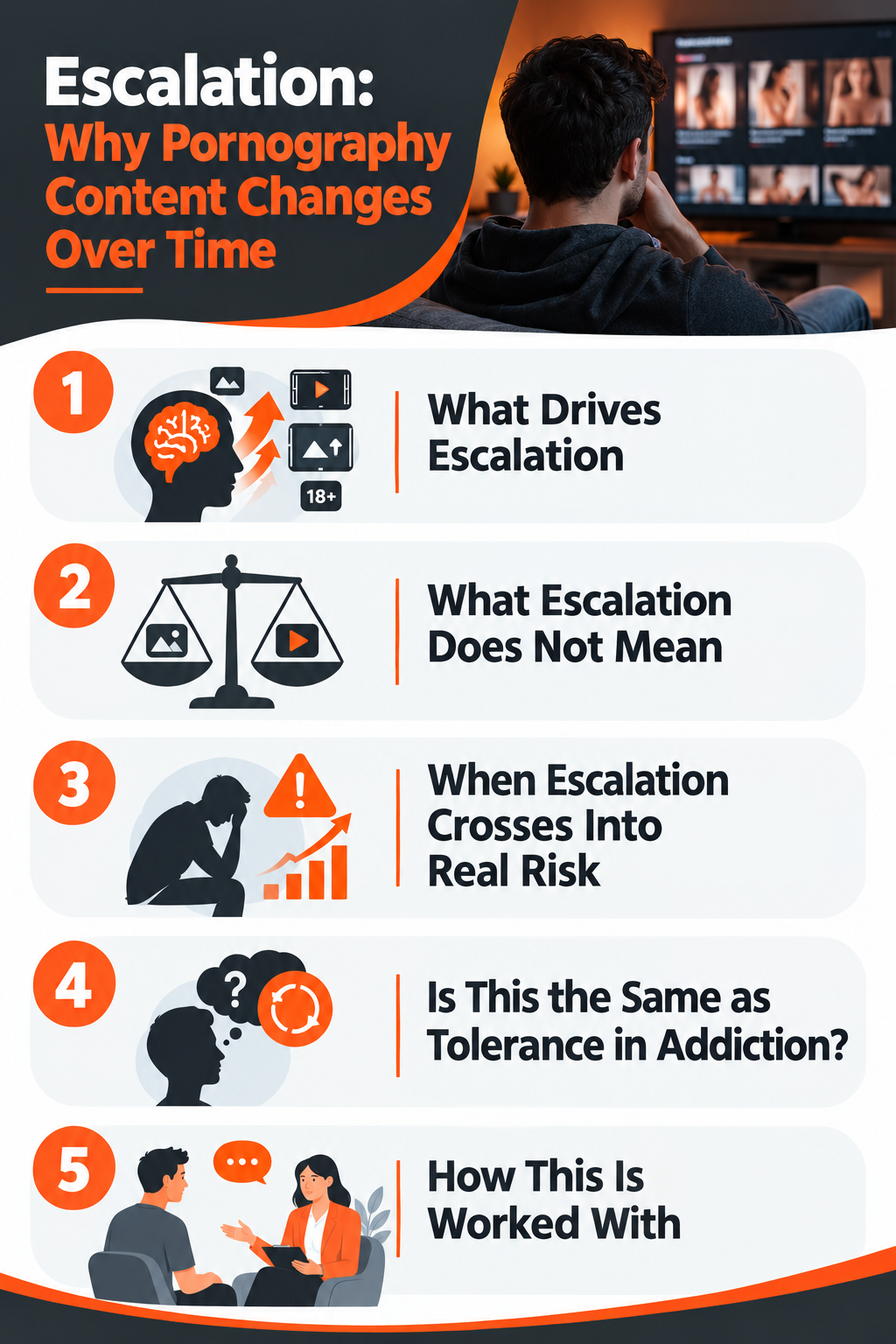
What Drives Escalation
Several mechanisms are proposed, and they are not mutually exclusive.
Habituation
Repeated exposure to a stimulus reduces the response to it. This is one of the most basic findings in behavioural science and is not specific to sexual material. As familiar content produces a weaker response, novelty or intensity is sought to restore it.
Novelty seeking
The response to sexual stimuli is strongly influenced by novelty. Unlimited and instantly available variety, which is a relatively recent circumstance historically, allows novelty seeking to operate without the natural limits that previously applied.
Chasing a receding effect
Where the use is serving an emotional function such as escape or relief, and the usual material stops delivering it, the natural move is towards something that will. The escalation is in pursuit of the effect rather than the content itself.
Shame as an accelerant
Escalation produces shame, shame is a trigger for use, and use continues the escalation. This loop tends to accelerate the process rather than slow it.
What Escalation Does Not Mean
This is the part people most need to hear.
Content viewed under conditions of habituation and compulsive seeking is a poor guide to what someone actually wants, values or would ever act on. The pattern is being driven by the search for a diminishing effect, not by a developing preference. Many people find that as the compulsive pattern resolves, interest in the escalated material falls away, which would be difficult to explain if it reflected genuine preference.
It also does not mean you are dangerous. Most escalation stays within legal material and involves no risk to anyone. It is worth stating clearly that ASAA does not provide forensic services, and that if content involving minors is involved this requires specialist services rather than general counselling.
When Escalation Crosses Into Real Risk
There is a distinction worth drawing carefully.
Escalation towards more extreme but legal material is uncomfortable and is a reason to seek help, but it is not in itself a safety matter. Escalation towards illegal material, or towards behaviour involving other people who have not agreed to it, is a different category entirely and requires specialist assessment. If you are concerned that this applies to you, say so at the point of first contact so you can be directed to appropriate services rather than beginning work that is not designed for it.
Is This the Same as Tolerance in Addiction?
The comparison is often made and it is worth being precise about it.
Habituation to a repeated stimulus is well established across many behaviours and is not unique to sexual material. Whether the specific mechanism in compulsive pornography use matches tolerance as it is understood in substance dependence is a separate question, and one researchers have not settled. Compulsive Sexual Behaviour Disorder is classified in ICD-11 as an impulse control disorder rather than as a substance-related or addictive disorder, which reflects that unsettled position.
For practical purposes the distinction matters less than it might appear. What is being worked with is the pattern, the function it serves, and the shame maintaining it, and that work is the same regardless of which theoretical frame turns out to be the better fit.
How This Is Worked With
The work is not primarily about the content, which is a relief to most people who expect to have to describe it in detail.
It focuses on the mechanism: what the use is providing, what precedes it, and what maintains the cycle. Escalation generally reduces as the compulsive pattern is addressed, rather than needing to be tackled as a separate problem. Where the escalation has affected a partnered sexual relationship, sex therapy may form part of the work.
You will not be asked to provide graphic detail as a condition of being helped. Counselling is confidential and non-judgemental, and the level of detail is yours to set.
If you are in distress or having thoughts of suicide, Lifeline is available 24 hours a day on 13 11 14.
Frequently Asked Questions
Will I have to describe what I have been watching?
No. Some general sense of the pattern and direction of change is useful clinically, but explicit detail is rarely necessary and is never a requirement. Many people find the fear of having to describe it is worse than the reality of the conversation.
Does escalation always keep going?
No. It is not an inevitable progression, and it commonly plateaus or reverses when the underlying compulsive pattern is addressed. Treating it as an unstoppable trajectory tends to increase distress without being accurate.