 Counselling via MS Teams, Zoom and FaceTime available


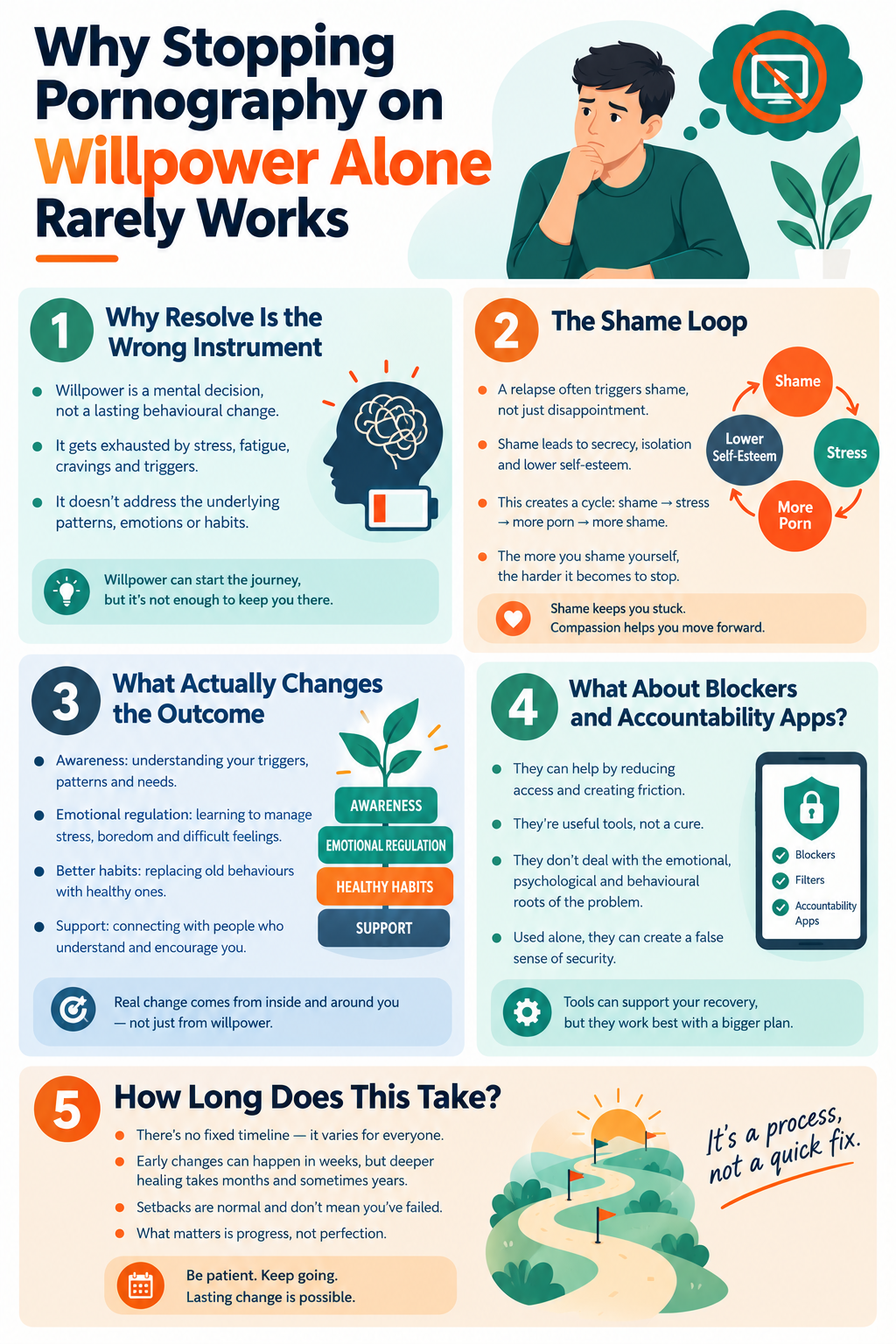
15 Oct Why Stopping Pornography on Willpower Alone Rarely Works
If you have resolved to stop watching pornography many times and have not managed to sustain it, the most useful thing to understand is that this is the expected outcome of the method, not evidence of a defective character. Willpower is a poor tool for this particular job, and the repeated failure of a poor tool says very little about the person using it.
This matters beyond reassurance. People who believe the problem is insufficient resolve tend to respond by resolving harder, which produces the same result and adds another layer of shame. At Sex Addiction Australia (ASAA), breaking that cycle is often the first practical step. Heide McConkey, founder and clinical sex therapist, has more than 25 years of experience with this pattern, online and face to face.
Why Resolve Is the Wrong Instrument
By the time a behaviour is well established, the sequence from trigger to action is running faster than deliberate thought.
A cue appears, often an emotional state rather than anything visual. Craving follows. The behaviour begins. The part of you that made the decision to stop is frequently not engaged until the sequence is already underway, or until afterwards. Asking willpower to intervene at that point is asking it to arrive late to a process that has already gained momentum.
This is why the resolution can feel completely sincere at the moment it is made and completely absent at the moment it is needed. Both are true, and they are not in contradiction.
The Shame Loop
There is a second reason the approach tends to fail, and it is the more damaging one.
Resolving to stop, and then not stopping, produces shame. Shame is itself one of the most reliable triggers for the behaviour. So the failed attempt generates exactly the emotional state most likely to produce the next episode. The method contains its own relapse mechanism.
Understanding this changes what the goal of early work is. It is not to generate more determination. It is to interrupt the loop that is converting each setback into fuel for the next one.
What Actually Changes the Outcome
Effective work happens upstream of the moment of craving rather than at it.
Mapping the specific pattern
Identifying your own triggers, the emotional states that precede use, the times and circumstances involved, and what the behaviour is providing. This replaces a vague sense of losing control with a specific sequence that can be worked on.
Addressing what the behaviour is doing
Pornography use in a compulsive pattern is almost always serving a function: relief from anxiety, escape from loneliness, regulation of an unmanageable mood. Removing the behaviour without addressing the function leaves the underlying need unmet, which is why abstinence achieved by force tends not to last.
Changing the environment
Reducing the ease and availability of the behaviour does not resolve the underlying pattern, but it widens the gap between cue and action, which creates room for the other work to operate.
Building tolerance for the feelings involved
Much of the work involves increasing the capacity to sit with discomfort without acting on it. This is a learned capability rather than an innate one.
What About Blockers and Accountability Apps?
They have a place, and they are not a treatment.
Blocking software and accountability arrangements increase friction, which is genuinely useful during early work when the gap between cue and action is narrow. What they do not do is address why the behaviour is occurring. Used alone they tend to produce either circumvention or a frustrating stalemate in which the behaviour is suppressed but the underlying pattern is untouched.
Used alongside counselling that addresses the function of the behaviour, they are a reasonable support.
How Long Does This Take?
There is no standard timeframe and anyone offering one is guessing. What can be said is that the trajectory is rarely a straight line, and that progress is more usefully measured by the pattern over months than by any individual week.
Setbacks during this work are common and are not a reason to stop. In a structured process a lapse is information about what triggered it, which is more useful than the same event treated as proof of failure. Treatment at ASAA draws on approaches including cognitive behavioural work and psychotherapy, with sex therapy where sexual function or the couple relationship is also involved.
If you are in distress or having thoughts of suicide, Lifeline is available 24 hours a day on 13 11 14.
Frequently Asked Questions
Does this mean willpower is irrelevant?
Not irrelevant, but wrongly placed. Determination is what gets someone to make an appointment and keep attending when the work is uncomfortable, which matters enormously. What it cannot reliably do is override a well-established cue-to-behaviour sequence in the moment. Directing it towards the process rather than towards the moment of craving is the more productive use.
I have stopped before for several months. Why did it come back?
Extended abstinence achieved through effort alone is common, and so is the return of the behaviour during a period of stress, isolation or disruption. It usually indicates that the underlying function was never addressed, so the pattern remained available when circumstances called for it. That is a reason to look at the function rather than to conclude that nothing works.