 Counselling via MS Teams, Zoom and FaceTime available


01 Sep Do I Have to Decide About My Relationship Right Now?
No. And the pressure you are feeling to decide immediately, whether it is coming from your partner, from family, from friends, or from your own need for the uncertainty to end, is worth resisting. A decision of this significance made in the first weeks after discovery is being made by a person under acute stress, with incomplete information, about a situation that has not yet stabilised. Deferring it is not avoidance. It is sequencing.
This is one of the most frequent conversations in partner support work. At Sex Addiction Australia (ASAA), Heide McConkey, founder and clinical sex therapist with more than 25 years of experience, works with spouses and partners at exactly this point, online across Australia and face to face in Sydney.
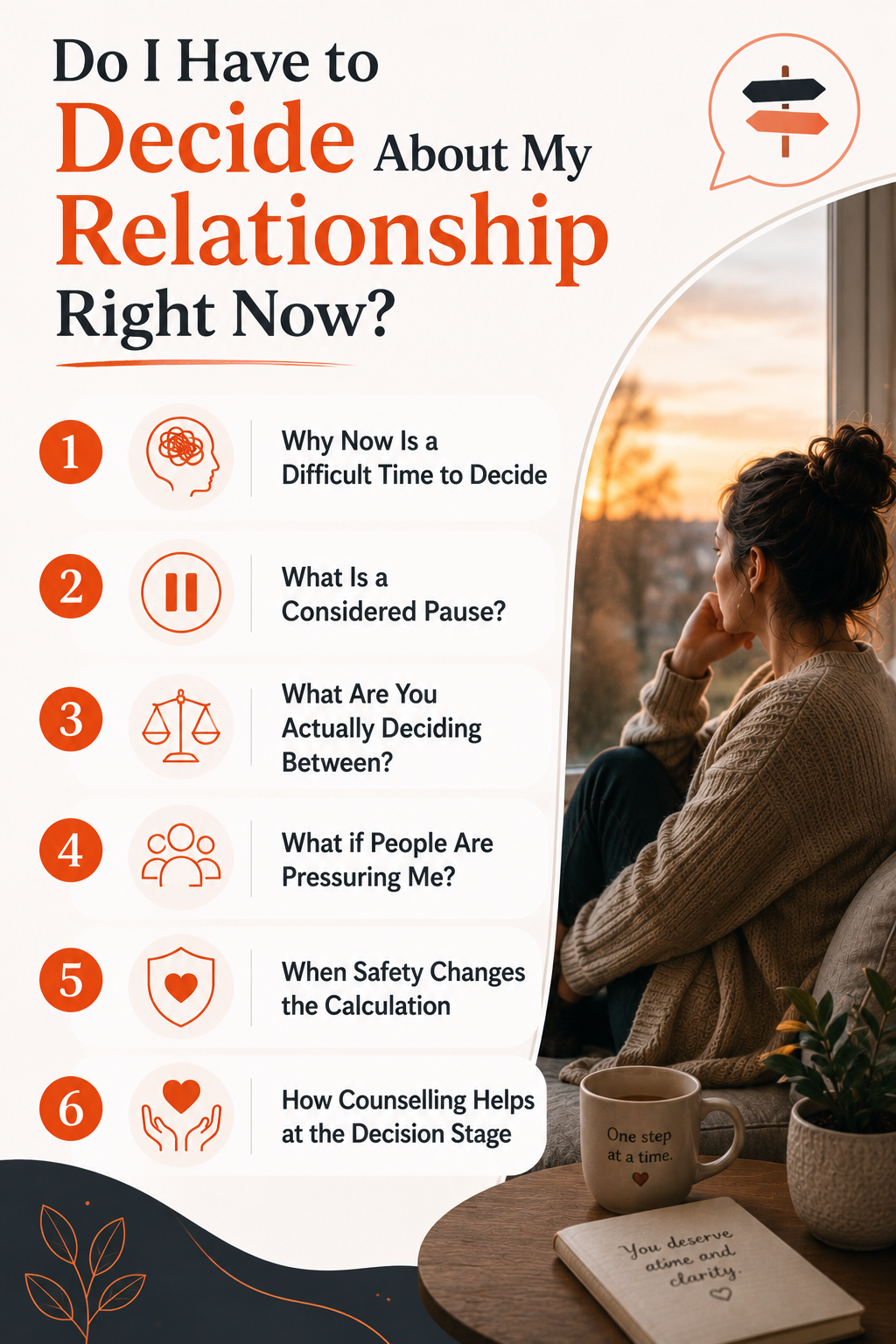
Why Now Is a Difficult Time to Decide
Three things are usually true in the period immediately after discovery, and each of them undermines decision-making.
The information is incomplete. In many situations further details continue to emerge over subsequent weeks. A decision made on partial information may need to be revisited when the picture changes, which is destabilising in itself.
The nervous system is not settled. Acute stress narrows thinking, pushes towards extremes, and makes it harder to hold two things in mind at once. The capacity you would normally bring to a decision of this magnitude is temporarily reduced, through no fault of your own.
Nothing has been tested yet. Whether your partner is willing to be honest over time, to seek help, and to sustain it, is not knowable in the first fortnight. That information only accumulates through observation, and observation takes time.
What Is a Considered Pause?
A considered pause is an explicit decision not to decide yet, with a rough sense of what you are waiting to learn. It is different from drifting, which is what tends to happen otherwise.
In practice it usually involves naming a period to reassess rather than resolving anything permanently, being clear with yourself about what you would need to see in that period, arranging your own support so you are not carrying it alone, and agreeing on practical arrangements at home in the meantime. Some people continue living together, some do not. Neither choice commits you to an outcome.
The point is that you retain the ability to decide, rather than being carried towards an outcome by exhaustion.
What Are You Actually Deciding Between?
It is rarely the simple choice it first appears to be. Framing it as stay or leave collapses a number of separate questions into one, which is part of what makes it feel impossible.
The separable questions usually include whether your partner is being honest with you now, whether they are willing to do something about the behaviour, whether the relationship was one you valued before this, whether you can imagine trusting again given what you know, and what you need in order to feel safe enough to find out.
Some of these can be answered now. Some can only be answered over time. Separating them tends to make the situation more workable than treating it as one binary question demanding an immediate answer.
What if People Are Pressuring Me?
People close to you will often have strong views, and those views usually say more about their own values than about your situation. Some will be certain you should leave. Some will be certain you should stay, particularly where children, finances or faith are involved.
You are not obliged to justify your position to any of them, and you are not obliged to decide on their timeline. It is reasonable to tell people that you are not discussing it yet. It is also worth noticing that the people offering the most confident advice are usually those with the least information.
Judgement about staying is common and is worth naming directly. Choosing to remain in a relationship while your partner addresses their behaviour is a legitimate choice made by many people, and it is not the same as accepting the behaviour.
When Safety Changes the Calculation
Everything above assumes a situation involving secrecy, betrayal and broken trust. If there is violence, threat, intimidation, coercion, or pressure into sexual activity you have not freely agreed to, the considered pause described here does not apply and safety planning takes priority.
In an emergency call 000. For 24 hour confidential support relating to sexual assault, domestic or family violence, call 1800RESPECT on 1800 737 732. If you are in distress or having thoughts of suicide, Lifeline is available on 13 11 14.
How Counselling Helps at the Decision Stage
Counselling at this stage is not about being steered towards a particular outcome. A counsellor’s role is not to tell you whether to stay, and you should be cautious of anyone who does.
The work is about restoring your capacity to make the decision well: settling the acute distress enough for you to think, separating the tangled questions into ones that can actually be answered, identifying what information you still need, and clarifying what you require in order to feel safe. Where both people want to work on the relationship, marriage counselling and relationship counselling are available once individual stabilisation is underway.
Frequently Asked Questions
How long should a considered pause last?
There is no standard period, and any specific figure would be arbitrary. What matters more than the length is that it is deliberate, that you know what you are waiting to observe, and that you reassess rather than letting it continue indefinitely by default. This is something worth setting with a counsellor rather than alone.
Does staying mean I have forgiven what happened?
No. Remaining in a relationship while things are worked through is a decision about the present arrangement, not a verdict on the past. Forgiveness, if it comes at all, is a separate process with its own timeline, and it is not a precondition for staying. Many people remain in a relationship for a considerable period before they have any clear sense of how they feel about what happened.