 Counselling via MS Teams, Zoom and FaceTime available


15 Oct Talking to Your Partner About Your Pornography Use
If you are planning to tell your partner about compulsive pornography use, the single most useful piece of preparation is this: decide what you are going to say before the conversation, and say all of it. Disclosure that emerges in stages, with each round of questions producing a little more, is the pattern that causes the most lasting damage. It is also the most common.
The reason is straightforward. Every new piece of information restarts the shock, and it teaches your partner that what they have been told is probably incomplete. At Sex Addiction Australia (ASAA), disclosure is frequently prepared with clinical support for exactly this reason. Heide McConkey, founder and clinical sex therapist, has more than 25 years of experience with both sides of this conversation.
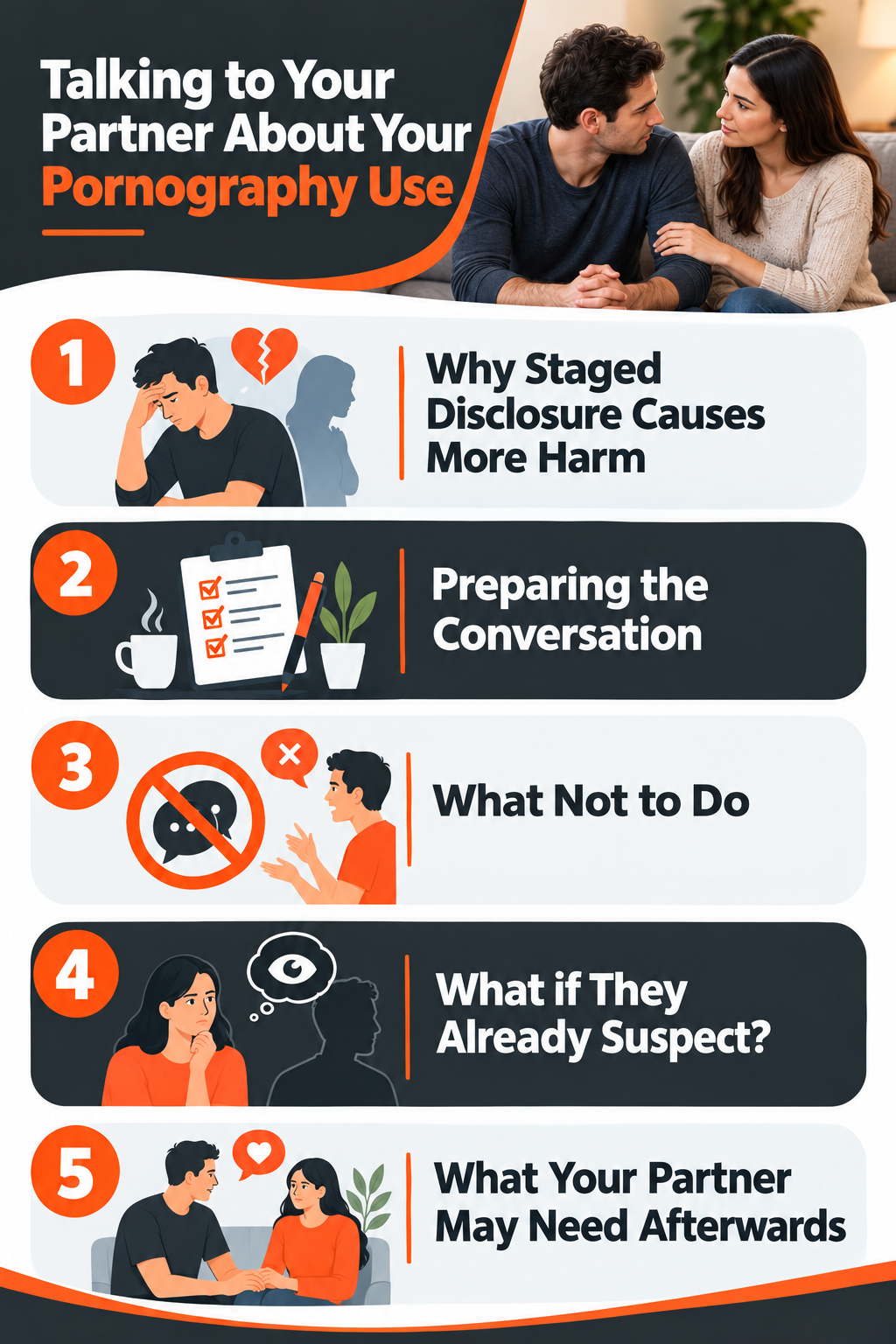
Why Staged Disclosure Causes More Harm
Most people who disclose in stages are not being deliberately deceptive. They are managing their own fear, offering what feels survivable, and intending to say more later.
The effect on the other person is nonetheless severe. Each new disclosure resets the distress and undermines the credibility of everything already said. Partners commonly describe the drip of information as harder to recover from than the original behaviour, because it prevents the situation from ever stabilising long enough to be processed.
A single prepared disclosure is harder in the moment and considerably easier to recover from.
Preparing the Conversation
Decide the scope in advance
Work out what you are disclosing before you begin, ideally with a counsellor. The aim is an account that is complete on the matters that affect your partner, so that there is nothing further to emerge.
Think about what they need rather than what you want to confess
Relief from guilt is a natural motive but it is not a good organising principle. Graphic detail is rarely needed and often causes lasting intrusive imagery. Sexual health, financial exposure, whether anyone known to them was involved, and the broad timeline are generally the matters that affect them.
Choose timing with some care
Not late at night, not immediately before work, not with children within earshot, and not at a moment when neither of you can leave the conversation.
Prepare for a response you cannot control
Anger, silence, distress, disbelief, or questions you have not anticipated are all possible. Preparing to receive the reaction without defending yourself is part of the preparation.
What Not to Do
Do not ask your partner to manage your distress about the disclosure. The impulse to seek reassurance is understandable and the timing is wrong.
Do not present the disclosure as evidence of how much progress you have made. It may be true and it is not what the moment is for.
Do not minimise with qualifiers about how common it is or how it could have been worse. Contextualising your own behaviour during the disclosure reliably reads as evasion.
Do not expect resolution in one conversation. The first conversation opens a process rather than closing one.
What if They Already Suspect?
Many disclosures happen after a partner has found something, raised it, or been told a partial version already.
This changes the conversation but not the principle. If a previous account was incomplete, the disclosure needs to acknowledge that directly rather than presenting the fuller version as though it were the first. Partners are generally more affected by discovering that an earlier explanation was managed than by the content of the new information.
It is also worth expecting that trust in your account will be low at the outset, and that this is a reasonable response to the circumstances rather than something to argue against. Consistency over time is what shifts it.
What Your Partner May Need Afterwards
The period after disclosure is difficult, and your partner will need support that is not you.
Partners frequently experience intrusive images, difficulty sleeping, hypervigilance and a strong urge to search for further information. These are recognised responses to relational betrayal rather than signs of overreaction. Spouse and partner support counselling is available at ASAA independently of your own work, and does not require your involvement or agreement.
Expect that they may need considerable time, and that questions will recur. Answering the same question consistently, without irritation, over an extended period is one of the more meaningful things you can do.
If either of you is in distress or having thoughts of suicide, Lifeline is available 24 hours a day on 13 11 14. For support relating to sexual assault, domestic or family violence, 1800RESPECT is available on 1800 737 732. In an emergency call 000.
Frequently Asked Questions
Should I disclose before or after starting counselling?
There is no universal answer, but preparing the disclosure with clinical support generally produces a more complete and better-structured conversation, and means you have somewhere to take your own reaction afterwards. Where disclosure is already imminent or unavoidable, that is a reason to seek support quickly rather than to delay the conversation indefinitely.
What if they ask questions I do not want to answer?
It is reasonable to say you will answer, and to ask for a short period to think, provided you then follow through. What is not workable is declining to answer questions that materially affect your partner, such as those concerning sexual health. Working out in advance which questions fall into which category makes the conversation considerably easier to handle.