 Counselling via MS Teams, Zoom and FaceTime available


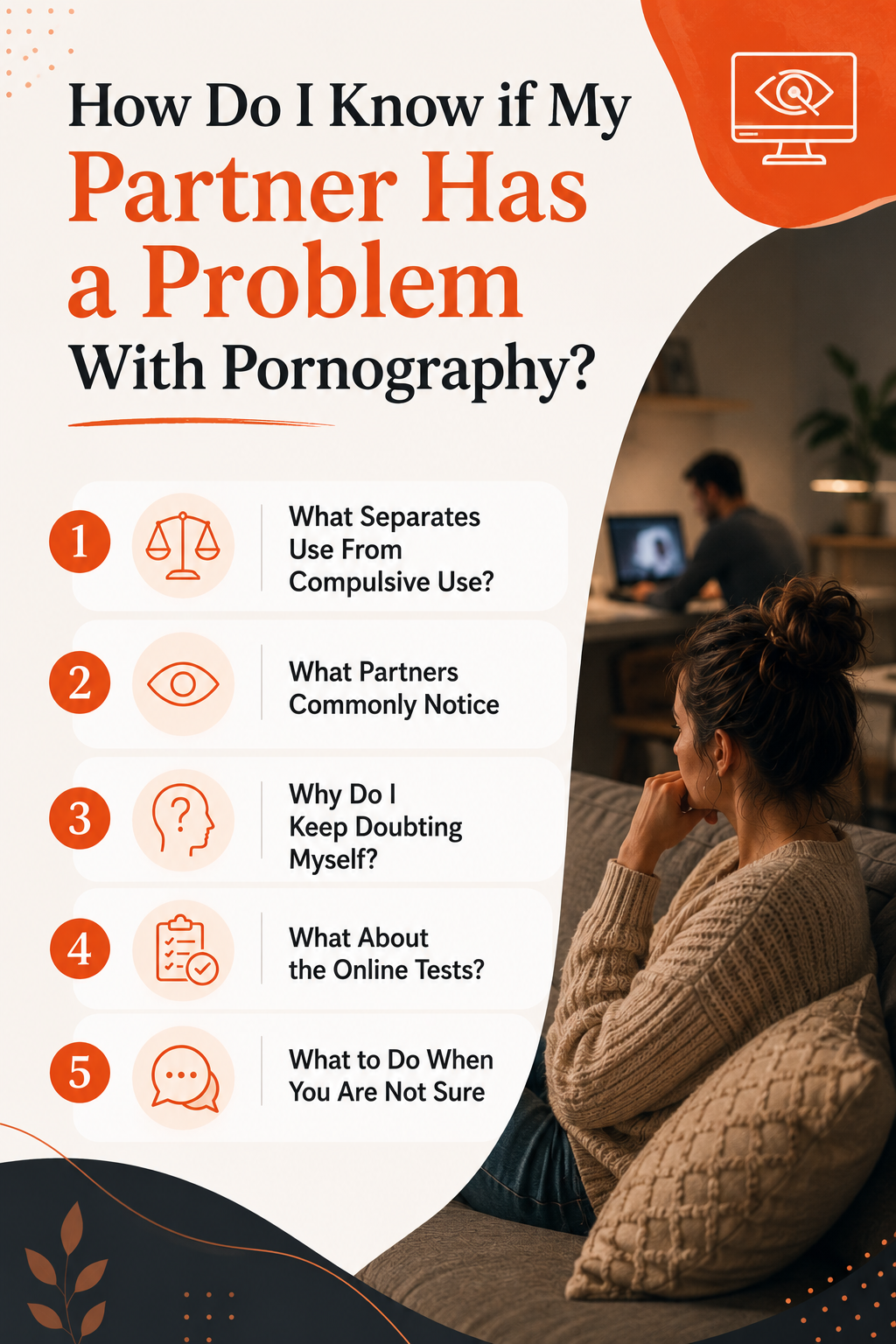
01 Sep How Do I Know if My Partner Has a Problem With Pornography?
There is no checklist that will give you certainty about someone else’s inner experience, and it is worth saying that plainly at the outset. What can be assessed is impact. The question that distinguishes pornography use from compulsive use is not how often it happens or what is being viewed, but whether the person continues despite it damaging things they value, and whether they can stop when they decide to.
That distinction matters because partners often get stuck trying to establish frequency, as though a number would settle the question. At Sex Addiction Australia (ASAA), pornography-related concerns are among the most common reasons both individuals and partners make contact. Heide McConkey, ASAA’s founder and clinical sex therapist, has more than 25 years of experience in this area, with counselling available online and face to face.
What Separates Use From Compulsive Use?
The clinical frame for compulsive sexual behaviour is set out in the World Health Organisation’s International Classification of Diseases, eleventh revision, which includes Compulsive Sexual Behaviour Disorder as an impulse control disorder. The term commonly used in everyday conversation is sex addiction or porn addiction, but the clinical description is the more precise one.
The features that description emphasises are a persistent failure to control repetitive sexual impulses, repeated unsuccessful attempts to reduce the behaviour, the behaviour becoming a central focus at the expense of other responsibilities and interests, and continuation despite adverse consequences or despite deriving little satisfaction from it. It also requires that the pattern causes marked distress or significant impairment over an extended period.
One point in that description is particularly relevant to partners. Distress arising purely from moral disapproval of the behaviour is specifically not sufficient. In practice this means that disliking a partner’s pornography use, on its own, does not establish that a disorder is present. That is not a dismissal of your feelings about it, which are legitimate and worth addressing in their own right. It is a distinction between a relationship problem and a clinical one, and the two need different responses.
What Partners Commonly Notice
Partners rarely arrive with clinical observations. They arrive with a set of accumulated impressions.
- Escalating secrecy around devices, browsing, or time spent alone, particularly where this is new
- Time patterns that do not add up, such as consistently late nights or unexplained absences
- Withdrawal from shared sexual intimacy, or a noticeable change in what is sought within it
- Broken commitments to stop, often repeated and often sincere at the time they were made
- Defensiveness that seems disproportionate when the subject is raised
- Impact on work, sleep, finances or parenting
None of these individually establishes anything. Any of them can have other explanations. What tends to be more informative is the combination, the direction of travel over time, and in particular the repeated pattern of genuine intention to stop followed by resumption.
Why Do I Keep Doubting Myself?
Self-doubt is close to universal among partners in this situation, and there are structural reasons for it rather than personal ones.
You are being asked to form a judgement about something that is, by its nature, concealed. You have partial information. The subject is one where cultural messages are contradictory and where you may be uncertain what is reasonable to expect. And you may have raised it before and been told you were overreacting, which makes the next attempt harder.
None of that means your perception is unreliable. It means you are trying to assess a hidden pattern with incomplete evidence, which is genuinely difficult and is not a task you should have to complete alone before you are permitted to seek support.
What About the Online Tests?
ASAA provides a free and anonymous pornography self-assessment, and similar tools are widely available elsewhere. These are best understood as structured prompts for self-reflection. They can help someone organise their own thinking and can make a difficult first conversation easier to start.
What they cannot do is produce a diagnosis. A screening tool has no access to context, history, or the distinction between distress caused by the behaviour and distress caused by disapproval of it. A diagnosis is a clinical judgement made by a qualified practitioner who has assessed the whole picture. Treating a self-assessment result as a conclusion, in either direction, is a mistake worth avoiding.
What to Do When You Are Not Sure
Uncertainty is a normal starting point, and it is not a reason to wait.
Speaking with a counsellor before you have resolved the question is often more useful than after, because the work at that stage is about clarifying what you are actually observing, what you need, and how to raise it in a way that has a reasonable chance of a useful response. If it emerges that the behaviour is compulsive, pornography-related counselling is available for the person concerned. If it emerges that the issue is a mismatch of expectations within the relationship, that is a different piece of work and an entirely workable one.
Either way, support for partners does not depend on establishing a label first.
Frequently Asked Questions
Is there an amount of pornography use that is automatically a problem?
No. Frequency alone is not the determining factor, which is why a specific number is not a useful benchmark. What matters clinically is loss of control, continuation despite harm, and the degree of distress or impairment involved. Two people with similar frequency can be in very different situations.
Should I raise it if I might be wrong?
Raising a concern is not an accusation, and it does not require you to have proof. A conversation about the impact something is having on you is legitimate regardless of how it is eventually understood. If you are unsure how to open that conversation, that is something counselling can help you prepare for.