 Counselling via MS Teams, Zoom and FaceTime available


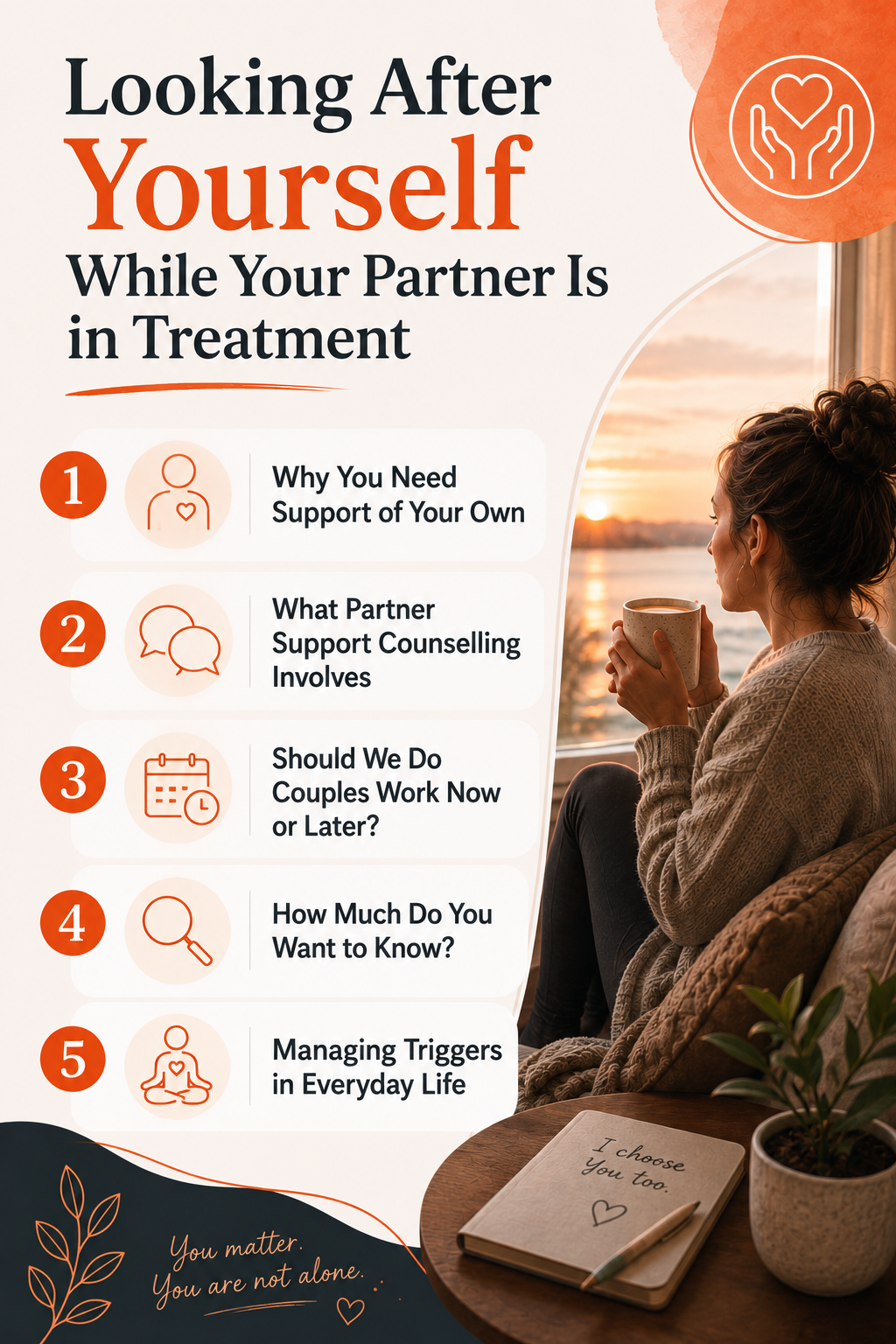
01 Sep Looking After Yourself While Your Partner Is in Treatment
If your partner has started counselling for compulsive sexual behaviour, one of the most common assumptions is that your role is now to wait, support them, and see how it goes. That assumption is worth reconsidering. Your own recovery from what happened is a separate process with its own requirements, and it does not run automatically on the back of theirs.
Partners frequently find the treatment period harder than expected, in part because the crisis has passed and the ordinary expectation is that things should be improving. At Sex Addiction Australia (ASAA), spouse and partner support is provided as its own piece of work rather than as an adjunct. Heide McConkey, founder and clinical sex therapist, has more than 25 years of experience with both sides of this situation, online and face to face.
Why You Need Support of Your Own
Your partner’s counselling is directed at their behaviour and the psychological structures underneath it. That is appropriate, and it is not the same thing as addressing the impact on you.
The experiences described in betrayal trauma work, including intrusive images, hypervigilance and difficulty trusting your own perception, do not resolve because someone else has started therapy. They are your responses to what happened, and they need attention directly. Relying on your partner’s progress as the mechanism for your own recovery also creates an uncomfortable dependence, where your wellbeing rests on their performance in a process you cannot control.
There is a practical consideration as well. Having somewhere to take your distress that is not your partner reduces the pressure on a relationship that is already carrying a great deal.
What Partner Support Counselling Involves
The work is shaped around what you need rather than around the other person’s treatment plan. In practice it commonly covers reducing the intensity of intrusive material and settling a nervous system still running on alert, working through the conclusions you have drawn about yourself, clarifying boundaries and what you need in order to feel safe enough to continue, and thinking through what you want from the relationship as the picture becomes clearer.
It is available whether or not your partner is engaged in treatment, and it does not require their agreement or involvement.
Should We Do Couples Work Now or Later?
Usually later, though it depends on the situation. Couples work asks both people to be present to each other’s experience, and that is difficult while one person is in acute distress and the other is at an early and often unstable point in addressing their behaviour. Beginning too early can turn sessions into a continuation of the same arguments in a more expensive room.
The more common sequence is individual work for both people first, with couples or sex therapy introduced once there is enough stability for it to be productive. When that point has been reached is a clinical judgement rather than a fixed interval.
How Much Do You Want to Know?
The question of disclosure resurfaces during treatment, often when a partner discloses something in their own counselling that has not previously been shared.
There is a meaningful difference between a single structured disclosure, prepared with clinical support and delivered once, and information emerging piece by piece over months. The second pattern tends to restart the distress each time, and is one of the most common reasons partners feel they are going backwards. If further disclosure is anticipated, it is generally better managed as a planned process than left to arise incidentally.
You are also entitled to set limits on detail. Wanting to know the shape of what happened without wanting explicit specifics is a reasonable position, not an avoidant one.
Managing Triggers in Everyday Life
Triggers during the treatment period are often mundane rather than dramatic. A phone face-down on the table. A late arrival home. An advertisement. A particular expression.
Two things tend to help. The first is recognising the trigger as a trigger rather than as new evidence, which creates a small gap between the reaction and the interpretation. The second is having somewhere to take the reaction. Raising every instance with your partner is exhausting for both of you and tends to erode goodwill; suppressing all of them tends to accumulate. Individual counselling provides a third option.
If you are in distress or having thoughts of suicide, Lifeline is available 24 hours a day on 13 11 14. In an emergency call 000.
Frequently Asked Questions
Will seeing my own counsellor create distance between us?
It more often does the opposite. Having your own support reduces the load the relationship is carrying and means that difficult material has somewhere to go other than into daily conversation. Many couples find that individual work makes the shared conversations more manageable rather than less frequent. Individual counselling is available at ASAA for both partners separately.
What if I feel worse now than I did at the start?
This is common and it is not evidence that things are going wrong. The acute period after discovery is often carried on adrenaline, and the drop that follows can feel worse even though the situation is more stable. It is also the point at which the longer questions about trust and the future become unavoidable. It is a reasonable time to seek support rather than a sign that support has failed.