 Counselling via MS Teams, Zoom and FaceTime available


02 Jun When Couples Therapy Helps (and When Individual Therapy Comes First)
One of the most common questions couples face in the aftermath of a sexual addiction disclosure is whether to begin couples therapy. The question makes sense. The relationship has been shaken. Both people are in pain. It seems logical that working on the relationship together, in a therapeutic setting, is where the healing should begin.
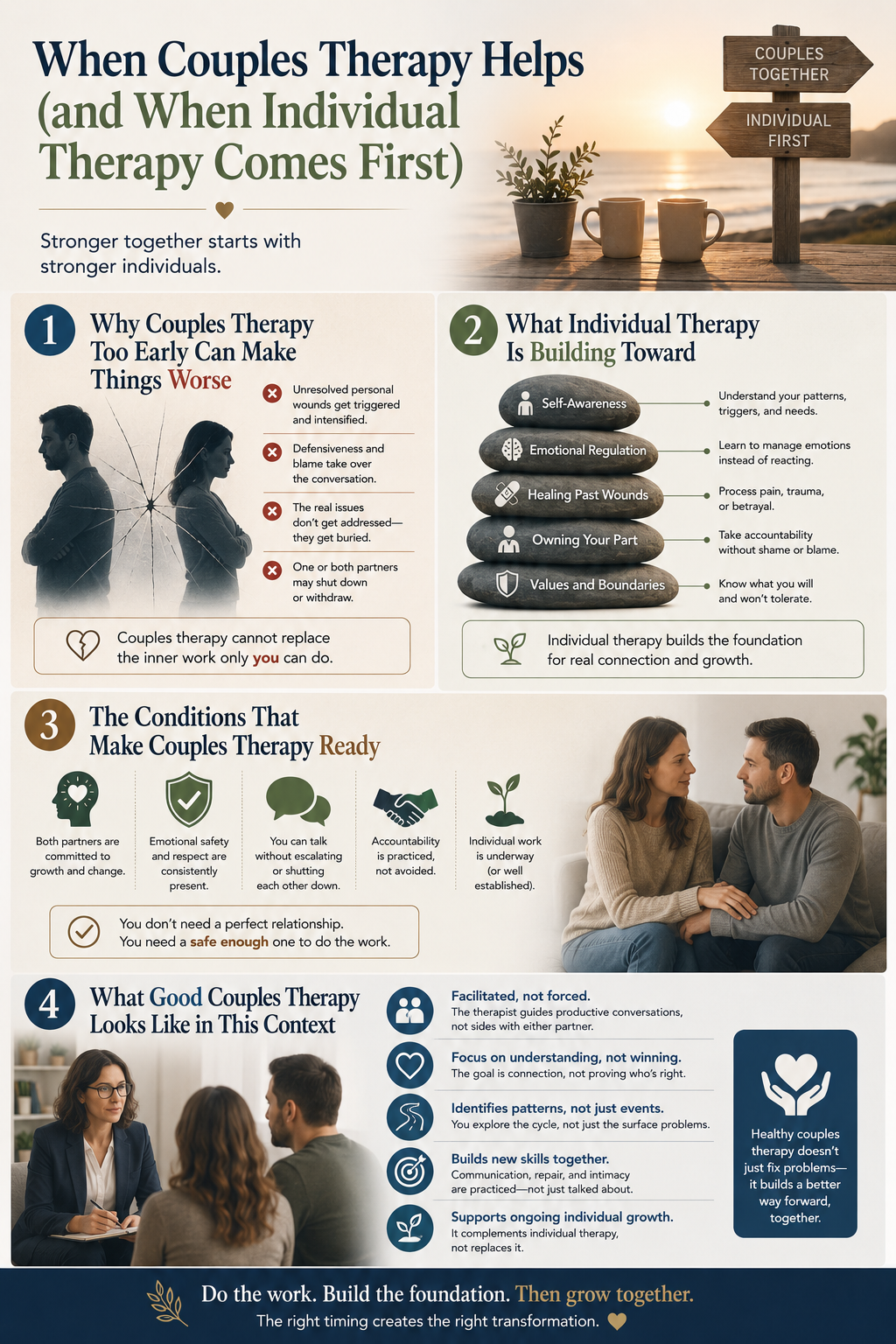
In practice, this sequence frequently backfires. Not because couples therapy is wrong, but because attempting it before either person has done sufficient individual work tends to replicate the dynamics of the relationship rather than transform them. Understanding when couples work is genuinely helpful, and what needs to be in place first, is one of the most important navigational questions in sex addiction recovery. It is something the team at ASAA addresses regularly in both individual and relational therapy work.
Why Couples Therapy Too Early Can Make Things Worse
When a couple enters couples therapy in the immediate aftermath of a sexual addiction disclosure, they typically arrive in very different places. The addicted partner may be in early recovery: stabilising behaviour, managing shame, beginning to understand the nature of the condition. The betrayed partner is likely in acute trauma: destabilised, alternating between numbness and rage, and deeply uncertain about whether what they are being told is the full truth.
Couples therapy in this context asks both people to engage in a relational process that presupposes a certain baseline of individual stability and emotional availability. The addicted partner may not yet have the capacity for the kind of consistent, non-defensive presence that couples work requires without their own shame hijacking the sessions. The betrayed partner may not be able to engage in relational work at all until their trauma response has been stabilised.
What can happen instead is that the couple sits in sessions rehearsing their existing dynamics: the addicted partner over-explaining, minimising, or becoming defensive under pressure; the betrayed partner oscillating between controlled presentation and emotional flooding; both people leaving the session feeling unheard and more hopeless about the relationship’s future than before they entered.
What Individual Therapy Is Building Toward
The work that needs to happen individually, before meaningful couples work is possible, is different for each person but follows a recognisable pattern.
For the person with sexual addiction
Individual sex addiction counselling in the early phase of recovery focuses on:
- Stabilising compulsive behaviour and establishing a foundation of sobriety from the specific compulsive pattern
- Developing an honest and non-defensive account of what has occurred, without minimisation or escalating disclosure
- Beginning to understand the emotional drivers and underlying psychological material that has sustained the addiction
- Developing enough shame tolerance to remain present in a difficult conversation without dissociating, deflecting, or defending
- Building accountability practices and transparency habits that will be the foundation of restored trust
Until these capacities are developing, the person cannot reliably show up in couples therapy in the way that makes the work meaningful. They will, despite their best intentions, revert to the patterns of minimisation, secrecy, or emotional unavailability that characterised the relationship during the addiction.
For the betrayed partner
Individual support for the betrayed partner addresses a different set of needs:
- Stabilising the acute trauma response so that the person can begin to function with some reliability
- Processing the grief, anger, and disorientation of the disclosure in a space that belongs entirely to them
- Developing clarity about what they need to feel safe, and whether those conditions are currently present
- Reconnecting with their own wants, values, and sense of self, which may have been significantly eroded by the relationship experience
- Making an informed decision, from a position of greater stability, about what they want the future to look like
A betrayed partner who enters couples therapy before this work has begun is often functioning in a state of trauma activation throughout the sessions. The therapeutic content is processed through a nervous system that is in fight, flight, or freeze. This limits what can actually be taken in and integrated.
The Conditions That Make Couples Therapy Ready
There is no universal timeline for when couples work becomes appropriate. But there are conditions that, when present, suggest the couple is ready to do relational work with a reasonable chance of it being productive:
| Person | Readiness indicators |
|---|---|
| Addicted partner | Has sustained behavioural stabilisation (not one or two days, but genuine early recovery); is consistently honest without prompting; can sit with the partner’s pain without becoming defensive or distressed to the point of shutdown; has begun to understand their own emotional patterns |
| Betrayed partner | Acute trauma symptoms have reduced sufficiently to permit sustained engagement in a session; has some clarity about what they need; is not making the decision from a place of extreme fear about being alone; has had space to process their own experience individually |
| Both people | Both are choosing couples work genuinely, not because of external pressure or fear of consequences; both are committed to honesty within the sessions; there is no ongoing deception that is not yet disclosed |
These conditions being present does not guarantee that couples work will restore the relationship. It does mean that the work has a real chance of producing something meaningful, whatever the ultimate outcome.
What Good Couples Therapy Looks Like in This Context
When couples therapy is appropriate and well-timed, it serves a different function from early individual work. In this phase, the therapeutic space holds:
- The process of full and honest disclosure, facilitated therapeutically, so that the betrayed partner can hear the truth and the addicted partner can deliver it without the session collapsing
- The rebuilding of communication patterns that have often been deeply distorted by years of deception and emotional unavailability
- The re-establishment of intimacy, which almost always requires a rebuilt framework of safety and truth before physical or emotional closeness can be genuine
- The negotiation of what the relationship’s future looks like, which may include continued partnership, a separation, or something in between
- Both people’s individual experiences being witnessed and validated in the same space, which is different from either person feeling that their suffering is being compared or ranked
| 🌿 Couples work done at the right time, with both people in a sufficient position of individual stability, can be one of the most powerful experiences in the recovery journey. Many couples describe the process of rebuilding their relationship after sexual addiction disclosure as producing a depth of honesty and intimacy they did not have before. This outcome is genuinely achievable, with the right support and in the right sequence. |
Specialist Support for Individuals and CouplesASAA provides confidential individual and relationship counselling for sex addiction and sexual betrayal trauma. Based in Sydney and available online across Australia. |
Frequently Asked Questions
Can we see the same therapist individually and as a couple?
In general, it is preferable for the couple’s individual therapy and couples therapy to be separate therapeutic relationships. When the same therapist attempts to hold both individual and couples work, there is a risk of the individual work being contaminated by the couple’s dynamic, and of the therapist’s neutrality in the couples context being perceived as compromised. ASAA’s approach involves coordinating care across individual and relational work with appropriate boundaries maintained between the therapeutic roles.
What if my partner refuses individual therapy?
If the addicted partner declines individual therapy, beginning couples work is not typically advisable. The dynamics that need to shift in individual therapy will simply replicate themselves in couples sessions, often causing additional harm to the betrayed partner who is engaging in good faith. The decision about whether to remain in the relationship while one partner is not engaging with treatment is a deeply personal one, and one worth exploring in the betrayed partner’s own individual therapy.
Is there a risk that the therapist will take sides in couples work?
A skilled therapist working with couples affected by sexual addiction will maintain a position of careful impartiality while simultaneously holding both people’s experiences as valid and important. This is not the same as treating what has occurred as a neutral or equivalent situation. The therapist’s role is to facilitate the process of recovery for the relationship, which requires holding the full complexity of both people’s realities. This is a specialised area that benefits from a therapist with specific experience in sexual addiction and betrayal trauma. ASAA’s Heide McConkey has over 25 years of specialist clinical experience in exactly this context.