 Counselling via MS Teams, Zoom and FaceTime available


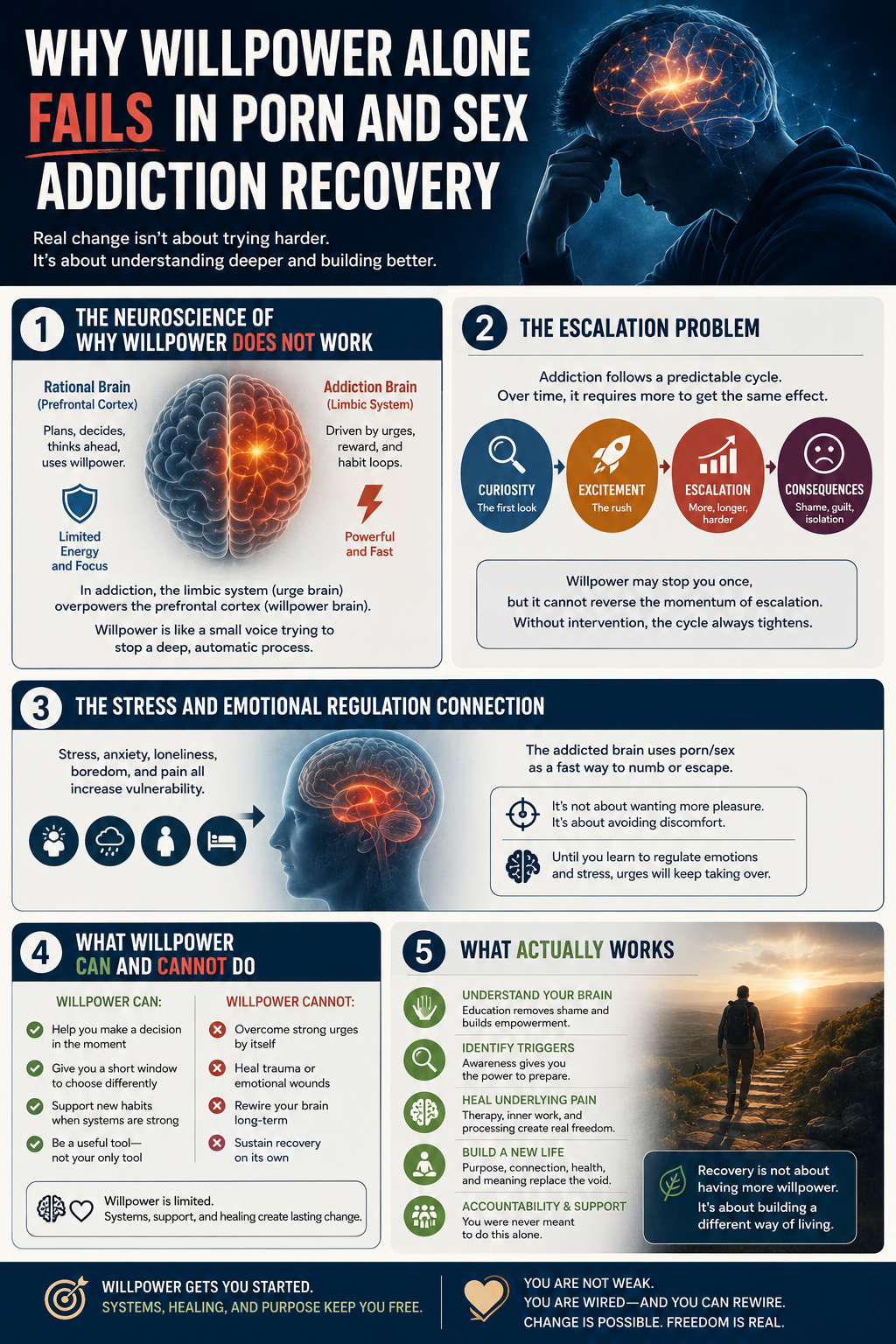
02 Jun Why Willpower Alone Fails in Porn and Sex Addiction Recovery
A conversation that happens with striking regularity in sessions with people seeking help for sex or pornography addiction goes something like this: they have been trying to stop for years. They have made resolutions. They have deleted apps, installed filters, made promises to partners or to themselves. And they have relapsed, sometimes within hours of the most sincere commitment they have ever made. And each time, the conclusion they draw is: I am weak. I have no self-control. I am fundamentally broken.
This conclusion is understandable. It is also wrong, and understanding why it is wrong is one of the most important steps in moving toward actual recovery. Sex addiction and compulsive sexual behaviour disorder are not disorders of insufficient willpower. They are brain-based conditions that willpower, by design, is poorly equipped to address.
The Neuroscience of Why Willpower Does Not Work
Willpower is a function of the prefrontal cortex, the front part of the brain responsible for executive function: planning, impulse inhibition, consequence assessment, and decision-making aligned with long-term values. In conditions of calm, with adequate sleep, low stress, and emotional stability, the prefrontal cortex can exert meaningful regulatory influence over behaviour.
Sexual addiction and compulsive sexual behaviour, like other addictive patterns, are driven primarily by the limbic system: the older, deeper, faster part of the brain associated with emotion, motivation, and reward. When sexual craving is activated, the limbic system generates an overwhelming drive toward the behaviour. Crucially, it also suppresses prefrontal function. The capacity for the very kind of rational, values-aligned decision-making that willpower requires is reduced precisely when it is most needed.
This is not a metaphor. Neuroimaging research has documented this inhibition of prefrontal function during craving states across a range of addictive behaviours. The person trying to use willpower to override a craving is attempting to deploy a resource that has been progressively impaired by the very craving they are trying to manage.
The Escalation Problem
Compulsive sexual behaviour disorder and pornography addiction are also characterised by a pattern of escalation that further undermines willpower-based strategies. As the brain’s reward circuitry habituates to existing levels and types of stimulation, greater intensity, frequency, or novelty is required to produce the same effect. What began as occasional behaviour becomes habitual. What began as relatively mild content may escalate to material that the person would have found genuinely disturbing at the outset.
This escalation pattern is deeply distressing and a source of significant shame. People often describe feeling that they have become someone unrecognisable to themselves. This is not evidence of moral deterioration. It is evidence of neural adaptation: the brain has reorganised its reward circuitry around the addictive behaviour in ways that persist and intensify without treatment.
The Stress and Emotional Regulation Connection
Another dimension that willpower cannot address is the emotional regulation function that the compulsive behaviour is serving. For the majority of people with sexual addiction or compulsive pornography use, the behaviour is not primarily about sexual desire. It is about emotional escape.
Stress, loneliness, anxiety, boredom, shame, grief, and emotional overwhelm are among the most common triggers for compulsive sexual behaviour. The behaviour reliably and rapidly reduces the intensity of these emotional states, at least temporarily. It functions as a coping strategy for emotional pain.
Willpower does not address the underlying emotional pain. Even when it successfully interrupts the behavioural response, it leaves the underlying emotional state unaddressed. The person sits with pain they do not know how to regulate without the tool they have been relying on. This is not a sustainable position.
| On emotional regulation A significant part of specialist sex addiction treatment involves developing alternative emotional regulation capacities: understanding the specific emotional states that drive craving, and building the skills and experiences that allow those states to be tolerated and processed without requiring the addictive behaviour as relief. |
What Willpower Can and Cannot Do
It would be inaccurate to say willpower has no role in recovery. It does. But the role is far more limited than the cultural narrative around addiction suggests. Willpower can:
- Prompt a person to reach out for help
- Create a brief window in which a different choice is possible
- Support engagement with a treatment plan
- Provide some capacity to use a coping skill in the moment, once that skill has been developed
Willpower cannot:
- Permanently override a deeply conditioned neural pattern
- Address the underlying emotional pain that drives the addictive behaviour
- Rewire the brain’s reward circuitry
- Build the relational skills, self-awareness, and emotional regulation capacity that sustained recovery requires
- Work without sleep, under extreme stress, in states of loneliness or emotional dysregulation
What Actually Works
Recovery from sexual addiction and compulsive sexual behaviour disorder is achievable. This is well established in clinical practice and supported by research. But it requires approaches that address what willpower cannot. At ASAA, the treatment programme draws on multiple evidence-based modalities that work together to address the different dimensions of compulsive sexual behaviour:
| Treatment component | What it addresses |
|---|---|
| Cognitive Behaviour Therapy (CBT) | Identifies and restructures the automatic thoughts and belief patterns that maintain the addiction cycle |
| Psychotherapy | Addresses underlying psychological wounds, attachment patterns, and developmental experiences that contribute to addictive behaviour |
| Trauma therapy | Processes unresolved trauma that the addictive behaviour has been managing or suppressing |
| Voice Dialogue | Works directly with internal parts (including the inner critic and the part that drives the compulsive behaviour) to develop greater internal coherence |
| Relapse prevention planning | Builds an individualised map of triggers, high-risk situations, and coping strategies |
| Accountability and support | Reduces the isolation that sustains addictive behaviour and provides external support for behavioural commitments |
None of these is a substitute for willpower in the sense of replacing the need for any internal effort. What they do is build the foundation that makes genuine, sustained recovery possible rather than relying on a resource that the condition itself continually depletes.
| 🌿 If you have tried to stop on your own and found that you cannot, that is not evidence that you cannot recover. It is evidence that the approach you have been using is not matched to the nature of the condition. Specialist support makes a real difference. |
Recovery Is Possible With the Right SupportASAA provides specialist sex and pornography addiction treatment in Sydney and online across Australia. 25 years of clinical experience. |
Frequently Asked Questions
If willpower does not work, does that mean I have no control?
No. What it means is that willpower operates within specific neurological conditions and is not sufficient on its own to address a brain-based compulsive disorder. Recovery involves developing real and lasting capacity for self-regulation, but this capacity is built through therapeutic work and environmental redesign rather than through force of will alone. People in well-supported recovery do develop genuine agency over their behaviour.
Is sex addiction a real diagnosis?
Compulsive Sexual Behaviour Disorder (CSBD) was included in the International Classification of Diseases 11th edition (ICD-11) by the World Health Organisation in 2019. It is classified as an impulse control disorder characterised by a persistent pattern of failure to control intense, repetitive sexual impulses or urges, resulting in repetitive sexual behaviour that causes significant distress or functional impairment. This classification reflects the substantial clinical and research evidence for the condition.
Can sex addiction be fully treated?
Yes. Clinical experience across 25 years at ASAA, and research evidence from the broader field, consistently shows that compulsive sexual behaviour disorder is a fully treatable condition. Full recovery, meaning sustained freedom from compulsive behaviour and the development of healthy, responsible sexuality, is achievable with appropriate specialist treatment. The timeline and path vary for each individual. Contact ASAA to discuss treatment options.