 Counselling via MS Teams, Zoom and FaceTime available


01 Sep Betrayal Trauma: Why Discovery Affects You the Way It Does
If, months after discovering a partner’s secret sexual behaviour, you are still experiencing intrusive images, disrupted sleep, hypervigilance and sudden waves of distress triggered by ordinary things, you are not failing to move on. These are recognised responses to betrayal by an attachment figure, described clinically as betrayal trauma, and they follow a pattern that is well understood.
Understanding that pattern matters, because partners frequently interpret their own symptoms as evidence that something is wrong with them. At Sex Addiction Australia (ASAA), betrayal trauma counselling for spouses and partners is a distinct part of the practice, delivered by Heide McConkey, ASAA’s founder and clinical sex therapist, with more than 25 years of experience. Counselling is available online across Australia and face to face in Sydney.
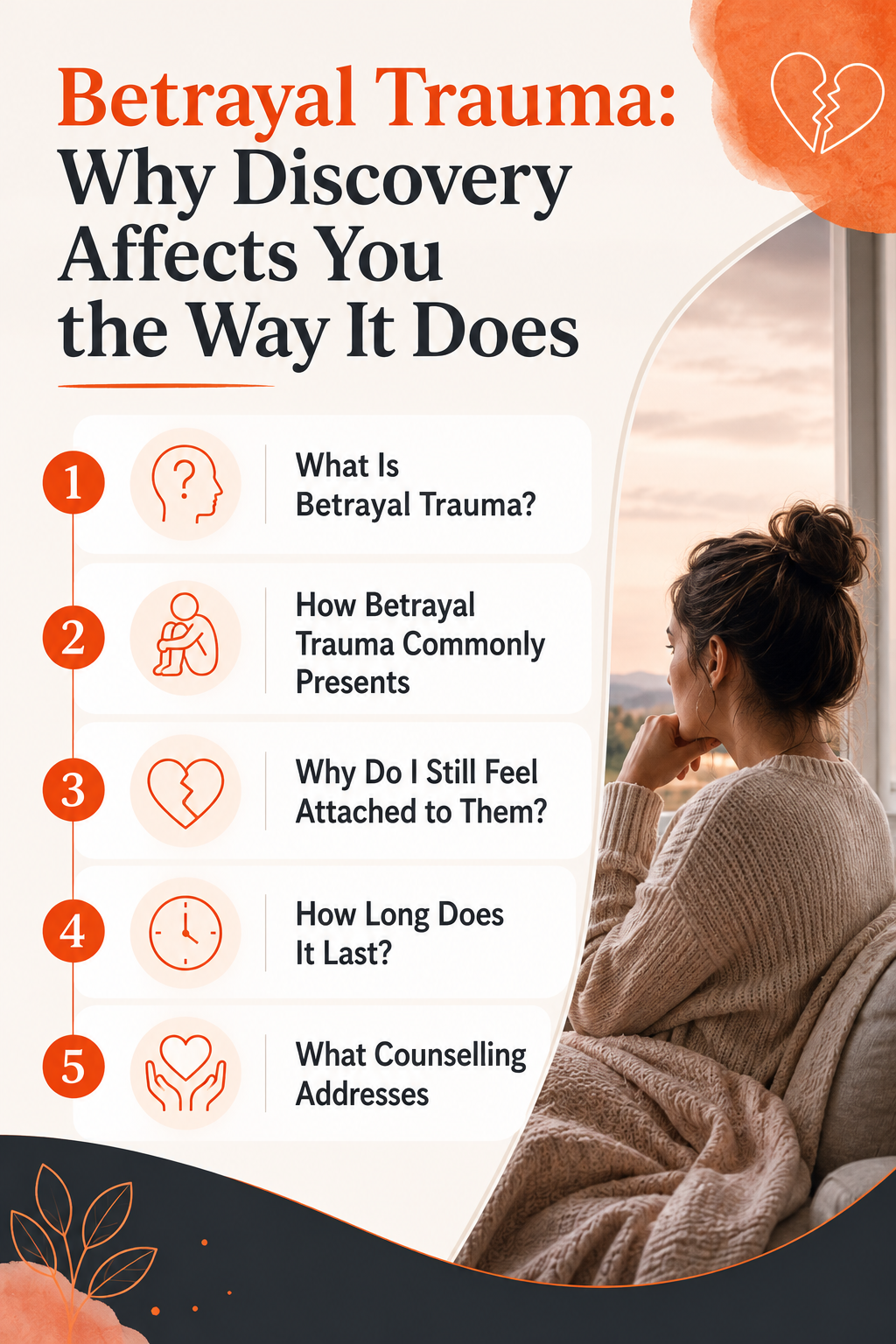
What Is Betrayal Trauma?
Betrayal trauma describes the psychological impact of a serious violation of trust by someone you depend on. The concept comes from attachment research, and its central observation is that betrayal by an intimate partner does not operate like an ordinary disappointment. It operates like a threat, because the relationship in question is one of your primary sources of safety.
This is why the response is so often physical, and why it persists. The difficulty is not simply that something upsetting happened. It is that the person you would normally turn to for reassurance after something upsetting is the same person the distress relates to. Betrayal trauma is a description of a pattern of response rather than a formal diagnosis, and only a qualified practitioner can assess what is happening for any individual.
How Betrayal Trauma Commonly Presents
Partners describe a recognisable cluster of experiences.
Intrusive images and thoughts
Unwanted mental images, often explicit, that arrive without warning and are difficult to displace. These are frequently worse at night, and are often triggered by neutral cues such as a location, a phone notification, or a time of day.
Hypervigilance
A constant background scanning for further evidence. Checking devices, monitoring behaviour, reading tone of voice for signs of dishonesty. This is exhausting and rarely produces lasting reassurance.
Emotional swings
Moving between rage, grief, numbness and, often confusingly, tenderness towards the partner, sometimes within a single hour. Partners frequently find these swings more distressing than any single emotion, because they undermine confidence in their own judgement.
Physical symptoms
Disrupted sleep, appetite changes, difficulty concentrating, and a persistent sense of being on alert.
Why Do I Still Feel Attached to Them?
This question causes more private shame than almost any other, and it has a straightforward explanation. Attachment does not switch off because trust has been broken. The bond that makes betrayal painful is the same bond that makes you want comfort from that person, and both are operating at once.
Feeling drawn to a partner after discovery is not weakness, naivety, or evidence that you have accepted what happened. It is what attachment does under threat. Recognising this tends to reduce the self-criticism that otherwise accumulates alongside the original distress.
How Long Does It Last?
There is no fixed timeline, and anyone offering one is guessing. What can be said is that the pattern typically changes in character over time rather than simply fading. Intrusive images generally become less frequent and less commanding. Emotional swings tend to become less extreme. Hypervigilance usually reduces as the situation becomes more predictable.
The pace is influenced by a number of things, including whether further information continues to emerge, whether you have support of your own, and what is happening in the relationship. Ongoing discovery of new information tends to restart the process, which is one reason a single structured disclosure is generally preferred over information emerging gradually.
What Counselling Addresses
Betrayal trauma work with partners generally covers the immediate symptoms, the meaning being made of the experience, and the practical questions that follow.
Symptom work focuses on reducing the intensity and frequency of intrusive material and on settling a nervous system that has been running on alert. Meaning work addresses the conclusions people draw about themselves after betrayal, which are frequently harsh and frequently inaccurate. Practical work covers boundaries, what you need in order to feel safe enough to remain in the relationship if that is your choice, and how to make decisions without being driven by the acute distress.
This work does not require your partner’s participation. Where couples do choose to work together, marriage counselling is usually more productive once individual support is in place.
If you are in distress or having thoughts of suicide, Lifeline is available 24 hours a day on 13 11 14. In an emergency call 000.
Frequently Asked Questions
Is betrayal trauma the same as post-traumatic stress disorder?
They are not the same thing. Betrayal trauma describes a pattern of response to relational betrayal, and while some of the experiences overlap with those seen in post-traumatic presentations, it is not a diagnostic category in itself. Whether any individual meets criteria for a diagnosable condition is a clinical assessment question, not something that can be determined from an article or an online description.
Do I need to know whether my partner has a sexual addiction before seeking support?
No. The impact on you does not depend on how your partner’s behaviour is eventually understood or labelled. Partners often arrive still uncertain about what has been happening, and that uncertainty is itself one of the difficult parts. Partner support counselling works with your experience as it actually is.